


Ukraine is preparing for what could be the most dangerous winter since the beginning of Russia’s invasion, with Moscow expanding its missile production and changing how it attacks Ukraine’s power grid. And with a new reliance on ballistic weapons that Kyiv is struggling to intercept, it all points to Moscow preparing for a new assault later in the year that could, the Kremlin hopes, turn the tide of the war back in its favor.
Speaking to CNBC, Ukrainian officials and defense executives warned that Russia may use the coming cold weather to launch its next sustained campaign – this time against electricity generation and heating systems, with the intent of raising the cost of fighting back against Russian attacks in the east. The objective, they said, would be to overwhelm repair crews and exhaust Ukraine’s limited air defenses, placing millions of Ukrainian civilians under extreme and intolerable pressure during the coldest months of the year.

MSTA-S Russian Army. Image Credit: Creative Commons.
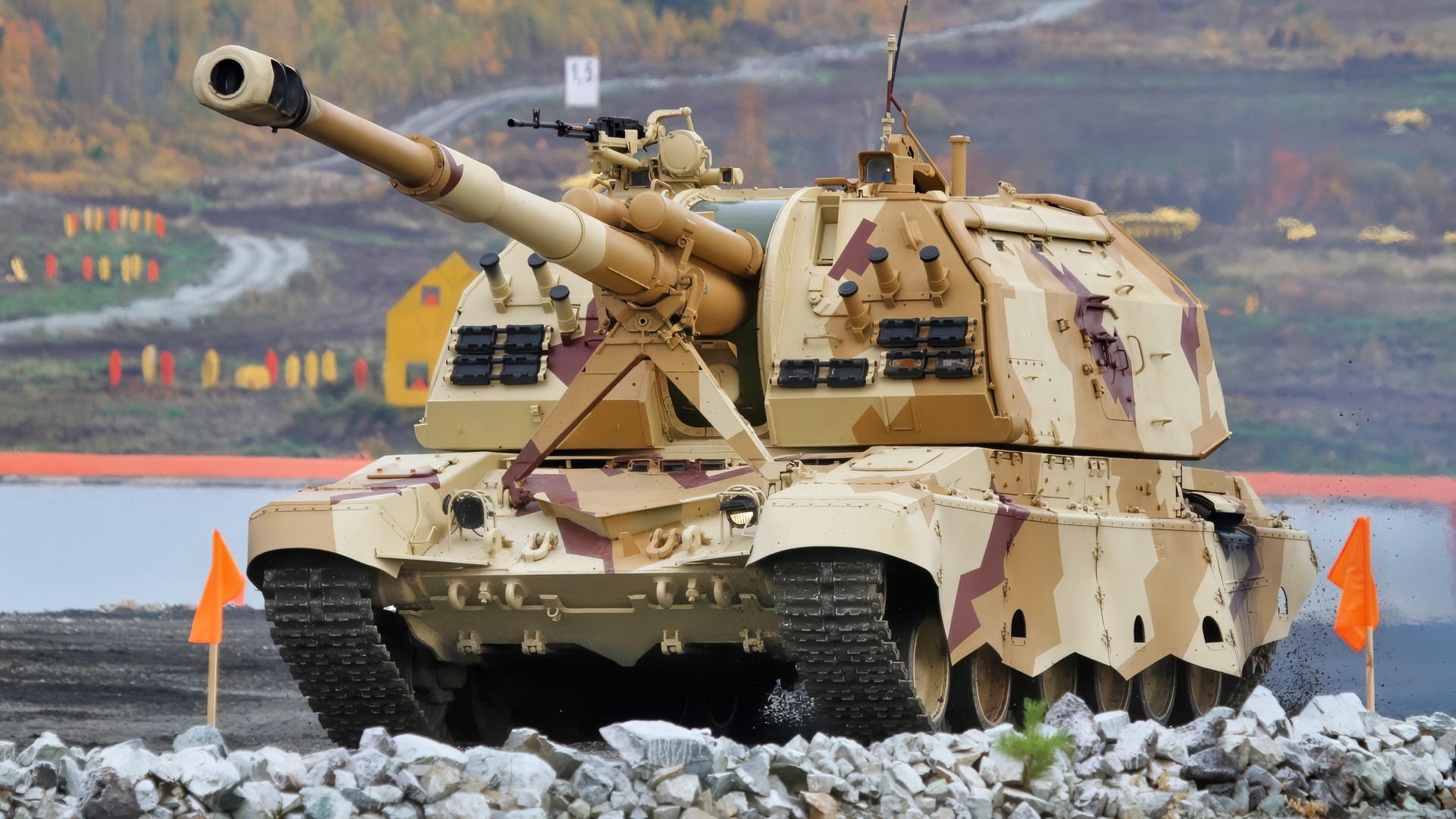
Russian Artillery. Image Credit: Creative Commons.
The tactic is not new, either. Winter has shaped every year of this war – but this time, Ukraine will enter the season with its energy system already badly damaged and its stockpile of Patriot interceptors severely depleted.
Winter As A Weapon for Russia
During the first winter of the war in 2022, Russia began systematically targeting Ukraine’s energy infrastructure following the expulsion of its forces from large areas around Kharkiv and Kherson.
Instead of attempting another rapid breakthrough on the ground, Moscow fired repeated missile barrages at transformers, substations, and power plants. The attacks caused rolling blackouts across the country, with millions of Ukrainians left without electricity, heating, or water. And this strategy has been repeated every winter since.
Russia initially focused heavily on the transmission network, which carries power between the regions, but later shifted toward targeting power-generation facilities that were harder and more time-consuming to repair or replace.
In August 2024, Russia launched more than 200 missiles and drones in a single attack largely directed at Ukraine’s grid, leaving roughly eight million households without power, according to the International Energy Agency.
The result is anxiety every single winter, with Ukrainians bracing for intensified attacks and Kyiv left preparing for what inevitably becomes a major problem for civilian life.
Every Winter Has Changed the War
The winter of 2022-2023 saw the front line largely stabilize following Ukraine’s successful counteroffensives. Russia then launched a costly ground offensive in Donbas, relying on mobilized troops, Wagner Group soldiers, and prisoners to advance around Soledar and Bakhmut. Troops only achieved limited gains after months of fighting, however.
During the winter that followed, Russia continued to strike Ukraine’s energy sector while conserving its missile stockpiles. By 2024, Moscow had started targeting thermal and hydroelectric plants rather than equipment that could be repaired relatively quickly. It’s a similar strategy to that which we see today from Ukraine’s long-range strike campaign against Russia’s most critical oil refineries and energy infrastructure.
Russia’s attacks in 2024 caused an estimated $16.1 billion in direct damage to Ukraine’s energy sector by the middle of the year, including $8.5 billion in damage to power-generation facilities, according to the Kyiv School of Economics.
The winter of 2025-2026 was even worse. Rather than focusing on Ukraine’s power plants, Russia began targeting distribution substations that deliver electricity to towns and cities. According to data from the Centre for Information Resilience, 58% of verified energy strikes between October 2025 and April 2026 hit smaller substations – an increase of 31% over the previous winter.
That same strategy has continued into this summer, too, with Russia using fiber optic drones to damage electrical substations in Ukraine’s Sumy region.
What Might Happen This Winter
Ukraine’s concern this winter is not just that Russia will launch another winter air campaign, but that Moscow is entering the winter season with larger missile stockpiles and a newfound willingness to use ballistic missiles. Russian forces are deploying tactics that make defending Ukrainian energy infrastructure even more difficult.
Ukraine will start the winter at a disadvantage compared to previous years, even as its long-range campaign against Russian infrastructure is raising the economic and political costs for Vladimir Putin to sustain the war. Much of the country’s power infrastructure has already been damaged by successive waves of Russian strikes, leaving less redundancy in the grid and making additional attacks even more destructive than in previous winters.
And with Ukraine’s shortage of Patriot interceptors, the country is more vulnerable to Russian ballistic missiles.
Four winters into the war, neither side expects the cold weather to slow the fighting. Instead, the winter tends to bring new challenges – and this year, the impact could be felt well beyond the front lines. Russian and Ukrainian citizens alike could feel the economic pressure on their wallets; Russians will also likely face continued queues at gas stations, and both sides could see their electric grids severely damaged. Unless, of course, a deal is forthcoming.
About the Author: Jack Buckby
Jack Buckby is a British researcher and analyst specializing in defense and national security, based in New York. His work focuses on military capability, procurement, and strategic competition, producing and editing analysis for policy and defense audiences. He brings extensive editorial experience, with a career output spanning over 1,000 articles at 19FortyFive and National Security Journal, and has previously authored books and papers on extremism and deradicalization.


