

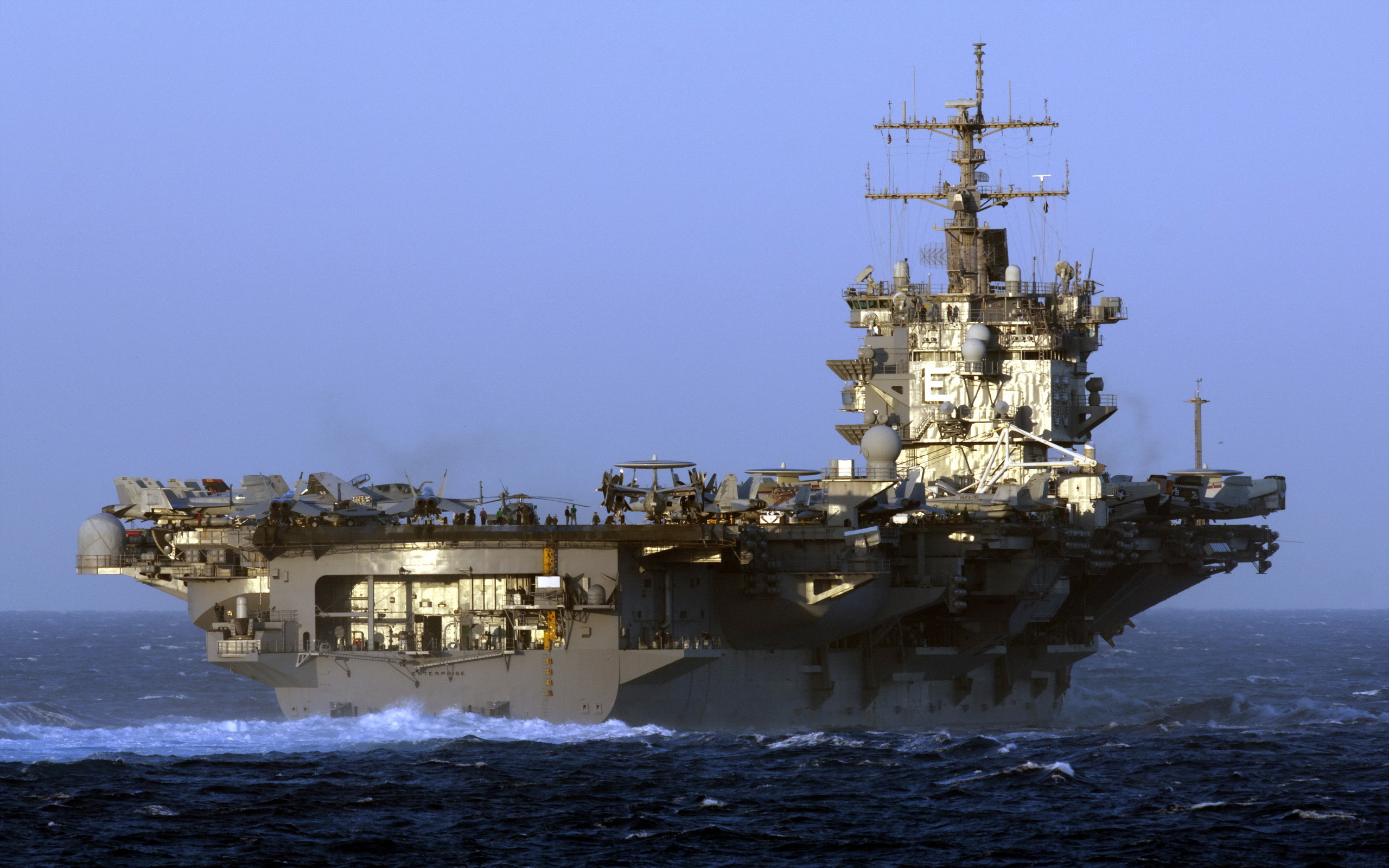
Key Points – In 1983, the USS Enterprise (CVN-65), the world’s first nuclear-powered aircraft carrier, experienced an embarrassing setback when it ran aground on a sandbar while approaching San Francisco Bay for a highly anticipated homecoming.
-The 90,000-ton carrier, returning from an eight-month deployment, missed the shipping channel due to cloudy and windy conditions. It took nearly six hours, the efforts of her crew shifting weight on deck, nine tugboats, and a rising tide to free the “Big E.”
-The incident, witnessed by thousands of waiting families and humorously documented by guest George Takei (“Enterprise on the Rocks”), resulted in minor damage and operational lessons.
USS Enterprise Aircraft Carrier Had a Problem
The USS Enterprise (CVN-65), the world’s first nuclear-powered aircraft carrier, had a long and glorious history filled with significant events and milestones—but there was some embarrassment in its career as well. One of the more humiliating incidents occurred in 1983, when the ship ran aground just before a highly anticipated homecoming.
This event not only delayed the reunions of sailors with their families, but it also cost the U.S. Navy a pretty penny in inspections and small-scale repairs.
Background of the USS Enterprise Aircraft Carrier
Launched in 1960, the Enterprise at the time was the finest carrier ever built by the U.S. As the first nuclear-powered aircraft carrier, it was a significant leap forward in naval engineering, and it ushered in the era of nuclear carriers. The ship played a crucial role during the Vietnam War, when its fighter planes carried out numerous missions. But despite its advanced technology and general reliability, the Enterprise had its fair share of accidents. In 1969, it survived a catastrophic fire, caused by an accidental missile firing, that killed 27 sailors and injured 314 more.
The Big E Runs Aground
In 1983, the Enterprise was returning from its 10th WESTPAC deployment, an eight-month tour that took it across the Pacific. The ship was scheduled to dock in San Francisco, where families eagerly awaited the return of their loved ones. The homecoming was a significant event, especially in an era before the widespread use of email, phones, and video calls on naval vessels.
As the Enterprise approached San Francisco Bay, it was initially steered by a civilian pilot. Command was handed over to a Navy pilot, however, as the ship neared its destination. At around 9:30 a.m., the 90,000-ton carrier missed the edge of a 400-yard-wide, 40-foot-deep ship channel due to cloudy and windy conditions. The ship ran aground on a sandbar just 1,000 yards from its berthing.
Humiliation and Humor
Captain Robert J. Kelly, the ship’s skipper, quickly mobilized the crew to dislodge the carrier. The crew assembled on the port side of the flight deck in an effort to shift the ship’s center of balance. Nine military and civilian tugboats joined the effort to free the Enterprise.
After nearly six hours of rocking, and with the help of the tide, the ship was finally freed at 3:12 p.m. Another 90 minutes of maneuvering were required before the Enterprise could dock, and the crew was finally released ashore.
The situation was made all the more humorous and ironic by the presence of Hollywood star George Takei, best known for his role as Sulu in Star Trek. Takei had flown out on a Navy helicopter to join the crew of the Enterprise that morning and welcome them home.
His presence (probably to the Navy’s chagrin) added more publicity and humor to the already famous accident. Takei later joked about the occasion, saying, “Our vessel is the Starship Enterprise, and this is the USS Enterprise. We’ve got a new drink—Enterprise on the Rocks”.
The grounding of the USS Enterprise was a frustrating experience for the crew and their families. Approximately 4,500 sailors and 3,000 family members could see each other, but were unable to reunite. Captain Jack McAuley, who was on board, recalled the situation as a “real drag,” with nothing to do but “sit around and grin and bear it”.
Consequences and Repairs
While the Enterprise suffered no obvious damage from the grounding, it underwent a thorough stress check to ensure its seaworthiness before its next deployment. Divers spent nearly 400 man-hours underwater inspecting the ship, and the accident caused an estimated $17 million in damage.
Captain Robert Leuschner, the captain during the incident, took full responsibility. Although he was relieved as captain of the ship, his career survived, and he was eventually promoted to a four-star admiral.
Lessons Learned for this Aircraft Carrier
In the aftermath of the incident, the Navy learned some crucial lessons. First, the event underscored the importance of clear communication and coordination between civilian and military pilots. The handover of command from the civilian pilot to the Navy pilot was a critical moment that required precise execution and was not handled with due diligence.
Second, it demonstrated the challenges of navigating large vessels in adverse weather.
The cloudy and windy conditions on the morning of the grounding played a significant role in the ship missing the channel edge. While no one was fired, there was likely a very unpleasant debriefing for the ship’s command.
The Enterprise Sailed on
In the grand scheme of things, the incident was more of an inconvenience, and a slight humiliation to the U.S. Navy, than an actual disaster.
Despite some thousand angry sailors and wives, no one was wounded, and the ship sustained no serious damage. But the San Francisco accident garnered a great deal of publicity and cemented itself as a somewhat humorous chapter in the USS Enterprise’s long aircraft carrier history.
About the Author: Isaac Seitz
Isaac Seitz, a Defense Columnist, graduated from Patrick Henry College’s Strategic Intelligence and National Security program. He has also studied Russian at Middlebury Language Schools and has worked as an intelligence Analyst in the private sector.
Meet the Best Tanks on Earth


jeff cleary
February 17, 2026 at 6:16 pm
yeah Captain Robert Leuschner was not the commanding office during this incident. he was the commanding officer in ’85 when the Big E ran aground on Bishop Rock. He retired as an O-6. I know because I was in charge of #4 reactor plant at the time.