


Summary and Key Points: A nuclear-powered supercarrier is one of the most complex machines humanity has ever built — yet the part that gave the U.S. Navy the most grief on the USS Gerald R. Ford wasn’t the reactor, the hull, or the radar. It was the catapult: the system that flings a loaded fighter from a standstill to flying speed in the length of a basketball court.
-The Navy had traded a century of reliable steam for something far more ambitious — in essence, a rail gun built to throw airplanes.
The Hardest Part Of Building A Ford-Class Supercarrier Isn’t The Ship — It’s The Catapult That Flings Jets Off The Deck

Ford-Class Aircraft Carrier Moving Fast. Image Credit: Creative Commons.
A nuclear-powered supercarrier is one of the most complex machines humanity has ever built, but the part that has caused the United States Navy the most grief on the USS Gerald R. Ford is not the reactor, the hull, or the radar. It is the catapult.
The system that hurls a fighter from a standstill to flying speed in the length of a basketball court turns out to be the single hardest piece of the entire enterprise to get right, and Ford’s troubled launch system is the clearest proof of why so few nations can field a modern carrier at all.
Master the catapult, and you can project airpower across oceans.
Fail to, and a ninety-thousand-ton ship becomes a very expensive parking lot.
What EMALS Actually Does for USS Gerald R. Ford
For most of the jet age, American carriers flung aircraft aloft with steam. A steam catapult routes high-pressure steam from the ship’s plant into a piston that drags the aircraft down the deck, a brutally effective method that powered naval aviation for decades.
The Ford class replaced it with the Electromagnetic Aircraft Launch System, or EMALS, built by General Atomics, which swaps the steam piston for a linear induction motor.
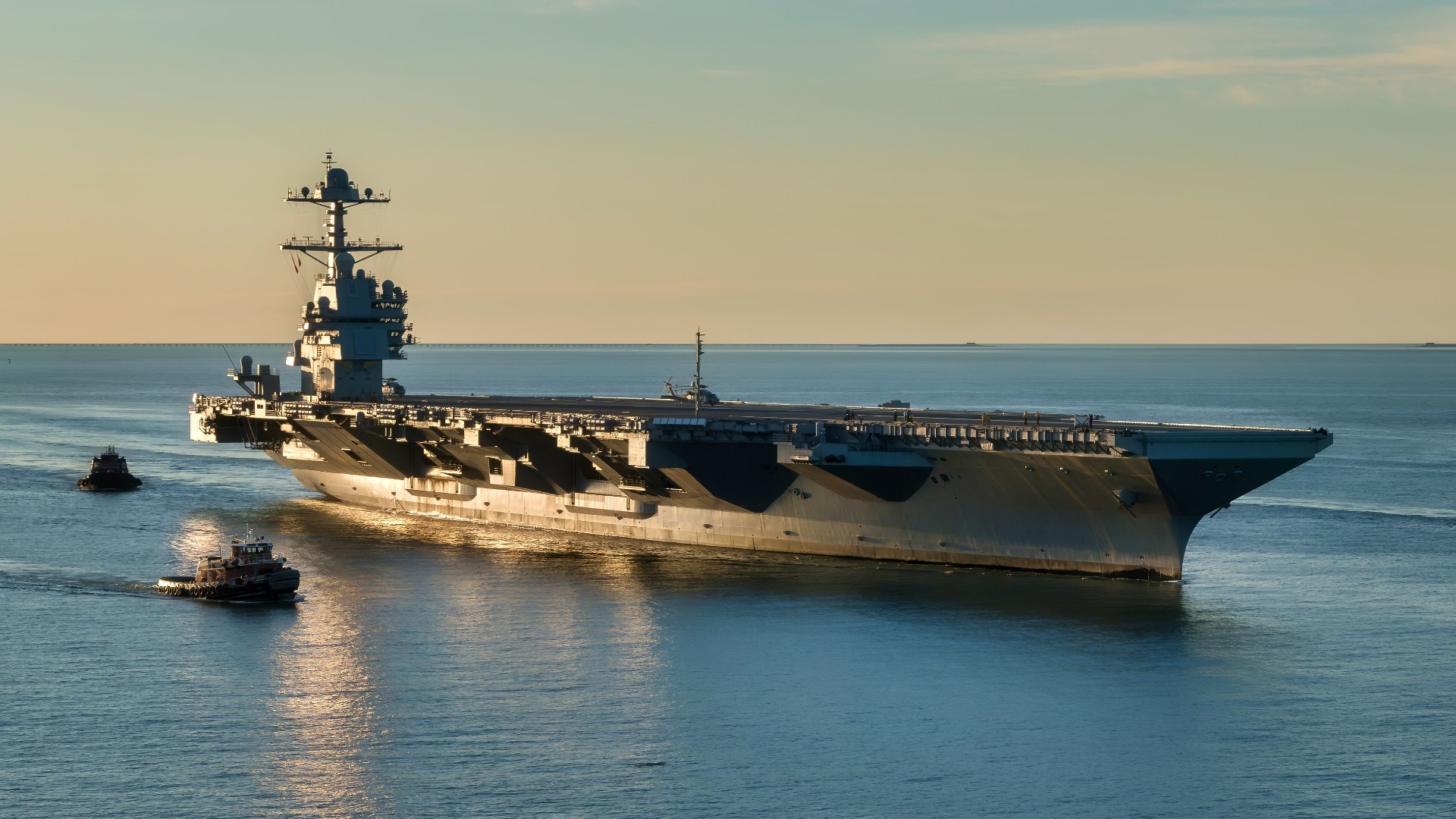
(April 14, 2017) The aircraft carrier Pre-Commissioning Unit (PCU) USS Gerald R. Ford (CVN 78) pulls into Naval Station Norfolk for the first time. The first-of-class ship – the first new U.S. aircraft carrier design in 40 years – spent several days conducting builder’s sea trails, a comprehensive test of many of the ship’s key systems and technologies. (U.S. Navy photo by Matt Hildreth courtesy of Huntington Ingalls Industries/Released)
Instead of a pressure pulse, the system energizes a sequence of stator coils along a 300-foot track, generating a traveling magnetic field that pulls a shuttle, and the aircraft attached to it, forward.
Only the section of track around the shuttle is energized at any instant, and the launch control system knows the exact speed the aircraft should be at every point along the stroke, adjusting on the fly to bring it within a few miles per hour of the target takeoff speed.
The performance demand is staggering in its own right. The motor has to accelerate a 100,000-pound aircraft to roughly 150 miles per hour over that short run, in a matter of seconds, and then do it again minutes later, drawing on a multi-megawatt power chain with onboard energy storage because no ship’s grid can deliver that surge directly.
It is, in essence, a railgun built to hurl airplanes, and building one that works at sea, repeatedly and for decades, is a genuine feat of engineering.
Why The U.S. Navy Took The Risk
The Navy did not abandon a proven steam system on a whim. Steam catapults, for all their reliability, carry real penalties.

(April 8, 2017) The future USS Gerald R. Ford (CVN 78) underway on its own power for the first time. The first-of-class ship — the first new U.S. aircraft carrier design in 40 years — will spend several days conducting builder’s sea trials, a comprehensive test of many of the ship’s key systems and technologies. (U.S. Navy photo by Mass Communication Specialist 2nd Class Ridge Leoni/Released)
They launch with an abrupt, uneven force that stresses airframes, they waste enormous amounts of energy, and the same fixed pressure that throws a heavy fighter cannot easily be dialed down for a light unmanned aircraft.
EMALS was meant to fix all of that at once. Its finer control delivers smoother acceleration that reduces stress on aircraft and pilots, allows gentler launches for lightweight drones, and widens the range of conditions under which the carrier can operate.
The logistical gains are just as significant. Doing away with the steam plumbing eliminates the boilers, pressure vessels, and miles of piping that a steam catapult demands, freeing up space below deck and reducing the crew and maintenance burden. The electromagnetic system promises 25 percent faster cycle times for launches and recoveries, reduced topside weight that helps a carrier’s stability, and the ability to handle a far wider span of aircraft, from heavy strike fighters to the light UAVs that steam simply cannot manage.
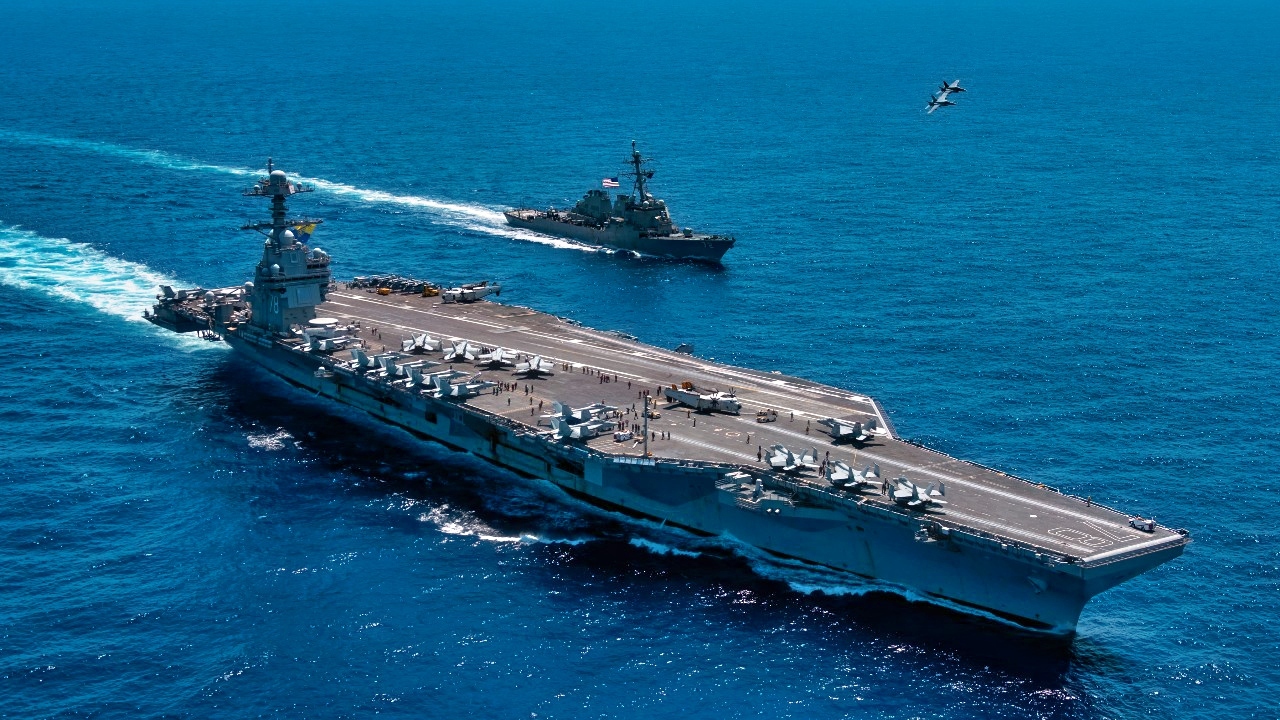
An F/A-18F Super Hornet, attached to the “Blacklions” of Strike Fighter Squadron (VFA) 213 and a F/A-18E Super Hornet, attached to the “Golden Warriors” of Strike Fighter Squadron (VFA) 87 fly over the world’s largest aircraft carrier, USS Gerald R. Ford (CVN 78), the Arleigh Burke-class guided-missile destroyer USS Mahan (DDG 72), April 11, 2025. The Gerald R. Ford Carrier Strike Group is underway in the Atlantic Ocean completing integrated naval warfighting training. Composite Training Unit Exercise (COMPTUEX) is the Joint Force’s most complex integrated training event and prepares naval task forces for sustained high-end Joint and combined combat. Integrated naval training provides America’s civilian leaders and commanders highly-capable forces that deter adversaries, underpin American security and economic prosperity, and reassure Allies and partners. (U.S. Navy photo by Mass Communication Specialist 2nd Class Maxwell Orlosky
Naval planners originally projected the Ford would generate sorties at a rate roughly 30 percent higher than the Nimitz-class it succeeds, which is the entire point of a carrier. For a fleet that expects unmanned aircraft to play a growing role, a launch system capable of launching both a heavy jet and a light drone is not a luxury but a requirement.
Why Even The Ford Struggled With It
The trouble is that EMALS has been brutally hard to make reliable, and the numbers tell the story. The system’s requirement is to average more than 4,000 launch cycles between failures. In testing during the spring of 2022, Ford’s catapults managed only about 600, a small fraction of the goal, and the figure regressed further in a later round that year.
Earlier assessments were worse still: a 2019 evaluation found the system going only 181 cycles between failures, far below what the Navy demanded. The companion system that stops aircraft on landing, the Advanced Arresting Gear, struggled on the same scale, falling well short of a reliability target measured in the tens of thousands of cycles.
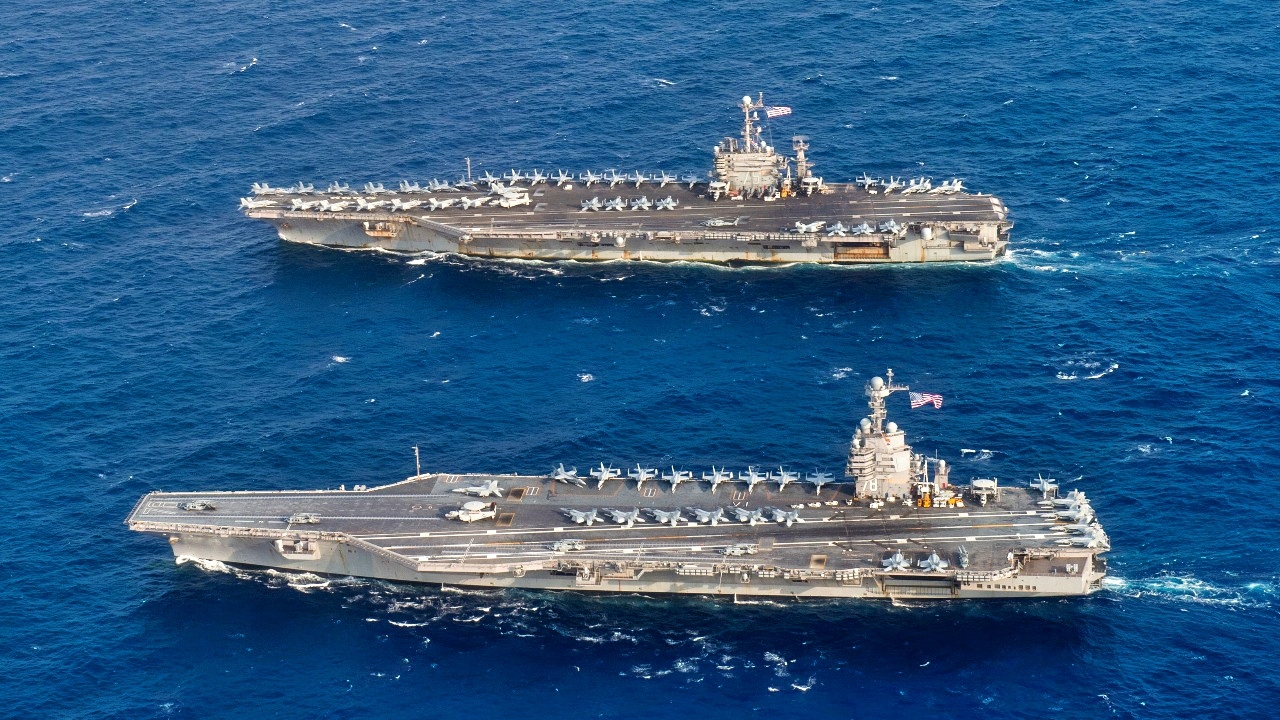
The U.S. Navy Gerald R. Ford–class aircraft carrier USS Gerald R. Ford (CVN-78) and the Nimitz-class aircraft carrier USS Harry S. Truman (CVN-75) underway in the Atlantic Ocean on 4 June 2020, marking the first time a Gerald R. Ford–class and a Nimitz-class aircraft carrier operated together underway.
The deeper problem is architectural, and it is the detail that makes a launch failure so dangerous in combat. Because EMALS is integrated into the ship’s electrical system, crews cannot easily isolate a failed catapult for repair while the others keep flying. A serious fault can force the carrier to suspend flight operations to fix it, which is precisely the moment in a flight when a carrier most needs to keep launching.
A floating airfield that has to stop flying to repair its runway is a floating airfield in trouble. The Ford’s elevators and jet blast deflectors added their own delays, but the catapult was the heart of the problem and the reason the ship arrived years behind schedule.
The Catapult Is The Real Barrier To Entry
The struggle is a reminder of why a working catapult, not a big hull, is what separates the handful of true carrier powers from everyone else. Plenty of nations can weld together a large ship.
Very few can build a system that reliably launches a loaded fighter off a moving deck thousands of times without breaking, which is why most of the world’s aircraft carriers use a ramp at the bow and let the aircraft claw their way into the air under their own power, accepting lighter fuel and weapons loads as the price. A catapult is what lets a carrier launch heavy, fully armed jets and large support aircraft, and an electromagnetic one is the hardest version of an already hard problem.
That difficulty is now the contested frontier of carrier aviation. China’s newest carrier, the Fujian, fields its own electromagnetic catapult, and Chinese sources have claimed it achieves far better reliability than Ford’s, a claim that has not been independently verified but that signals how seriously Beijing takes this single technology. Whether that boast holds up or not, it underscores the point.
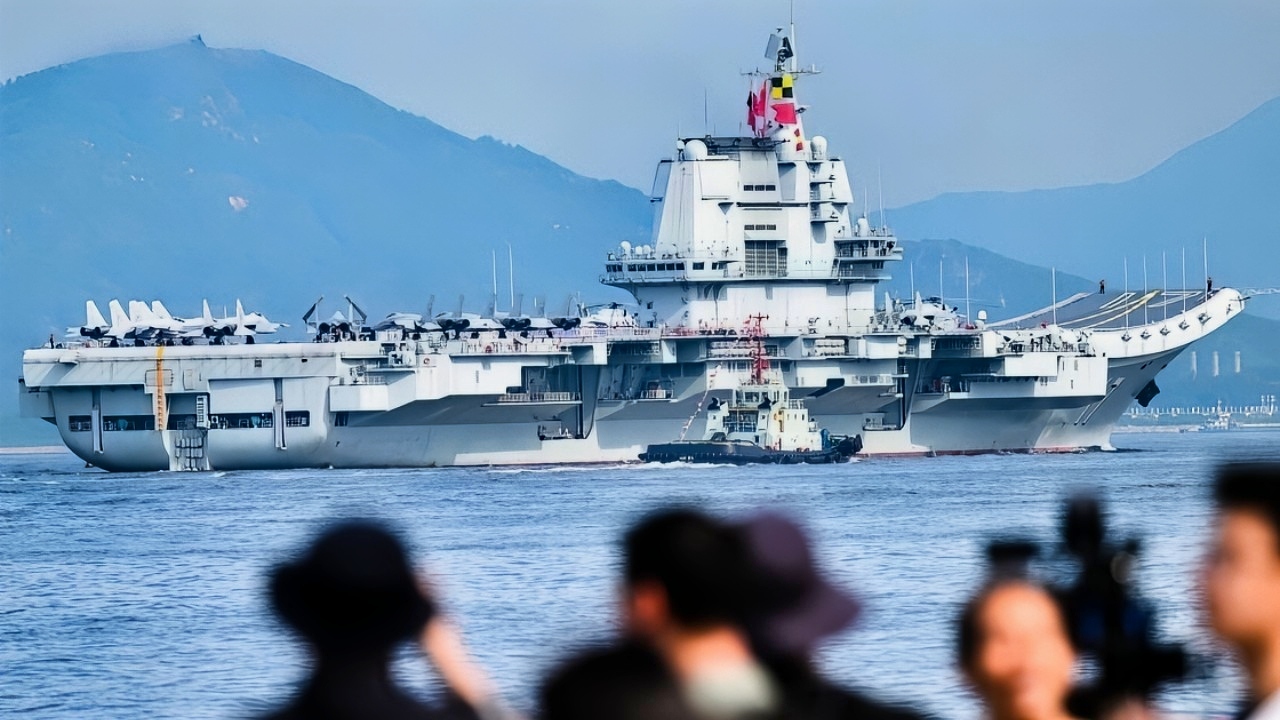
China’s Aircraft Carrier in Port. Image Credit: Chinese Navy.
The race in carrier aviation is no longer about who can build the biggest ship. It is about who can master the catapult, and Ford’s long and painful road to a working one shows just how high that bar sits.
About the Author: Harry J. Kazianis
Harry J. Kazianis (@Grecianformula) was Senior Director of National Security Affairs at the Center for the National Interest (CFTNI), a foreign policy think tank founded by Richard Nixon based in Washington, DC. Harry has over a decade of experience in think tanks and national security publishing. His ideas have been published in the NY Times, The Washington Post, The Wall Street Journal, CNN, and many other outlets worldwide. He has held positions at CSIS, the Heritage Foundation, the University of Nottingham, and several other institutions related to national security research and studies. He is the former Executive Editor of the National Interest and the Diplomat. He holds a Master’s degree focusing on international affairs from Harvard University.


MrObvious
June 8, 2026 at 1:46 pm
The Hardest Part of Building a U.S. Navy Aircraft Carrier Isn’t the Nuclear Reactor or Hull. It’s the One System That Keeps Failing:
A unionized labor force that goes on strike as often as the wind changes and their unique ability to NEVER finish anything ON TIME and ON BUDGET!!!