


Key Points and Summary – China’s J-20A is the first major evolution of the Mighty Dragon stealth fighter, built around new WS-15 engines, a refined fuselage, deeper spine, and updated sensors.
-First seen in runway photos and then paraded alongside the twin-seat J-20S and carrier-capable J-35, the J-20A showcases a maturing fifth-generation ecosystem.

J-20 Fighter with Jet Stream. Image Credit: Weibo.
-Chinese analysts say the redesign boosts range, payload, and avionics, reflecting a broader shift from fourth- to fifth-generation forces.
-While many details remain opaque, the J-20A underlines that China now fields multiple stealth types as part of one of the world’s largest and fastest-advancing air arms.
J-20A Mighty Dragon: The Engine Upgrade That Changes Everything
The J-20A is a Chinese stealth fighter, a variant of the established J-20. Like much of China’s weaponry, the information available about it is incomplete, though observers got a good look at the J-20A during the Chinese military parade in early September.
In September of 2024, a year before the parade, The War Zone reported what was described as “our clearest view so far” of the J-20A.
“While the appearance of the photo at this point raises a number of questions, it’s meanwhile clear that the significant shortcoming of the J-20—its powerplant—is well along its path to being addressed,” TWZ reported in the 2024 story.
The fighter is shown from the rear, providing a detailed view of the twin WS-15 turbofan nozzles. The aircraft is wearing the characteristic yellow primer that is applied prior to the final paintwork being added.”The WS-15 upgrade is significant because previous Chinese fighter jets have used older Russian engines.

China J-20 Fighter Yellow. Image Credit: Creative Commons.
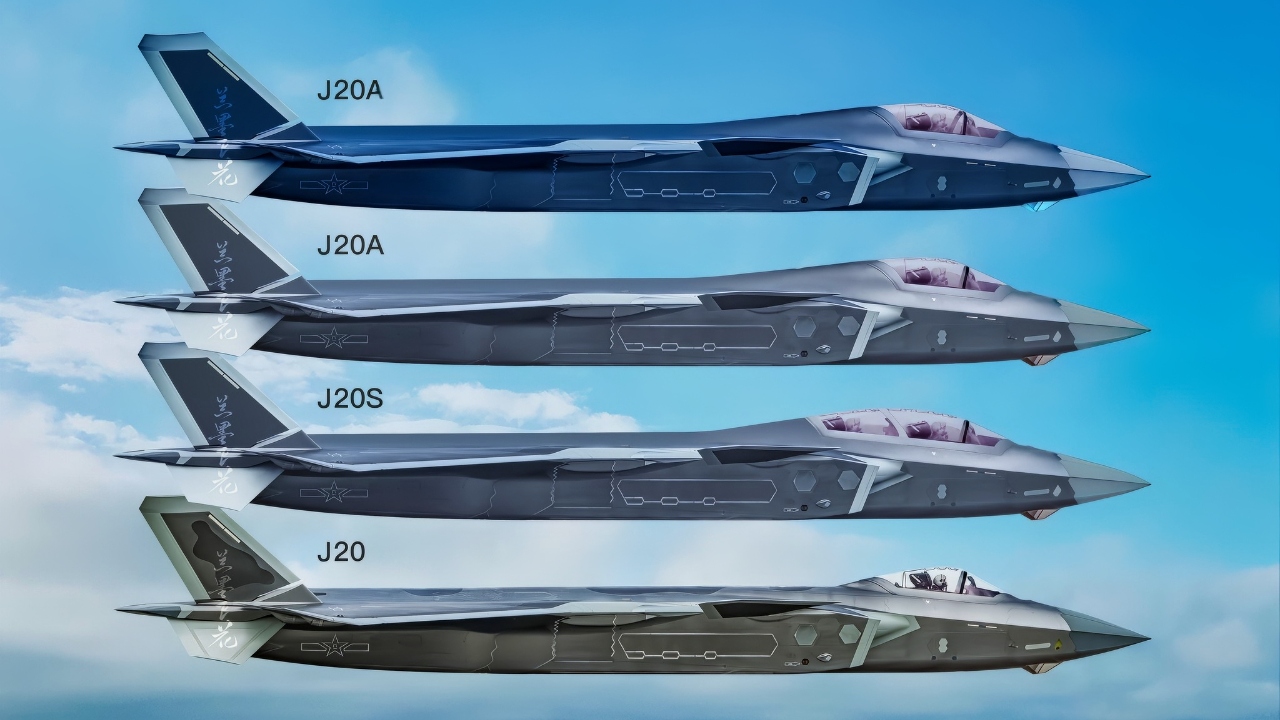
TWZ went on to describe the new J-20A as “a refined single-seat version of the basic J-20, with changes that include a revised fuselage mold line, including a reprofiled nosecone, a deeper spine, and a slightly raised cockpit, as well as provision for WS-15 engines.”
That report was based on a photo taken of the jet on the runway. But we would get a much better look at the J-20A later on.
A Summer Look
This July, the South China Morning Post published photographs of the J-20A, which had been “Circulating on Chinese social media,” amid speculation that the J-20A would be appearing in the September military parade.
“The photos of the J-20A were shared on Wednesday alongside photos of the J-35, another fifth-generation Chinese stealth fighter,” SCMP said in the July story.
“In recent weeks, advanced aircraft have repeatedly been seen flying in formation across the country, including several identified as J-20A jets, according to social media posts.”
The speculation was correct: the J-20A indeed appeared at the V-Day Military Parade on September 3 in Beijing, held to commemorate the 80th anniversary of the end of World War II.

J-20 Mighty Dragon in Camo Back in 2018. Image Credit: Chinese Air Force.

Chinese J-20 Fighters. Image Credit: PLAAF.
China J-20 Fighter X Screenshot.
Parading the Jets
According to an Air and Space Forces magazine account of the September 3 parade, “The People’s Republic of China showed off operational and near-operational fifth-generation aircraft in a massive military parade marking the 80th anniversary of Japan’s defeat in World War II.”
And a big part of that was the appearance of the three J-20 jets.
“It was the first time three versions of the J-20 ‘Mighty Dragon’—China’s top-line stealth fighter—were displayed, along with two versions of the J-35, the Chinese Navy’s first stealth carrier-based jet, which resembles the U.S. F-35,” the account said. “The event also showed off new versions of Chinese intercontinental ballistic missiles, hypersonic missiles, and other gear.”
The J-20 S is the one with two seats, the first jet of its kind to include that feature.
The Air and Space Forces account quoted Wang Yanan, the editor of the magazine Aerospace Knowledge, who had said the J-20 and J-35 meant “the Air Force and Navy are in the middle of a systematic transformation,” from “fourth- to fifth-generation types.”
“The deepened spine of the J-20A likely means it can carry more fuel, and that the lower-profile canopy will aid stealth,” the Air and Space Forces characterized that expert as adding. The jet also sports “electro-optical sensors mounted around the fuselage.”In China’s state-run Global Times, military expert Zhang Xuefeng analyzed the new jets, including the J-20A.
“Generally speaking, the upgrade from the J-20 to the J-20A with a new designation means that the J-20 has undergone significant upgrades, and various systems of J-20 may have significant improvements,” Zhang said, per Global Times.

J-20. Image Credit: Creative Commons.
A military affairs expert, Fu Qianshao, also noted to the Global Times that the J-20 had been upgraded.
“If more advanced airborne equipment could be carried, it would mean that the J-20A’s various subsystems would also be strengthened accordingly,” the Global Times characterized Fu as saying.
“Although the J-20 has made multiple appearances at military parades and air shows, every time it makes an appearance, it has new upgrades and improvements, and every time it brings surprises. As the cornerstone of safeguarding the security of China’s airspace, the J-20 has been constantly updating and growing,” Fu added.
Should the US Be Worried?
There haven’t been many known developments in China’s fighter jet capabilities since the September parade. However, Newsweek reported in early October that China had released footage of its stealth fighter development.
The footage was of a hangar where the J-35 and J-35A jets were under construction at the Shenyang Aircraft Company’s hangars. None of the J-20 aircraft are present in the October footage, although the J-35 jets were part of the September parade.
China released footage of the J-20’s maiden flight, which took place in 2011 but did not surface until now.

J-35A Fighter at Le Bourget Air Show. Image Credit: Author/National Security Journal.
“China operates the largest aviation force in the Indo-Pacific region, according to the Pentagon,” Newsweek reported. “It is also the second country, after the US, to have developed two types of stealth fighter jets—the J-20 and J-35 families of aircraft—capable of evading radar detection and rivaling their American counterparts, the F-22 and F-35.”
Newsweek went on to quote from China’s Military Power Report in 2024:
“The [People’s Liberation Army Air Force] and [People’s Liberation Army Navy] Aviation together constitute the largest aviation forces in the region and the third largest in the world, with over 3,150 total aircraft (not including trainer variants or [Unmanned Aircraft Systems]), of which approximately 2,400 are combat aircraft (including fighters, strategic bombers, tactical bombers, multi-mission tactical, and attack aircraft),” that report said.
About the Author: Stephen Silver
Stephen Silver is an award-winning journalist, essayist, and film critic, and contributor to the Philadelphia Inquirer, the Jewish Telegraphic Agency, Broad Street Review, and Splice Today. The co-founder of the Philadelphia Film Critics Circle, Stephen lives in suburban Philadelphia with his wife and two sons. For over a decade, Stephen has authored thousands of articles that focus on politics, national security, technology, and the economy. Follow him on X (formerly Twitter) at @StephenSilver, and subscribe to his Substack newsletter.


Terry
December 9, 2025 at 7:36 am
What was it – Happy Christmas?
Julio
December 9, 2025 at 7:44 am
I don’t trust Chinese toys
Xyz
December 9, 2025 at 12:55 pm
And only country who produces 2 stelt fighters. USA now have only one, F-35, in production.