

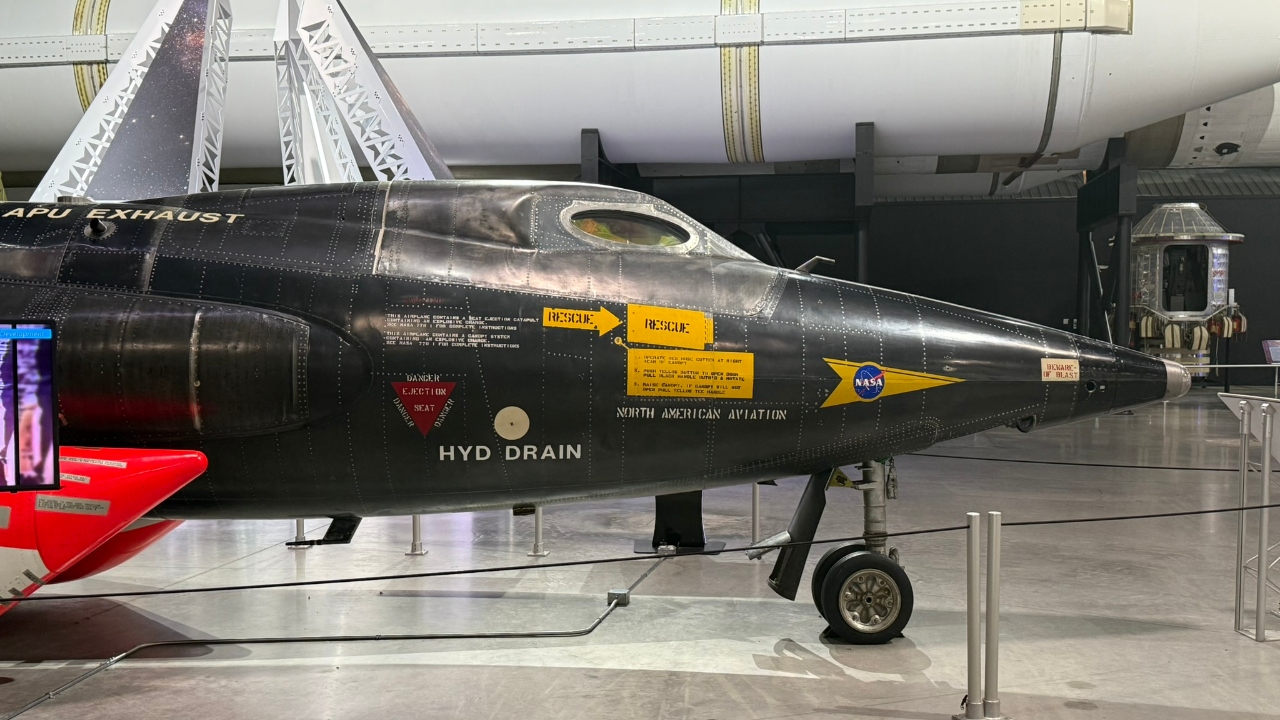
Published on August 14, 2025, 9:26 PM EDT – Key Points: The North American X-15 was a revolutionary rocket-powered aircraft that pushed the boundaries of high-speed flight in the 1960s.
-Air-launched from a B-52, the X-15 reached a record-breaking speed of Mach 6.7 and flew high enough to earn astronaut wings for eight of its pilots.
-While never intended as a weapon, the X-15 was a “resounding success” as a research platform.
-It pioneered critical technologies that became standard in the aerospace industry, including the use of titanium alloys, practical full-pressure space suits, and reaction controls for attitude control in space.
The X-15 Made History
In 1967, William “Pete” Knight made history at the stick of his North American X-15A-2 rocket-powered aircraft when he reached a speed of Mach 6.7, or around 5,140 miles per hour, at an altitude of some 102,000 feet. While this particular flight was one for the record books, it was no fluke.
Over nine years, 12 pilots would take the stick of the X-15 for a total of 199 flights, 13 of which even met the Air Force’s criteria for spaceflight, earning eight pilots their astronaut wings.
A total of three were built and while they were indeed hypersonic aircraft, they were a long way from operational platforms. In order to achieve such incredible speeds, the X-15 relied on a liquid-propellant rocket engine that would only burn for between 80 and 120 seconds. But in that short time, boy did it burn.
The XLR99 rocket engine in the X-15 produced 600,000 horsepower and 70,400 pounds of thrust, or about 2/3 the thrust Blue Origin’s New Shepard rocket leverages to send a six-person capsule into orbit.
In order to make the most of that short burn, the X-15 was carried aloft under the wing of a B-52 Stratofortress and dropped at a speed of around 500 miles per hour before hitting the throttle and dumping fuel into the idling rocket engine.
During atmospheric flight, the X-15 used conventional aerodynamic control, relying on rudder surfaces on the vertical stabilizers to control yaw (or movement of the nose from the left to right) and canted horizontal surfaces on the tail to control pitch (aiming the nose up and down).
However, once the X-15 left the atmosphere, it would transition to using hydrogen peroxide thrust rockets on the nose and wings of the aircraft to orient its nose.
Although the United States had already experimented with the idea of using aircraft like the B-36 Peacemaker as flying aircraft carriers, the Air Force and NASA had no illusions about the practicality of the X-15 as a tactical platform. Its purpose was testing the limits of the technology of the day, and in that regard, it was a resounding success.
In all, the plane made 199 successful flights, forever changing how the United States saw high-speed aviation.
“The fallout was far-reaching in numerous crucial areas . . . The X-15’s survival encouraged extensive use of comparatively exotic alloys, such as titanium and Inconel-X, which led to machining and production techniques that became standard in the aerospace industry,” Fromer NASA historian, Dr. Roger Bilstein wrote in his book, “Testing Aircraft, Exploring Space.”
“The chance of accidental loss of pressurization prompted development of the first practical full-pressure suit for pilot protection in space. The X-15 was the first to use reaction controls for attitude control in space; re-entry techniques and related technology also contributed to the space program, and even earth science experiments were carried out by the X-15 in some of its flights.”
On October 24, 1968, NASA’s William H. Dana brought the final X-15 flight to a close after touching down on a dry lake bed at around 200 miles per hour.
In just nine years, the X-15 had changed the shape of high-speed aviation, but chances are good that we’ll continue to see lessons learned throughout the X-15 program manifest in new efforts as the world shifts its focus toward hypersonics.
About the Author: Alex Hollings
Alex Hollings is the editor of the Sandboxx blog (where this first appeared) and a former U.S. Marine who writes about defense policy and technology. He lives with his wife and daughter in Georgia.


