

Key Points and Summary – Decades before the rumored SR-72 “Darkstar,” America had already conquered hypersonic flight with the X-15 rocket plane.
-In 1967, this remarkable experimental aircraft, developed by North American Aviation, reached a stunning speed of Mach 6.7, a record for a crewed, powered aircraft that remains unbroken to this day.
-Launched from a B-52 bomber, the X-15 also flew to the edge of space, providing invaluable data for the Mercury, Gemini, and Apollo programs.
-While the SR-72 remains a Hollywood fantasy, the X-15’s real-world achievements from over 60 years ago are the stuff of aviation legend.
The X-15 Exceeded Mach 6 Speed Over 6 Decades Ago
Thanks in no small part to the summer 2022 cinematic blockbuster “Top Gun 2: Maverick,” you’ve seen that the SR-72 “Darkstar” has become kind of a big deal, even though its real-life existence remains shrouded in mystery.
It’s also known as the “SOB” as in “Son of Blackbird” because it’s envisioned as the direct successor to the iconic SR-71 Blackbird spy plane, which still holds the world record as the fastest air-breathing aircraft ever built—officially Mach 3.2 but unofficially at or above Mach 3.5 (2,685 mph, 4,321.8 km/h, 2,333.5 knots)—a whopping 35 years after its initial official retirement.
Suppose the RUMINT (RUMor INTelligence) was (and still is) to be believed. In that case, the 6th Generation SOB will leave its father (so to speak) in the dust, to the tune of Mach 6 speed capabilities (and mind you, anything Mach 5 or above is considered to be hypersonic.)

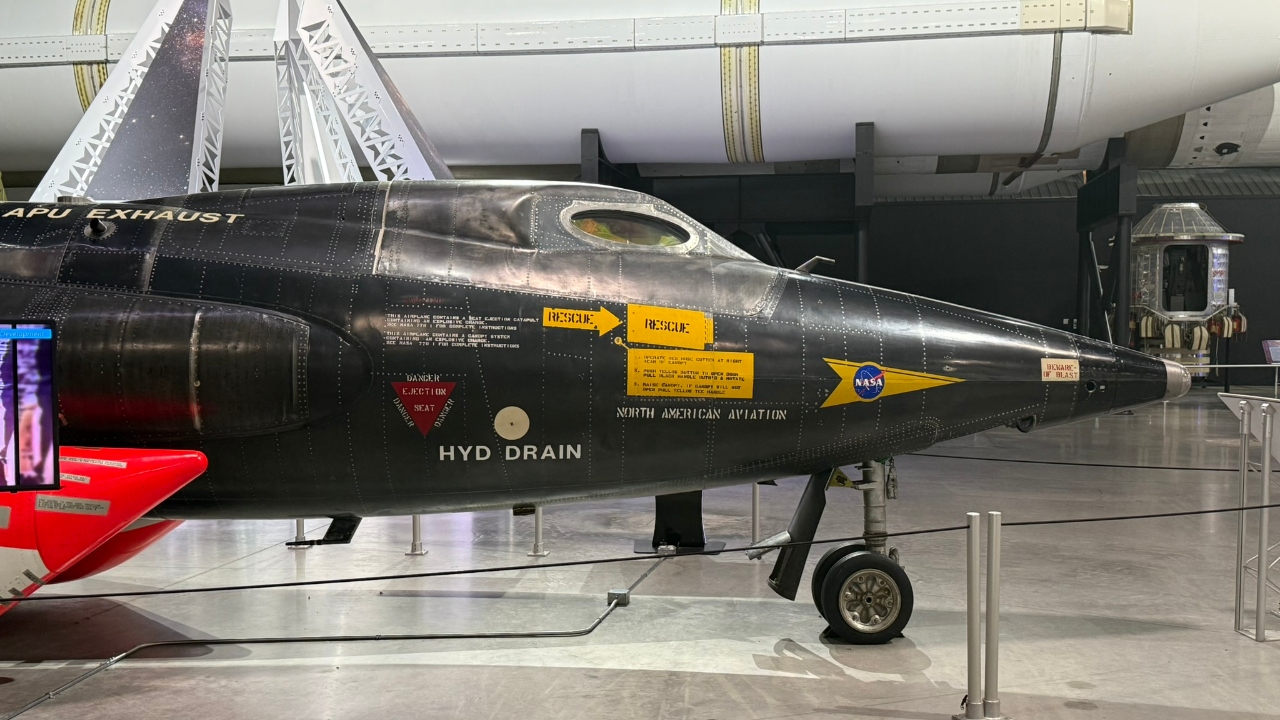
X-15 Long Shot and Engine Photo. Image Credit: National Security Journal.
As impressive as that hypothetical capability sounds, one must bear in mind the proverb “Everything old is new again.” A whopping six decades ago, during the heady days of the Cold War, an American-made aircraft already achieved Mach 6+ speed within the confines of the Earth’s atmosphere (as opposed to outer space).
Say hello again to the X-15 rocket plane.
X-15 Initial History
Unlike the SR-71 and SR-72 alike, the X-15 wasn’t a product of Lockheed’s (now Lockheed Martin’s) legendary “Skunk Works” division. Instead, it was produced by the sadly now-defunct North American Aviation (NAA), an aerospace firm that had already gained fame during World War II via (1) the P-51D Mustang fighter plane that proved to be the game changer in the deadly skies over Western Europe and (2) the B-25 Mitchell medium bomber immortalized by the Doolittle Raid on Tokyo in 1942.
The X-15 made its maiden flight on June 8, 1959, and was officially introduced on September 17, 1959. The plane was conceived as part of a hypersonic flight research program designed to test and investigate several aspects associated with piloted hypersonic flight. The information gleaned from the program would be used in the development of the Mercury, Gemini, and Apollo piloted spaceflights, as well as in the Space Shuttle Program.

North American X-15 Head On. Image Credit: National Security Journal.
A total of three airframes were built, which flew a combined total of 199 flights—divvied amongst 12 pilots—before the plane was officially retired in December 1968. Tragically, one of those pilots lost his life whilst operating the aircraft.
X-15 Technical Specifications and Vital Stats
Crew: 1
Length: 50 ft (15.24 m)
Wingspan: 22 ft (6.71 m)
Height: 13 ft 8 in (4.21 m)
Empty weight: 13,000 lb. (5,897 kg)
Gross weight: 15 tons (13607.8 kg)
Powerplant: Thiokol 57,000-pound thrust liquid propellant rocket engine
Range: 280 mi (451 km)
Rate of climb: 60,000 ft/min
Other noteworthy features included:
–An innovative ejection system that included the use of a pressure suit that protected the pilot from both the windblast of ejecting at Mach 3 and allowed pilots to survive at altitudes of over 250,000 feet (76,200 meters).
–An ejection seat included measures designed to help transfer weight from the pilot’s rear to the seat; this was vital in light of the thrust involved in the ejection mechanism that was required to ensure that the pilot would clear the aircraft’s hypersonic shockwave
–Special restraints that prevented the pilot’s arms and legs from flailing during ejection, which helped to protect against heat burns.
The X-15 Sets the Still Unbroken Speed Record
On October 3, 1967, the X-15 plane achieved a speed of Mach 6.7 (5,140.7 mph, 8.273.16 km/h, 4,467.15 knots), thus making its test pilot, then-USAF Maj. (eventual retired Col.) William John “Pete” Knight (November 18, 1929 – May 7, 2004) was the fastest flying pilot ever.
Sixty-seven years and 9 months later, this remains the highest speed ever recorded by a crewed, powered aircraft. (Alas, the SR-72 is expected to be an unmanned aircraft, unlike the fictitious version flown by the titular hero of “Top Gun: Maverick.”) Pete Knight achieved this milestone at an altitude of 102,100 feet (31,120 meters), or 19.34 miles.
This remarkable achievement was accomplished 11 days shy of the 20th anniversary of then-Capt. Chuck Yeager (later retired Brig. Gen.) became the first human to break the sound barrier (doing so in the Bell X-1).
As if that alone weren’t amazing and mind-blowing enough, that wasn’t the only super-impressive feat pulled off by the X-15. Believe it or not, this remarkable plane made a foray into outer space, albeit just barely: on August 22 1963 (yes, four years *before* Pete Knight’s speed record-shattering flight), NASA test pilot Joseph A. (Joe) Walker reached 354,200 feet (107,960 meters), an unofficial record altitude of almost 67 miles (107.82 km), thus exceeding the Kármán line, the internationally recognized 100 km altitude used by the Fédération Aéronautique Internationale (FAI) as the demarcation line for the edge of space.
We Got Within An Inch of the X-15
Out of the three X-15 airframes built, one has been preserved for posterity. X-15A-2 (AF Ser. No. 56-6671) sits proudly in the National Museum of the United States Air Force at Wright-Patterson AFB, in the vicinity of Dayton, Ohio.
As luck would have it, National Security Journal’s own intrepid Editor-in-Chief, Mr. Harry Kazianis, had the honor and privilege of visiting the USAF Museum and getting multiple good photos and video of the X-15 display.
We now present them here for your viewing pleasure, as well as throughout the article.

X-15 USAF Museum Photo. Image Credit: National Security Journal.

X-15 from U.S. Air Force Museum Original Photo. Image Credit: National Security Journal.
For the benefit of our dear readers living on the West Coast who don’t have either the time, money, or desire to book a trip to the Midwest, you have some realistic full-size mockup options to choose from:
–The Dryden Flight Research Center, Edwards AFB, California
–The Pima Air & Space Museum, adjacent to Davis-Monthan AFB, Tucson, Arizona –
The Evergreen Aviation & Space Museum, McMinnville, Oregon
About the Author: Christian D. Orr, Defense Expert
Christian D. Orr is a Senior Defense Editor. He is a former Air Force Security Forces officer, Federal law enforcement officer, and private military contractor (with assignments worked in Iraq, the United Arab Emirates, Kosovo, Japan, Germany, and the Pentagon). Chris holds a B.A. in International Relations from the University of Southern California (USC) and an M.A. in Intelligence Studies (concentration in Terrorism Studies) from American Military University (AMU).
More Military
We Almost Touched the F-117 Stealth Fighter


Horsemen
July 22, 2025 at 8:26 pm
China’s aerospace industry today is in a position to dethrone the X-15 and its legendary place or spot in history but first, the people must overthrow its current paramount leader xi jinping.
Xi is a real danger to china’s aerospace industry and its many other world-beating industries as well.
The recent test of feitian-2 showed X-15 and SR-71 are mere small kiddies’ stuff by comparison.
Never mind craft that have already flown, like starry sky2, and wu-14 which proved extreme maneuvers remain possible in hypersonic flight.
Feitian-2 (2025) and the earlier feitian-1 (2022) demonstrate exactly who’s now truly in charge of extreme high-speed flight in human history.
But xi’s standing in the way, and he MUST be pulled down from his high Horse and exiled abroad. To rikers island for example.
taco
July 23, 2025 at 6:40 am
The lynchpin of nazi defense in donetsk, pokrovsk, has fallen to russian forces.
After over a year of attacks.
Pokrovsk is about 120km east of the dnieper river.
Once pokrovsk falls, it’s going to be easier going as the land behind the city facing toward the river is mostly flat and not heavily defended.
That kind of territory makes it hard for the retreating nazi forces to take cover from glide bombs and iskander missiles. And FPV drones.
Zelenskyy must be wondering What went wrong. Perhaps the mercenaries fighting with the azov corps weren’t paid enough.
doyle
July 23, 2025 at 9:08 am
The ukro redoubt of Pokrovsk which lies east of the dnieper has fallen to russian forces.
Sporadic fighting is still ongoing in some parts of the city, but the banderovtsy remnant won’t last very long.
So, what now.
The russians need to do some mopping up operations, and then ramp up glide bomb strikes on the other locations still in ukro possession.
Once that’s done, time to flatten large major cities like odessa and kyiv.
Remember the Crocus city hall killing by hired agents of the ukro fsb.