

Key Points and Summary – The North American X-15 was a revolutionary rocket-powered aircraft from the 1960s designed to explore hypersonic flight at the very edge of space.
-Flown by legendary test pilots, including future astronaut Neil Armstrong, the X-15 shattered records.
-It reached incredible speeds of Mach 6.7 and altitudes over 354,000 feet, setting records for a piloted rocket plane that still stand today.
-To survive the extreme heat, it was built from a special nickel alloy.
-The crucial data gathered from the X-15 program on high-speed flight and atmospheric reentry was vital for the success of the later Apollo and Space Shuttle programs.
The X-15 Made History and Shattered the Record Books
The North American X-15 was an experimental rocket-powered aircraft developed as part of the X-plane program, a series of test aircraft flown and developed by the United States to explore high-speed and high-altitude flight.
The X-plane program, initiated in the 1940s, was meant to push the boundaries of aviation technology and glean flight information that would be useful for both military and civilian aerospace purposes.
The X-15 was among the most ambitious of these X-plan programs, designed to study hypersonic speeds, the effects of high-altitude flight, and spacecraft-like reentry conditions.
X-15, Explained and History
Developed by North American Aviation for NASA and the U.S. Air Force, the X-15 first flew in 1959. Its primary goals were to investigate aerodynamic heating, control at hypersonic speeds, and human performance during extreme flight conditions.
The program also aimed to gather information relevant to space travel, as its flights often reached altitudes beyond the boundary of space.
The X-15 was powered by the XLR99 rocket engine, burning liquid oxygen and anhydrous ammonia, and produced a whopping 57,000 pounds of thrust.
A documentary by NASA in 1962 provides background information on the X-15, including the plane’s research and development process.
“The basic concept of a specialized research aircraft, of which only several will be produced and which do not require being rapidly serviced as in a combat aircraft permits considerable compromise in favor of extreme simplicity in order to assure a high degree of ruggedness and reliability,” a NASA publication explains.
“NAA, through detailed study of current research aircraft and as a result of conferences with the operating personnel is acutely aware of and has incorporated this concept in the preliminary design of the proposed aircraft.”
Challenges
One of the major engineering challenges was thermal protection. At speeds exceeding Mach 6, the aircraft’s fuselage, wings, and control surfaces would reach temperatures high enough to weaken conventional materials and threaten the integrity of the airframe.
Engineers used a special nickel alloy, Inconel X, in order to withstand the extreme heat. The aircraft’s shape and control surfaces also had to be designed for stability both in the thin upper atmosphere, where maneuvering would be difficult and during high-speed reentry, where management of extreme temperatures would also be necessary.
“Major problems to be approached and solved by the use of the X-15 will be those material and structural problems caused by the high temperatures encountered in the very high speed portions of experimental flights,” NASA explained.
“At a Mach number of 7, the boundary layer recovery temperature will be on the order of 4399°F and the skin equilibrium temperature, where heat input is balanced by radiation output, will exceed 1200°F even at altitudes above 100,000 feet. 1200°F approaches the upper limit for usage of Inconel X as a structural material.”The X-15 program saw several notable test pilots, including Neil Armstrong, who would later become the first person to walk on the Moon. Armstrong’s experience with high-speed flight and atmospheric reentry contributed to his later selection and role within the Apollo 11 program.
Other pilots included Joe Walker, who flew the X-15 to a record altitude of 107.8 km, or 354,200 feet, and William J. Knight, who set the aircraft’s fastest speed record at Mach 6.7, or 4,520 mph.
Records the X-15 Set: Mach 6.7
The records set by the X-15, despite their age, are nothing short of impressive. Walker’s altitude flights exceeded the 100-km Kármán line, the widely recognized boundary of space, qualifying him for astronaut wings.
Knight’s speed record also remains the fastest for a piloted, rocket-powered aircraft today.
Legacy
The X-15 program provided crucial research data for the Apollo program as well as for later space missions. It offered data on hypersonic flight, high-temperature materials, and challenges inherent to high-speed, high-altitude human spaceflight.
Furthermore, the X-15 program’s findings influenced the design of the later Space Shuttle, which looked at manned missions to space, as well as other high-speed aerospace vehicles.
In 4 Words: We Got Up Close
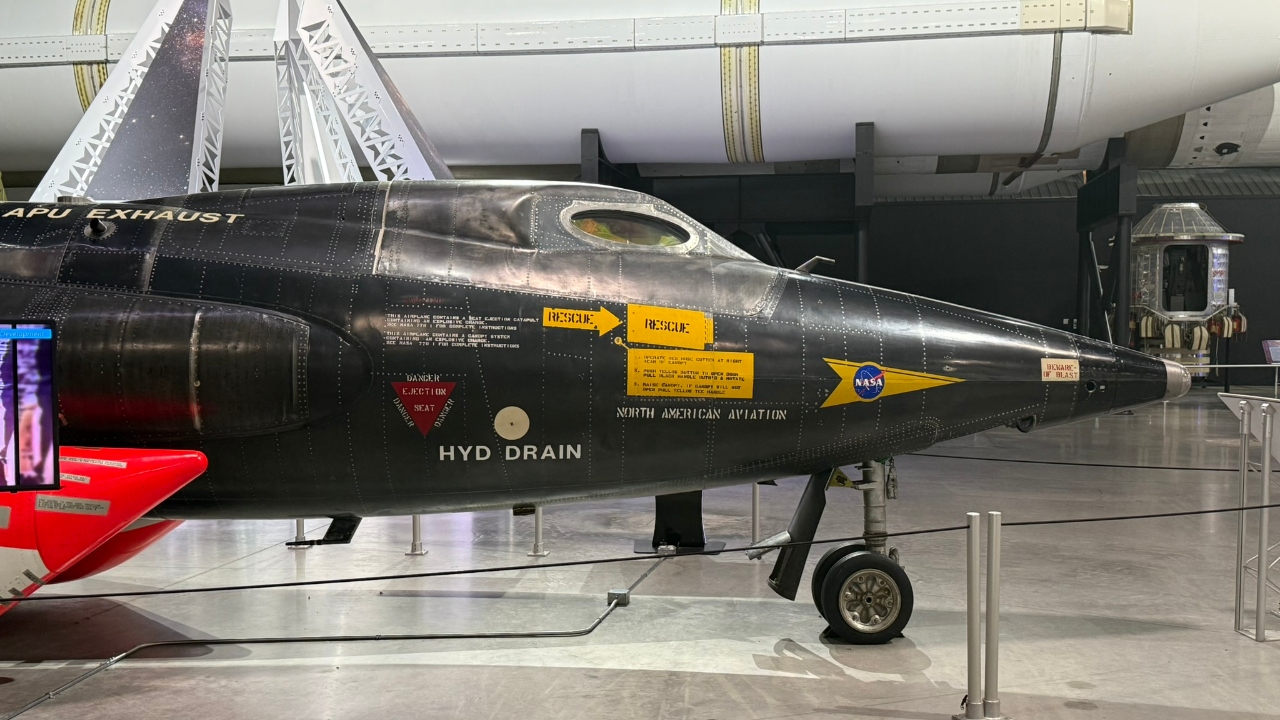
On July 19-20, 2025, the National Security Journal was able to visit the X-15 at the U.S. Air Force Museum. You can see some of the fantastic photos we were able to take as close as we were allowed to get.

X-15 Long Shot and Engine Photo. Image Credit: National Security Journal.

North American X-15 Head On. Image Credit: National Security Journal.

X-15 from U.S. Air Force Museum Original Photo. Image Credit: National Security Journal.

X-15 USAF Museum Photo. Image Credit: National Security Journal.

X-15A from U.S. Air Force Museum. Image Credit: National Security Journal.
About the Author: Caleb Larson
Caleb Larson is an American multiformat journalist based in Berlin, Germany. His work explores the intersection of conflict and society, with a focus on American foreign policy and European security. He has reported from Germany, Russia, and the United States. Most recently, he covered the war in Ukraine, reporting extensively on the war’s shifting battle lines from Donbas and writing on the war’s civilian and humanitarian toll. Previously, he worked as a Defense Reporter for POLITICO Europe. You can follow his latest work on X.
More Military
We Almost Touched the F-117 Stealth Fighter


