


Key Points and Summary – Europe’s Mobile Ground Combat System (MGCS) is a Franco-German bid to replace Leopard 2 and Leclerc with a modular, networked family: a 130/140mm ASCALON-armed core vehicle, teamed with UGVs, drones and a “combat cloud” for sensor fusion and AI decision aids.
-KNDS, Rheinmetall and Thales formed an MGCS Project Company in 2025; Phase 1A runs to 2029 across eight tech pillars.
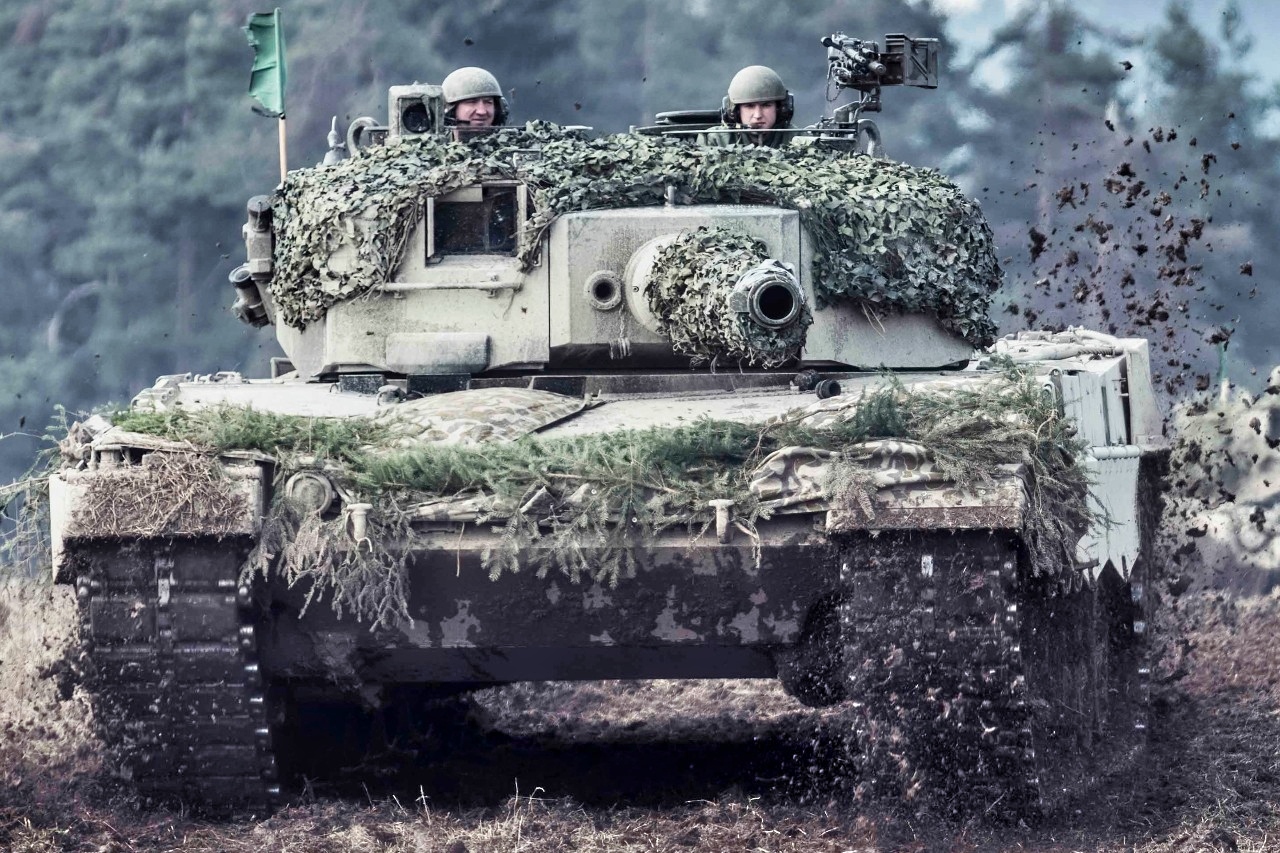
Leopard 2. Image Credit: Creative Commons.

A Canadian Army Leopard 2A4M tank fires a round while taking part in the Canadian Army Trophy tank competition at Ādaži in Latvia. The Canadian Army Trophy tank competition, held in May 2024, allowed participating nations to show off their gunnery skills while building camaraderie. Image Credit: Creative Commons.
-Prototype delivery is targeted for 2030, with initial operational capability slipping to 2040–45 amid budget, workshare and export-policy fights.
-Critics cite drones and precision fires; proponents argue tanks remain vital—if shielded by active defenses and integrated networks at scale.
Main Ground Combat System Explained: Franco-German Super-Tank—or a 20-Year Money Pit?
The Mobile Ground Combat System is Europe’s newest attempt to create a universal combat platform.
It is a joint German-French venture with several other European nations expressing interest in the project.
The new system promises to provide a new platform for various types of systems that can reportedly operate as part of a broader networked system with manned and unmanned systems.
However, the project is a long way from completion and is not expected to enter service until the 2040s.
With such a long development timeline, there are potential concerns about cost overruns and potential conflicts between parties.
What is the Mobile Ground Combat System?
The MGCS program was officially launched in 2017 by French President Emmanuel Macron and German Chancellor Angela Merkel after years of conceptual work.
It arose from a shared recognition that existing tanks, despite upgrades, were reaching the limits of adaptability.
The Leopard 2, introduced in the late 1970s, and the Leclerc, fielded in the early 1990s, cannot fully meet modern battlefield demands, such as network-centric warfare, multi-domain integration, and counter-drone capabilities.
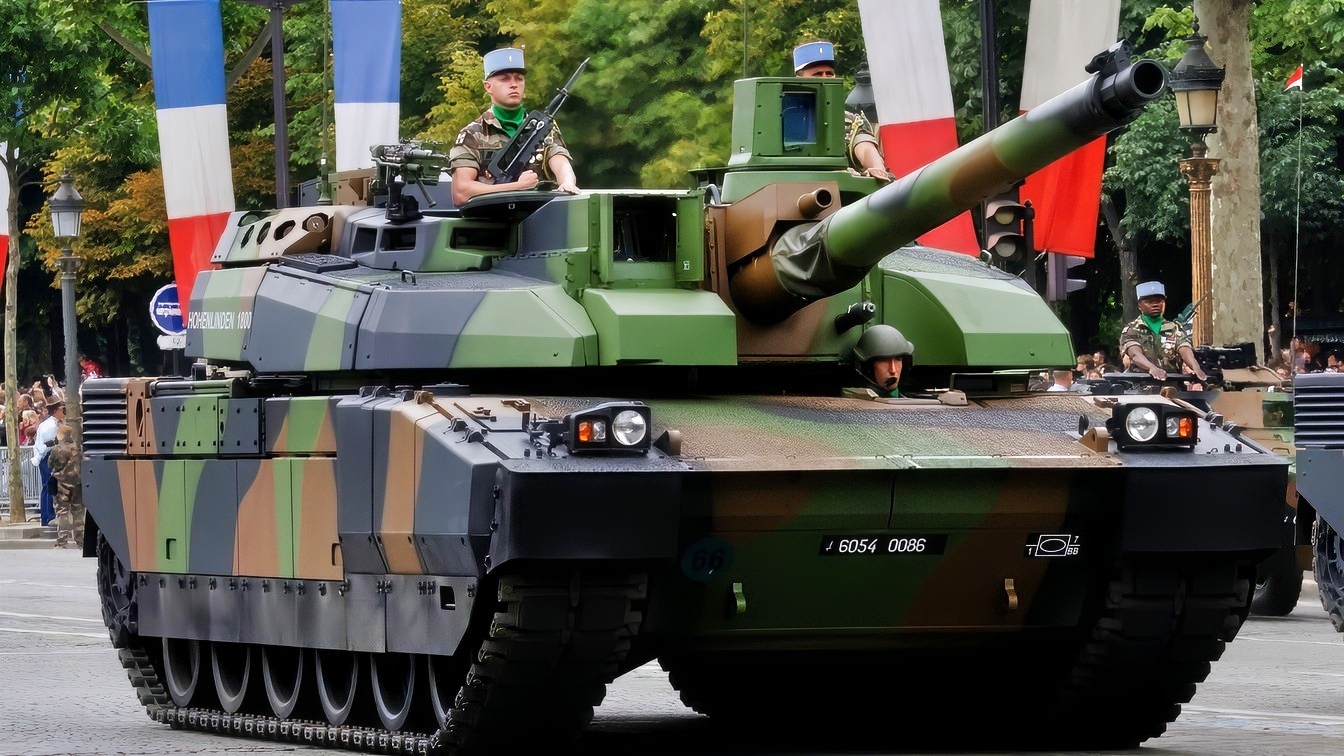
Leclerc Main Battle Tank in Parade. Image Credit: Creative Commons.

Leclerc Tank. Image Credit: Creative Commons.
MGCS aims to address these challenges by creating a platform that is future-proof, adaptable, and interoperable within NATO frameworks.
MGCS is envisioned as a new platform that serves as a basis for multiple vehicles. The core will be a heavily armed tracked platform equipped with a 130mm or 140mm gun (ASCALON concept), supported by unmanned ground vehicles for reconnaissance and fire support, tactical drones for ISR and strike missions, and networked command systems operating within a “combat cloud” for real-time data sharing.
This modular approach allows multiple specialized vehicles to share a standard chassis, reducing logistical complexity while enabling role-specific configurations such as artillery or anti-air variants.
Major Players and Development Timeline
The program is led by a consortium of major European defense firms: KNDS (a merger of Krauss-Maffei Wegmann and Nexter), Rheinmetall Landsysteme, and Thales Group. In April 2025, these companies established the MGCS Project Company GmbH, headquartered in Cologne, Germany.
This entity acts as the industrial prime contractor for the next development phase, consolidating the system’s architecture and technological pillars. Each partner holds a 25% stake, ensuring a balanced 50/50 workshare split between France and Germany.
Frequent delays and adjustments have plagued the development timeline. After the official launch in 2017, Germany was designated the lead nation in 2018, and Rheinmetall joined KNDS in 2019. By 2020, the System Architecture Definition Study (SADS) began, and in 2023, France and Germany agreed on a High-Level Common Operational Requirements Document (HLCORD).
In 2024, industrial workshare was finalized, and eight technological “pillars” were defined, including platform, firepower, connectivity, sensors, simulation, protection, and infrastructure. In 2025, the MGCS Project Company was established, and Phase 1A commenced.
This phase, running until 2029, focuses on detailed architecture studies, technology demonstrators, and integration of AI, active protection, and advanced communication systems.
Prototype delivery is targeted for 2030, with initial operational capability projected for 2040–2045, a decade later than initially planned due to political, industrial, and budgetary delays.
Where is the Project Now?
As of late 2025, MGCS is firmly in Phase 1A. Key developments include the signing of a shareholder agreement in January 2025, formalizing collaboration among KNDS, Rheinmetall, and Thales; the operational launch of the Project Company in April; and budget allocations, with France earmarking €98 million for 2025 and Germany expected to match that level.
The program is currently focused on eight technological pillars, including AI-driven decision-making, advanced sensors, and modular armament systems.
However, challenges persist, including industrial rivalries over armament systems, export policy conflicts between Germany and France, and the need to adapt to emerging threats such as kamikaze drones and cyber warfare.
Almost eight years after inception, the program remains far from completion, with serial production unlikely before 2045.
Cost overruns are a concern, with current estimates exceeding €1.5 billion for architecture studies and demonstrators, and full program costs are likely to be several times higher.
Critics question the utility of heavy tanks in an era dominated by drones and precision fires. However, proponents argue that tanks remain indispensable for high-intensity warfare, provided they evolve technologically.
Design Concept
MGCS aims to incorporate several cutting-edge technologies. These include the ASCALON gun, offering scalable performance and compatibility with future ammunition types; multi-layered active protection systems to defend against anti-tank guided missiles and loitering munitions; AI and autonomy for decision-support tools and unmanned operations; sensor fusion for advanced situational awareness; and hardened cybersecurity architecture to resist electronic warfare and hacking attempts.
The MGCS is primarily designed to serve as Europe’s next-generation ground platform. By pooling resources, France and Germany seek to reduce dependence on U.S. platforms, strengthen NATO interoperability, and position European industry at the forefront of armored warfare innovation.
The program also serves as a test case for Franco-German cooperation, following lessons from the Future Combat Air System (FCAS) project. Success here could pave the way for deeper integration in defense procurement across Europe.
About the Author: Isaac Seitz
Isaac Seitz, a Defense Columnist, graduated from Patrick Henry College’s Strategic Intelligence and National Security program. He has also studied Russian at Middlebury Language Schools and has worked as an intelligence Analyst in the private sector.
More Military
Russia’s Mach 2 Su-30SM Fighter Has A Message for Any Air Force on Earth
The Mach 2.2 B-1A Bomber Has A Message for the U.S. Air Force
The Mach 2.35 ‘Super’ Eurofighter Typhoon Fighter Has a Message for Any Air Force On Earth
Canada’s CF-18 Hornet Fighter Crisis
Forget NGAD or the J-20: A 7th Generation Fighter Could Hit Mach 5


Edward Baker
November 15, 2025 at 8:48 am
This will not go well, joint national projects are usually acrimonious especially if the French are involved.