

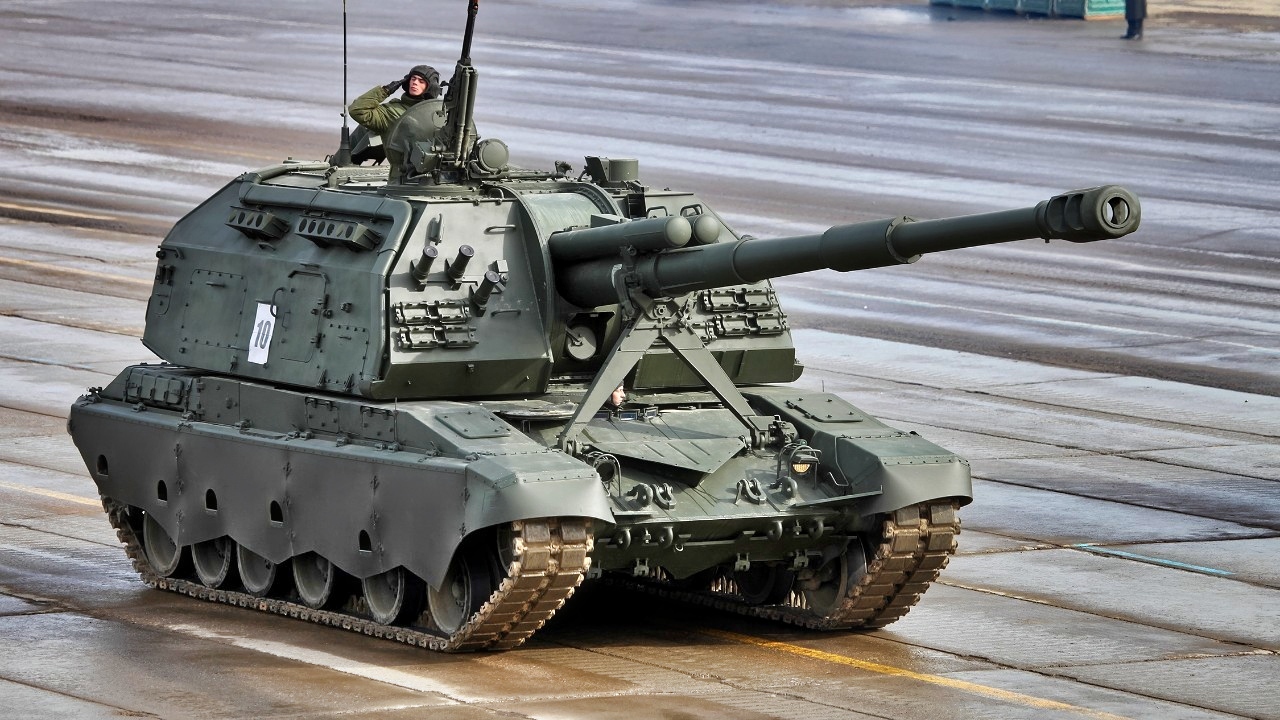
Key Points – Russia’s 2S19 Msta-S, a Soviet-era 152.4mm self-propelled howitzer built with T-80 tank components and a T-72 diesel engine, continues to play a significant role in the Ukraine war despite suffering heavy losses (Oryx confirms nearly 300).
-Ukrainian forces have even captured and effectively turned these “Frankenstein” systems against their former operators, praising their accuracy.
-While Russia has developed a more advanced successor, the Koalitsiya-SV, the current attritional nature of the conflict and limited production of the new system mean Moscow continues to rely on refurbishing and deploying stored Msta-S units, ensuring its battlefield presence for the foreseeable future.
Msta-S Explained
Russia’s 2S19 Msta-S, better known simply as Msta-S, is a self-propelled howitzer that made its combat debut during the latter phases of the Cold War in the late 1980s. The Msta-S, firing the Eastern Bloc-standard 152.4 mm artillery shell, replaced the Akatsiya, also a self-propelled howitzer, from the late 1960s.
Interestingly, the Akatsiya was a response to the American M109 howitzer and was built around the D-20 field artillery piece from the early days of the Cold War.
The Msta-S is the Frankenstein’s Monster of self-propelled artillery. Although it is built on top of components from the T-80 main battle tank, the Msta-S’s diesel engine is derived from the older T-72. Since its service debut, several variants have been introduced, incrementally incorporating newer technologies—including an export version chambered in the NATO-standard 155mm shell.
The War in Ukraine
Msta-Ss have played a role in the ongoing war in Ukraine, with Russia losing hundreds of platforms during the fighting. Oryx, an open-source website tracking Ukrainian and Russian losses in Ukraine, places the number of visually confirmed 2S19 Msta-S losses across all variants at an astounding 293. It is possible, perhaps even likely, that this figure is an understatement, as not all losses are visually documented. Despite the stiff losses the platform has experienced, its role in the war in Ukraine is unlikely to diminish anytime soon.
Captured and Pressed into Service
One Russian Msta-S, captured and pressed into service, was reported on recently by Ukrinform, a Ukrainian media. “In the Zaporizhzhia sector, soldiers from the 130th Battalion of the 241st Territorial Defense Brigade, subordinated to the 65th Brigade Combat Team, are fighting using enemy trophy military equipment,” Ukrinform wrote.
“In particular, this is a Soviet self-propelled artillery system 2S19 “Msta-S,” which the Russians had previously abandoned while fleeing the battlefield in the Kharkiv region.”
“The soldiers of the 130th battalion have successfully captured this powerful iron beast. By the way, the Msta-S is considered a “sniper rifle” among other self-propelled artillery systems and one of the best artillery systems developed by the Soviet Union due to its accuracy. Although it is far from similar models of NATO equipment,” the brigade noted in the report.
“Now the trophy self-propelled artillery under the control of the 130th Battalion’s well-trained crew is doing an excellent job of destroying enemy equipment and manpower in the 65th Brigade’s area of responsibility.”
Into the Future
Despite the Msta-S’ relatively seasoned service life, Russia has already prepared for a future in which the Msta-S is replaced by a more advanced, more capable replacement, and one that is a Russian rather than Soviet design: the Koalitsiya-SV.
That self-propelled gun made its debut during the 2015 Moscow Victory Day parade almost exactly 10 years ago. Along with other advanced platforms, such as the T-14 Armata, Western commentators initially noted that Russia’s new equipment was evidence of the country’s deep military modernization — proof that Russia deserved its “number two world military” moniker.
However, the ongoing war in Ukraine has shifted Russia’s defense industry, now laser-focused on persecuting the ground war in Ukraine, perhaps at the expense of the country’s air and naval forces. At first blush, that would appear to be a good opportunity for the Koalitsiya-SV, as the latest and greatest in Russian self-propelled artillery. However, the devastating losses and attritional warfare that have ground Russian forces down is not the kind of war in which advanced platforms with expensive and limited production runs would excel.
Rather than doubling down on cutting-edge self-propelled howitzer technology, it has been more affordable and expedient for Russia to instead pull older Msta-S, Akatsiya, and other self-propelled howitzers out of storage and press them into service in Ukraine.
What Happens Now?
While the newer Koalitsiya-SV has supplanted the Msta-S, the Msta-S’s high production numbers mean that it will likely enjoy precedence for some time yet. If Russia’s defense industry is in a position to build more Koalitsiya-SVs after peace of some kind is found in Ukraine, they may do so. However, until then, the simpler and cheaper Msta-S may enjoy a long run of production and refurbishment precedence.
About the Author: Caleb Larson
Caleb Larson is an American multiformat journalist based in Berlin, Germany. His work covers the intersection of conflict and society, focusing on American foreign policy and European security. He has reported from Germany, Russia, and the United States. Most recently, he covered the war in Ukraine, reporting extensively on the war’s shifting battle lines from Donbas and writing on the war’s civilian and humanitarian toll. Previously, he worked as a Defense Reporter for POLITICO Europe. You can follow his latest work on X.
Hypersonic Weapons In Depth
Russia’s Hypersonic Missiles Summed Up in 4 Words


Pingback: Russia's Military Is a Drone 'Superpower' - National Security Journal
Pingback: Do the Math: Russia Is Actually Losing the Ukraine War - National Security Journal