

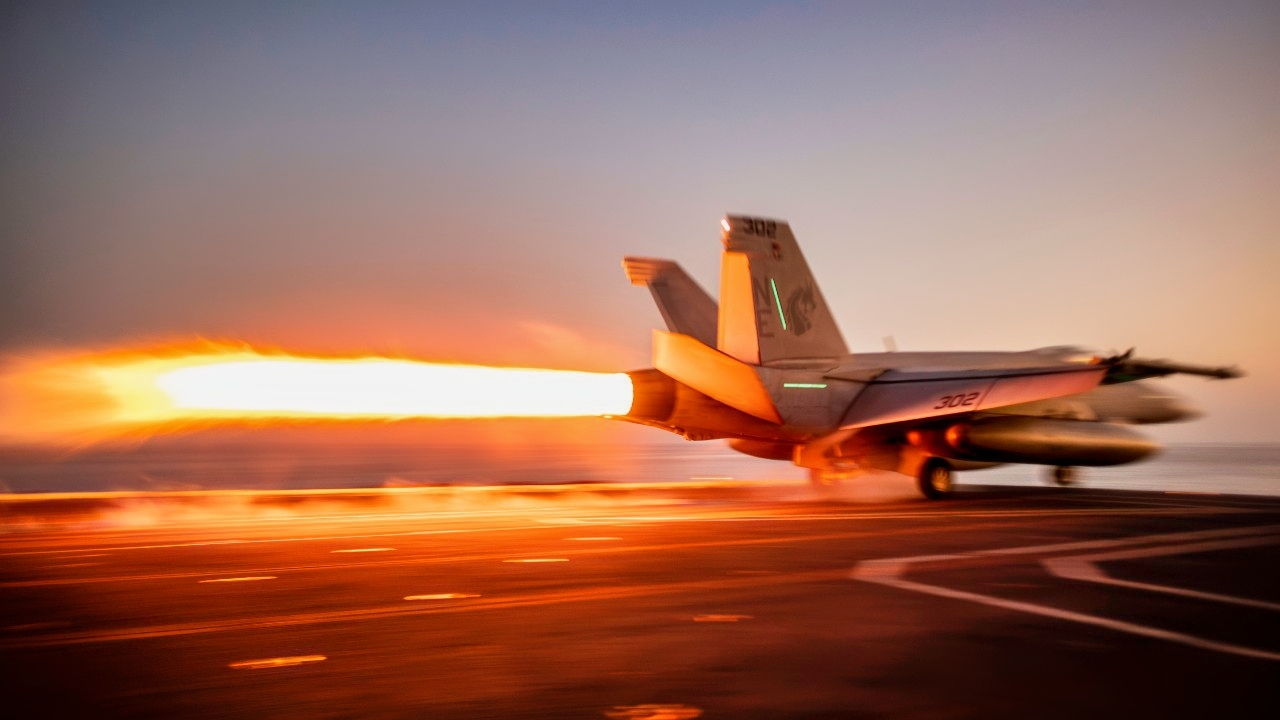
Key Points and Summary on F/A-XX Fighter Challenge – The U.S. Navy’s F/A-XX sixth-generation fighter program, envisioned as a crucial replacement for the aging F/A-18 Super Hornet, is now at risk of becoming a “fairy tale” due to significant delays and budget battles within the Pentagon.
-The program is caught in a perfect storm of competing priorities, technological uncertainty, and a budgetary process that favors short-term needs over long-term investment.

F/A-XX U.S. Navy Fighter. Image Credit: Creative Commons.
-As the U.S. prioritizes the Air Force’s F-47 NGAD, the F/A-XX has been put on the back burner, a move that risks ceding future naval air dominance to peer adversaries like China.
F/A-XX: The Future Of Naval Aviation Or A Fairy Tale?
Now, we stand on the precipice of a new era in military air power, and the F/A-XX program looms above us.
This next-generation fighter was to be a linchpin of naval air power in a world of changing geopolitical realities and a wholesale replacement for the aging F/A-18 Super Hornet.
But as we pursue more recent dispatches or budget drubbings, the F/A-XX is not only late but also quite likely to be obsolete before even becoming airborne in earnest.
And in fact, the program has been placed on hold.
How the F/A-XX Was Born
The F/A-XX was born out of a time of enormous uncertainty and change when the threat of advanced adversaries such as Russia and China necessitated a bold leap in capability.
The concept was sound: a multi-role stealth fighter based on advanced sensor fusion, networked warfare organization, and possibly even unmanned systems control.
However, over the years, the program encountered numerous obstacles, including budget constraints and a clash of priorities that hindered its progress.
But understanding what lies behind them requires us to calibrate our conceptualization of the F/A-XX finely.

F/A-XX U.S. Navy Fighter. Image Credit: Creative Commons.
For decades, carrier strike groups have been the U.S. Navy’s workhorse for projecting American power. Nonetheless, as the number of adversaries developing increasingly sophisticated integrated air defense systems (IADS) in the form of anti-access/area denial (A2/AD) systems increases, the need to bring to the fore a penetrator with next-generation capabilities has never been more paramount.
This was to be the F/A-XX, a program widely seen as emblematic of a broader shift in military acquisition: The American military has an institutional disdain for high-risk, long-term programs that may or may not lead to a warfighting system.
The truth is, the F/A-XX has not just been becalmed and slowed – it’s spent the past few years caught at the epicenter of a perfect storm of competing priorities and technological fog.
Budgets and Tech Challenges
The Navy is a budgetary contrarian, with new money being an increasingly logical solution to where it would be allocated each year, away from readiness, older airframes, and upgrading ship companies, among other priorities.
The result is that defense is viewed in terms of bumps and spurts, with long-term investments — such as the F/A-XX — being pushed aside for more pressing concerns.
And then there’s the problem that technology is moving so fast itself.
The rise of new technologies, such as unmanned systems and artificial intelligence, has led some, including within the Pentagon, to wonder if a manned fighter like the F/A-XX is even necessary.
As drones and other unmanned systems become increasingly capable, it is also possible to argue that buying a traditional fighter may be a waste of money.
This march to war will raise very valid questions about the necessity of a future pilot fighter and whether the F/A-XX is a dinosaur years before it was even conceived on paper.
The implications of those F/A-XX cancellations — or at least heavy postponements in their timelines — are substantial and go well into the middle of the century.
The U.S. has long commanded military aviation technology, particularly carrier-borne fighters. As a national priority, we must maintain this edge, or it will inevitably be surrendered to a potential adversary.
The China Fighter Challenge
China’s military is, for instance, racing to modernize and construct aircraft so sophisticated that the U.S. will no longer maintain its past dominance in the skies, and on the water, in the Pacific.
If the F/A-XX program fails, we may find ourselves strategically outgunned in a theater that is growing increasingly strategically important to our national security.
And lost in its implications is the impact such F/A-XX delays will have on our allies.
The truth is that, for better or worse, the U.S. has long provided the world with the leading edge in military aviation, and our alliances are based in part upon our ability to remain ahead (in terms of technology and capabilities).
Military Matters
Russia’s Su-57 Felon Stealth Fighter Is a Waste of Rubles
America’s YF-23 Black Widow II Might Be Better Than F-22
The Challenger 3 Tanks Could Be a Game Changer
If the F/A-XX program is allowed to wither, it may send the message to our allies that the U.S. is ceding its role as a world security guarantor.
That could start a chain reaction in which allied governments, driven by necessity, develop separate military capabilities as well, thereby eroding the collective security framework that has maintained peace in Europe since the end of World War II.
As we look toward the future, it is that much more critical that we remain steadfast in our support for the F/A-XX program and resource it appropriately. It’s not just a question of building a new fighter jet; it’s about keeping our technological edge over ascendant rivals.
The F/A-XX is a significant investment in our nation’s defense and our top cover for the future, and it is essential for the future of the Navy and Marine Corps’ aviation from 2030 and beyond.
F/A-XX: Can It Fly Into the Future?
Bottom line: We must have a bold vision of the future through the F/A-XX and not be afraid to realize that vision. The future of naval aviation — and, in fact, the future of American military power — depends on it.
If we let the F/A-XX slip away, we won’t be playing catch-up — we’ll be left behind in a world where the skies over it are not ours and the seas no longer ours to command.
The time to act is now.
About the Author: Dr. Andrew Latham
Andrew Latham is a non-resident fellow at Defense Priorities and a professor of international relations and political theory at Macalester College in Saint Paul, MN. You can follow him on X: @aakatham.
Iran War
B-2 Bomber: How America Would Strike Iran


bobb
July 6, 2025 at 8:51 am
For the US, which after ww2 has been pummeling and hammering other nations with its airpower (it dropped between 7 to 8 million tons of bombs in S E Asia during nam war), F/A-XX is a no-brainer.
But What about other nations.
Other nations with no history or zero history at sowing terror from the sky prefer the traditional method of defense.
The use of rockets and missiles and drones and artillery.
Thus the need to establish and set up a countrywide cottage industry for making and fabricating rockets and rocket parts and assemblies.
That kind of rural-based infrastructure is far far more important than multi-billion dollar LM-type projects.
(Note the brit f-35 stuck in kerala for over 22 days now. All the best royal Navy technicians are unable to repair the jet.)
hngm
July 6, 2025 at 10:25 am
F/A-XX ain’t gonna see the lite of day. It’s gonna be a stillborn project.
The reason being USN aircraft carriers need to be hugely revamped to accommodate the F/A-XX. Aircraft too large.
Aircraft carriers today are largely obsolete. A rain of missiles very likely to send them to Davy jones’ locker !
Recall the battle of bluff cove. The brit landing ships were hit and smashed up.
Now is the era to sue for peace and cherish the march of technological progress and innovation.
But western nations prefer to worship and walk the road of war. To where.
To perdition.
JingleBells
July 7, 2025 at 12:09 am
US defense projects, many of them, will eventually fall of the cliff including the US Navy’s f/a-xx.
The reason is Donald trump’s unpredictable leadership style which has led to his moving many of his publicly declared goalposts frequently like the very recent announcements on tariffs.
Then also the so-called critical gaza ceasefire. How many of his grand gaza ceasefire announcements have the world already gone through now.
It’s like shifting a mobile goalpost. Move a bit to the right, a bit to the left, a bit more to the rear and a bit sideways. Then a bit south.
When that trumpian rule gets applied to combat aircraft, they’ll begin crashing after becoming airborne. Like the osprey. Or the f7u cutlass.
Barondog
July 8, 2025 at 5:35 am
The Navy has too many critical priorities right now that cannot be put on the back burner. The F/A-XX is among them. The Super Hornet was a good jet for fighting lower tech adversaries. But it is old, has short range, is too slow to act as an interceptor, and is not equal to the jets China puts on their carriers. The Navy needs to find a way to get its prices and priorities in order. That includes coming up with a next gen fighter that they can afford to build. Perhaps they should look into developing different versions of the F-47 (similar to the F-35 variants) that is optimized for Carrier use and Navy requirements.