

Key Points and Summary – The war in Ukraine is a contest of endurance, a race between two “hourglasses”: Ukraine’s military resolve versus Russia’s ability to sustain the invasion.
-While Vladimir Putin believes he can outlast Kyiv, Russia’s own military hourglass is emptying at a catastrophic rate.

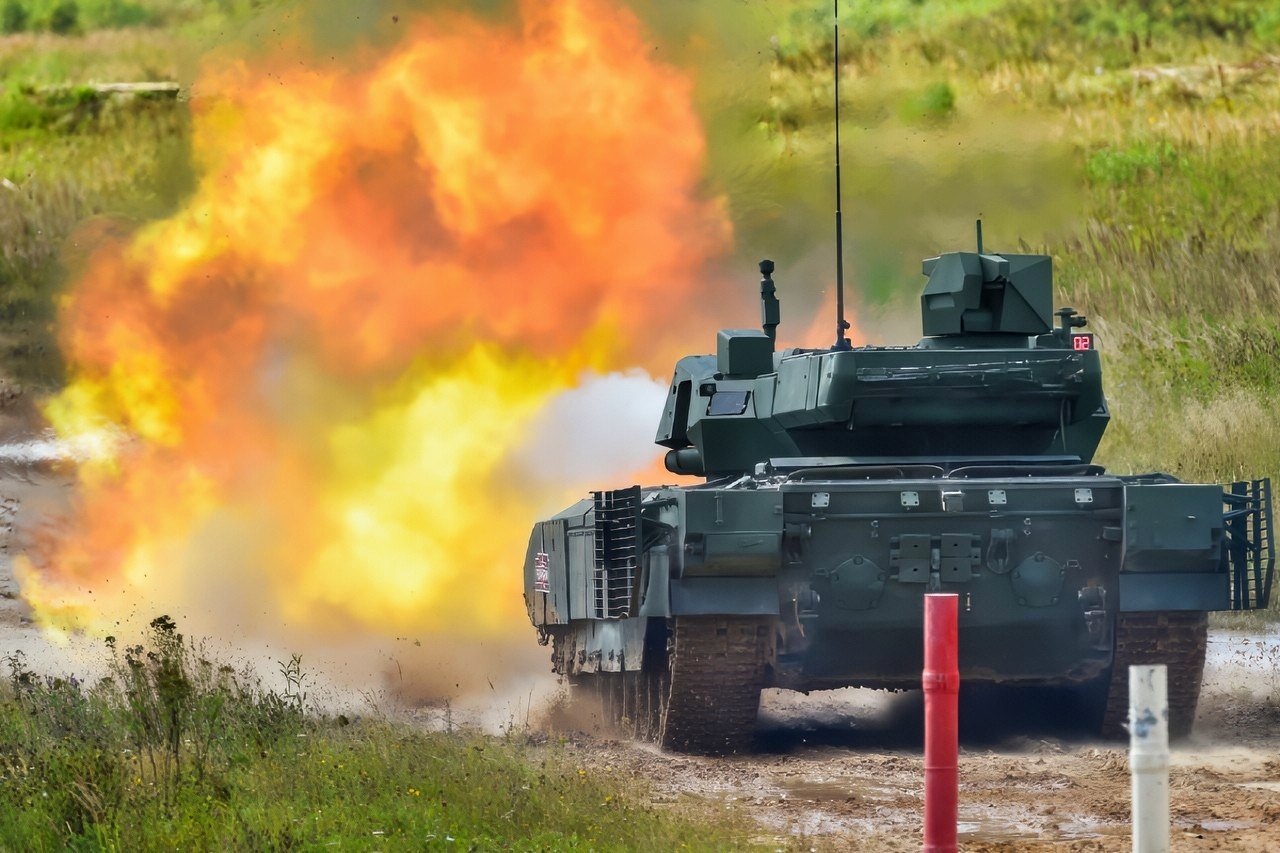
Russian T-90M Tank. Image Credit: Creative Commons.
-Having lost thousands of modern tanks, Russia is now relying on obsolete Soviet-era models and even WWII-era T-34s pulled from museums.
-With battlefield attrition far outpacing its limited industrial production, projections suggest Russia could run out of military vehicles by 2026, posing the question of what will collapse first: its army or its economy.
Tank Shortage Coming Soon: What Does the Russian Army Have Left to Fight With?
WARSAW, POLAND – An article in this past weekend’s Wall Street Journal has assessed the Ukraine war as having “become a contest between two hourglasses: one measuring how long Ukraine’s thinly stretched army can keep up the fight, and the other how long Russia’s economy can sustain the invasion without hurting the stability of [Russian President] Vladimir Putin’s regime.”
The reason United States President Donald Trump is unable to force Putin to the negotiating table is that the latter believes the Ukrainian hourglass will run out first. When it does, the former KGB Lt. Col. presumes he would be able to force his unchanging and long-standing maximalist demands onto Ukraine.
This situation would amount to Ukrainian President Volodymyr Zelenskiy being forced to cede vast tracts of territory to Moscow. Putin and his coterie of former KGB officer cronies would then impose victor’s terms on Ukraine, said a former US intelligence official. “Then the dial will be turned up to the max on the Kremlin’s propaganda machine and enshrine Putin in the pantheon of ‘great victorious Russian leaders’—like Stalin after World War II or Peter the Great,” he said.
But the proverbial fly in the ointment with this scenario is that the rate at which the Russian military has been losing equipment on the battlefield far outstrips the ability of Moscow’s defense production enterprises to replace them. Putin’s hourglass may not have as much sand left in it as he imagines.
There is Not Much Left
Ukraine’s military decimating the level of Russia’s armored forces is a story that has been around for some time now, but slowly and surely, that trend has been accelerating.
By the fall of 2024, Russia had lost over 9,000 tanks and infantry vehicles during the invasion of Ukraine that had begun more than two years before.
By the beginning of 2025—less than 5 months later—those losses had increased to more than 11,000. This count included some 3,000 of the T-80 model, which was one of the less successful designs of the Soviet Union’s tank industry. That tank had also been built in two variants. Initial attempts to build some of the models with a gas turbine engine—mirroring the propulsion concept used for the US M-1 Abrams tank—did not pan out. As a consequence, these models have been attritted at higher-than-average rates.
Many of the other tanks destroyed in the conflict are also from the Soviet era. These include T-64 and T-72 models that were originally designed 50-60 years ago. There are varying estimates of how many vehicles remain in inventory, but some put the current force level at about 2,000 tanks, 2,000 infantry fighting vehicles, and 3,000 armored personnel carriers.
If accurate, this would mean that only 41 percent and 52 percent of Moscow’s pre-war reserves are still intact. Many of these are not up to working, battlefield condition and would require complete remanufacturing.
Many of the newer T-90 models and most of the T-80s have been lost in battle, leaving Russia’s tank reserves composed almost entirely of obsolete models, of which the T-62 is the most modern of the lot. The situation is so dire that World War II-era T-34 tanks have been pulled from depots and museums and sent into battle in Ukraine.
This situation begs the question of what could collapse first in Russia—economic stability or the ability of its military to mount a major operation.
Running Out By Next Year
Given these numbers and rates of losses, projections are that Russia will be out of military vehicles by late 2025 or early 2026. The older model tanks are being lost at higher-than-normal rates, a situation being blamed on the Russian military’s inadequate repair and maintenance capabilities.
Counting on new-build models to fill the gap is also not feasible. Russia’s armored vehicle industry produces only 250 T-90M tanks and 460 of the latest BMP-3 infantry fighting vehicles annually.
“The capabilities of Russian industry to produce modern tanks are extremely limited, with 100-200 tanks per year,” retired military officer and defense analyst Viktor Kevliuk said to the Kyiv Independent in May 2025. “The bulk of the tanks supplied to the front are restored machines from the 1960s, 1970s and 1980s,” he added.
In the meantime, on the home front, Putin has been trying to minimize the impact that the combination of skyrocketing defense spending and falling revenues from exports of oil and gas—the traditional cash engine for Russia’s economy—has on the everyday lives of ordinary Russians. But Ukraine’s escalating campaign of drone attacks against Russian oil refineries and pipelines continues to degrade these export revenues and disrupt domestic supplies of petrol. This had already caused the Russian state to institute fuel rationing in some regions.
“It is getting harder to maintain the appearance of normalcy,” said Maria Snegovaya, a Russia analyst at the Center for Strategic and International Studies in Washington who spoke to the WSJ. “Russians become unhappy if the war interferes with their lives.”
What Happens Next in the Ukraine War?
The war continues to be a test of wills. Putin’s assumption that Russia can continue its runaway defense spending without economic collapse may not be a safe bet. Against a Ukrainian military that shows no signs of ever being willing to give up, the former KGB Lt. Col. will have to hope that his people possess a higher tolerance for suffering that can be endured indefinitely.
About the Author: Reuben F. Johnson
Reuben F. Johnson has thirty-six years of experience analyzing and reporting on foreign weapons systems, defense technologies, and international arms export policy. Johnson is the Director of Research at the Casimir Pulaski Foundation. He is also a survivor of the Russian invasion of Ukraine in February 2022. He worked for years in the American defense industry as a foreign technology analyst and later as a consultant for the US Department of Defense, the Departments of the Navy and Air Force, and the governments of the United Kingdom and Australia. In 2022-2023, he won two awards in a row for his defense reporting. He holds a bachelor’s degree from DePauw University and a master’s degree from Miami University in Ohio, specializing in Soviet and Russian studies. He lives in Warsaw.
More Military
Seawolf-Class: The Best Submarine Ever?
The Royal Navy Has a Destroyer Stuck in Port for 3,000 Days
America Is the King of Stealth Fighters
China’s J-20 Mighty Dragon Stealth Fighter Has Just 1 Mission


Swamplaw Yankee
September 9, 2025 at 3:20 am
Every hardware item in the Putin military can be manufactured inside the PRC CCP Xi regime.
The Xi Regime can easily send 5,00 to 10,000 tanks over the border to tsarling Putin.
As in the EU and NATO it is much more realistic to assign manufacturing to PRC CCP that to risk erecting a new structure inside rump russkie.
The NATO contributor can send cash so easily to a Ukrainian factory. Production starts quickly and Ukraine can determine BEST when to modify the speed of an assembly line. Ukraine is quick but still resources may be lacking or tight.
Again, a stat with some interest, but not one with high impact on a NATO nation.
The PRC CCP can spend huge cash on whatever it decides. Doubling or tripling a production speed is a political CCP decision of strategy.
The analogy: the USA can hardly start production before a war is decided or even completed. Examples flood the MSM. Ukraine can win or be defeated and the USA is mired in internal delays. -30-
Prague 1968
September 9, 2025 at 8:45 am
The modern battlefield is becoming less dependent on armor, and is leaning toward troop mobility, drone warfare, and precision guided missile strikes. Ultimately, the key factors will be public support, and the number of new recruits that are willing to die for the cause. Nobody wants to go on a suicide mission. You can’t have a war without soldiers and supplies. Estimates are close to 70,000 Ukraine army deserters in the Czech Republic alone. Do the math. Tanks are becoming useless.
Jim
September 9, 2025 at 10:38 am
Well, where have we heard this refrain before?
I mean seriously, this continuous cant, “they’re running out of [fill in the blank] real soon…”
… never actually happens.
By 2026?
I’ve been wrong too many times to count on predictions of when the war will be over, waiting for the Great Pumpkin to rise over the pumpkin patch… (a general collapse of Kiev’s forces at the front). Linus was dragged home by Lucy long ago… and I’m still waiting for the giant, orange orb to fly over the patch… dawn is starting to break… and it’s cold.
But attrition… that’s the word, is hitting Kiev’s forces much harder than Russia.
The sands of the hourglass are draining away… and time is running out.