


Summary and Key Points: For decades, American warplanes ruled the skies against enemies who could barely shoot back. That era is ending — and the war in Iran has laid bare how exposed older, non-stealthy fighters are to modern air defenses. Now the U.S. Navy has tested its answer, and it’s a clever one. Engineers took the ordinary JDAM — a cheap, dumb bomb strapped with a guidance kit — bolted on foldable wings and a small jet engine, and turned it into a weapon that flies hundreds of miles, roughly twenty times farther than before. The payoff is simple but profound: pilots can strike from far outside the reach of enemy missiles, never flying into danger.
The JDAM Upgrade

B-52 Stratofortress, 40th Expeditionary Bomb Squadron, loaded with 12 Joint Direct Attack Munitions (JDAM) heads toward Iraq with it’s new mission directive. The bomber’s mission is to provide close air support for coalition troops stabilizing the country of Iraq, April 15, 2003. Operation Iraqi Freedom is the multi-national coalition effort to liberate the Iraqi people, eliminate Iraqi’s weapons of mass destruction and end the regime of Saddam Hussein. (U.S. Air Force photo by Tech. Sgt. Richard Freeland) (Released)
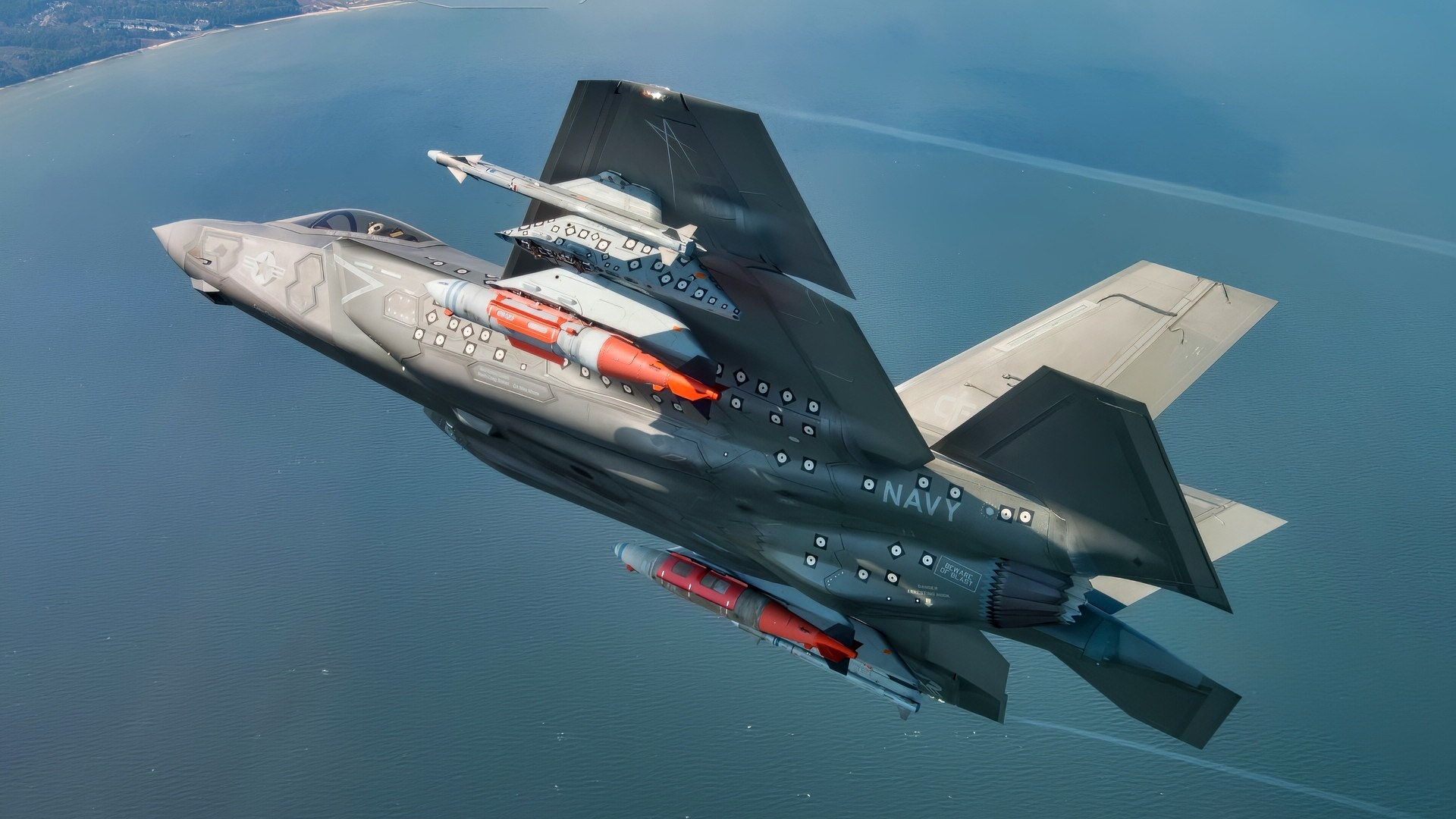
The final SDD Test flight CF-2 Flt 596 was piloted by BAE Test pilot Peter Wilson, April 11, 2018, from the F-35 Pax River Integrated Test Force. The F-35C completed a mission to collect loads data while carrying external 2,000-pound GBU-31 Joint Direct Attack Munitions (JDAM) and AIM-9X Sidewinder heat-seeking missiles. (Photo courtesy of Lockheed Martin)
The U.S. Navy recently tested a new long-range bomb that can be dropped from an F/A-18 Super Hornet and fly over 300 nautical miles to its target—a 20-fold range extension from the standard JDAM. Called the GBU-75 JDAM-LR, the weapon is the answer to a critical problem: how do non-stealth Super Hornets stay relevant against China’s increasingly sophisticated air defenses?
The F/A-18 Super Hornet Is Getting A Big Weapons Upgrade
The United States Navy is keen on extending the strike range of its carrier-based fighter jets by making long-range, stand-off munitions available to them. And earlier this month, the Navy made good on that wish, successfully testing a new standoff strike weapon.
That munition, called the GBU-75 Joint Direct Attack Munition Long Range, or JDAM-LR, was fired from a U.S. Navy F/A-18 Super Hornet over the Navy’s Point Mugu Sea Range in California.
Like other munitions in the JDAM family, the JDAM-LR is essentially a dumb, free-falling bomb equipped with a precision guidance kit. Early JDAM munitions have typically been outfitted with a tail kit and GPS guidance kit to bring them to target.
Depending on the variant and environmental and launch conditions, earlier JDAMS have a range of approximately 15 miles.
This newer missile’s range is significantly greater, at over 300 nautical miles.

An F/A-18 Super Hornet from Naval Air Station Oceana, Virginia, performs an aerial demonstration over Rickenbacker International Airport, Ohio, June 16, 2024, as part of the Columbus Air Show. This year’s event featured more than 20 military and civilian planes, including a KC-135 Stratotanker from the 121st Air Refueling Wing, which served as the base of operations for military aircraft participating in the show. (U.S. Air National Guard photo by Senior Airman Ivy Thomas)

An F/A-18C Hornet, assigned to the “Stingers” of Strike Fighter Squadron 113, transits over the haze of southern Afghanistan. VFA 113, part of Carrier Air Wing 14 aboard the aircraft carrier USS Ronald Reagan is supporting Operation Enduring Freedom. The mission of CVW 14 is to protect the people of Afghanistan and to support coalition forces. Ronald Reagan is currently deployed to the U.S. 5th Fleet area of operations. Operations in the U.S. 5th Fleet area of operations are focused on reassuring regional partners of the United States’ commitment to security, which promotes stability and global prosperity.
Pushing Boundaries
“As Naval Air Forces in theater continue to rely heavily on JDAM systems, the program recognizes a critical need to provide the fleet with greater standoff range,” said Captain Sarah Abbott, Precision Strike Weapons program manager, weeks back. “This new capability allows pilots to engage targets from significantly safer distances, maintaining a tactical advantage in contested environments.”
The JDAM-LR’s range is achieved through the mating of several different components to the JDAM munition, Boeing explained in a press release, including foldable wings, built by Ferra Engineering, an Australian firm, as well as a TDI-J85 turbine engine made by Kratos Defense & Security Solutions Inc.
Importantly, the JDAM-LR is compatible with aircraft that are already qualified with previous JDAM munitions.
Testing, 1, 2, 3
Boeing explained that the first JDAM-LR flight test, on the first of April, “demonstrated safe separation, engine start, cruise, and guidance through terminal flight and impact in water after a 34-minute flight. The weapon sustained powered flight for nearly 200 nautical miles and landed within meters of its planned target.”
During the second test, just two days later, “teams flew a second planned flight profile, successfully incorporating altitude changes and weapon maneuvering during an otherwise similar flight.” In the future, “data and lessons” gleaned from the recent flight will be used to “finalize JDAM LR software and hardware for future testing.”
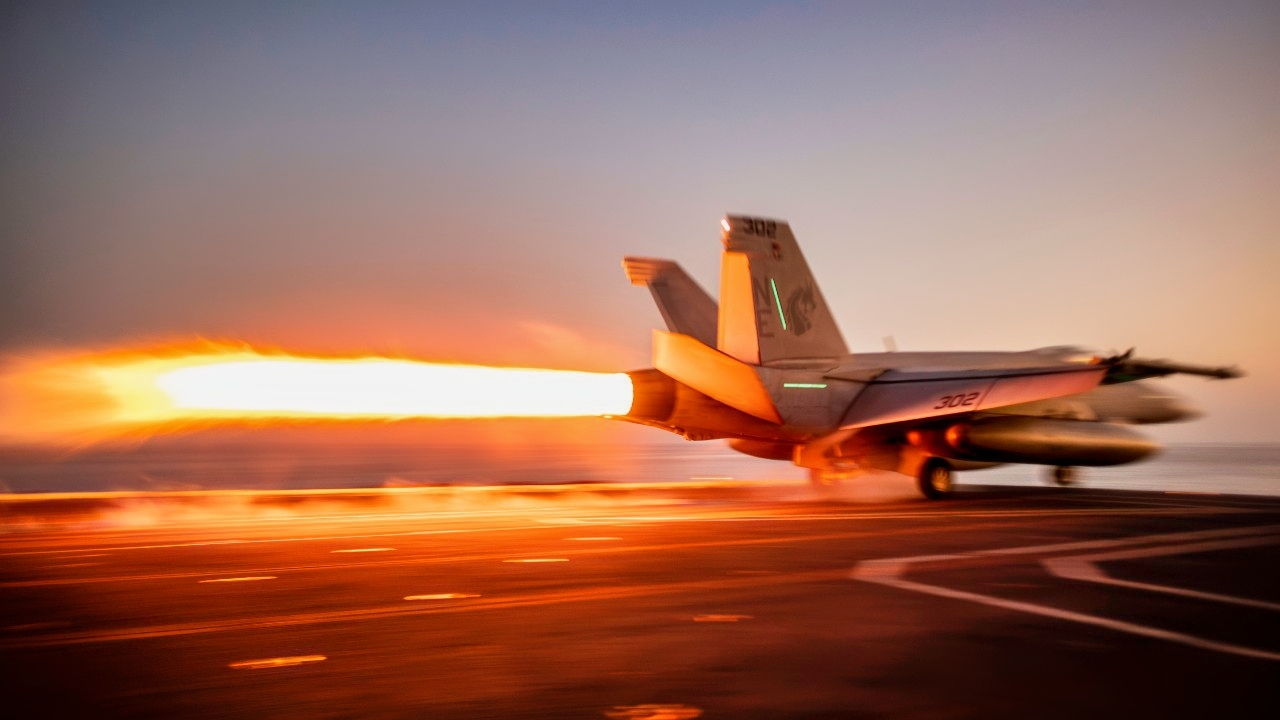
250429-N-FS097-1154 U.S. CENTRAL COMMAND AREA OF RESPONSIBILITY (April 28, 2025) An F/A-18E Super Hornet, attached to Strike Fighter Squadron (VFA) 192, launches from the flight deck of the Nimitz-class aircraft carrier USS Carl Vinson (CVN 70) in the U.S. Central Command area of responsibility. (Official U.S. Navy photo)

A Sailor directs an F/A-18E Super Hornet from the “Kestrels” of Strike Fighter Squadron (VFA) 137 on the flight deck of the aircraft carrier USS Nimitz (CVN 68) in the South China Sea, May 12, 2025. Nimitz is underway in the U.S. 7th Fleet area of operations on a scheduled deployment, demonstrating the U.S. Navy’s unwavering commitment to a free and open Indo-Pacific. (U.S. Navy Photo by Mass Communication Specialist Seaman Apprentice Franklyn M. Guage)
Naval Air Systems Command, or NAVAIR, released a video of the testing event to X, formerly Twitter, in which the JDAM-LR is released from a Navy F/A-18 Super Hornet and flies to the target.
Ranges Extended
In virtually all conflicts involving the United States following the end of the Cold War, American combat aviation has fought enemies with little to no robust air defenses and, consequently, has enjoyed near air supremacy.
But as the United States rearms and retools for a large-scale conflict against a peer adversary with robust air defenses, combat aircraft will not enjoy the same degree of freedom as during the last three and a half decades.
Although no stealth aircraft have been lost during the course of the ongoing war in Iran, the fighting has exposed how vulnerable fourth-generation, non-stealthy aircraft can be.
For aircraft like the Navy’s Super Hornet to remain relevant against, say, China, that platform will have to leverage long-range, standoff munitions like the JDAM-ER.
The Challenge of the Indo-Pacific
Naval mines are currently topical, given the hostilities against Iran and in the Strait of Hormuz.
And while Iran’s ability to effectively choke off traffic through the Strait with mines has been laid bare, the long-range deployment of naval mines by the United States is an angle that American combat aircraft could pursue in the future.
The distances across the Indo-Pacific are immense, but one strategy for tackling those distances in the future may be to leverage America’s B-52 Stratofortress bombers.
Though strategic bombers have both the range and payload capacity to threaten wide swaths of the Indo-Pacific, and previous JDAM-LR testing revealed that the munition can be used to deploy anti-ship naval mines.
During that evaluation, 20 JDAM-LRs were deployed with a single B-52 Stratofortress, highlighting both the speed and scale at which the relatively inexpensive — and now long-range — munitions can be deployed.
Outside the range of enemy air defenses, the JDAM-LR and related munitions promise to keep warplanes out of harm’s way while also remaining combat-relevant.
From the Archive: The YF-23 Is the Stealth Fighter the Air Force Almost Built
About the Author: Caleb Larson
Caleb Larson is an American multiformat journalist based in Berlin, Germany. His work covers the intersection of conflict and society, focusing on American foreign policy and European security. He has reported from Germany, Russia, and the United States. Most recently, he covered the war in Ukraine, reporting extensively on the war’s shifting battle lines from Donbas and writing on the war’s civilian and humanitarian toll. Previously, he worked as a Defense Reporter for POLITICO Europe. You can follow his latest work on X.


Doyle
June 6, 2026 at 4:53 pm
Send these JDAM-LRs to Ukraine for testing. Putin needs some love.
Zazu
June 8, 2026 at 10:01 am
Unfortunately if we supply the Ukraine with them, Z will give some to China so that Xi’s teams can reverse engineer them and use them on us.