

Key Points and Summary – Russia built the T-14 Armata to fix old Soviet flaws with a crew capsule, unmanned turret, active protection, and a digital backbone.
-But integrating a new powertrain, high-end optics, and APS in a thin industrial base proved slow and costly.
-Sanctions and wartime pressures pushed Moscow to favor upgraded legacy tanks it could field in hundreds, while the T-14 remained a low-rate, high-unit-cost outlier. \Training, doctrine, and sustainment systems never scaled with it.
-The concept wasn’t wrong; the context was. Barring a dramatic turnaround, Armata’s legacy will be its ideas—adopted piecemeal elsewhere—rather than a mass-produced fleet.
T-14 Armata: Russia’s “Next-Gen” Tank That Never Became The Present
Moscow didn’t sketch the T-14 Armata in a vacuum. Post–Cold War combat footage and two decades of export feedback laid bare the limitations of legacy Soviet designs: crew survivability problems from ammunition stored in the crew compartment, limited growth space for modern sensors and active defenses, and a design philosophy optimized for mass over modularity.
Meanwhile, Western tanks doubled down on crew protection, networking, and precision gunnery.
By the early 2010s, Russia wanted a clean-sheet answer that promised survivability through separation (crew vs. ammo), digital command-and-control, and futureproofing for sensors and active protection.
The answer was the T-14: a radical break from the T-72/T-90 lineage.
The Radical Promise: Capsule Crew, Unmanned Turret, Active Protection
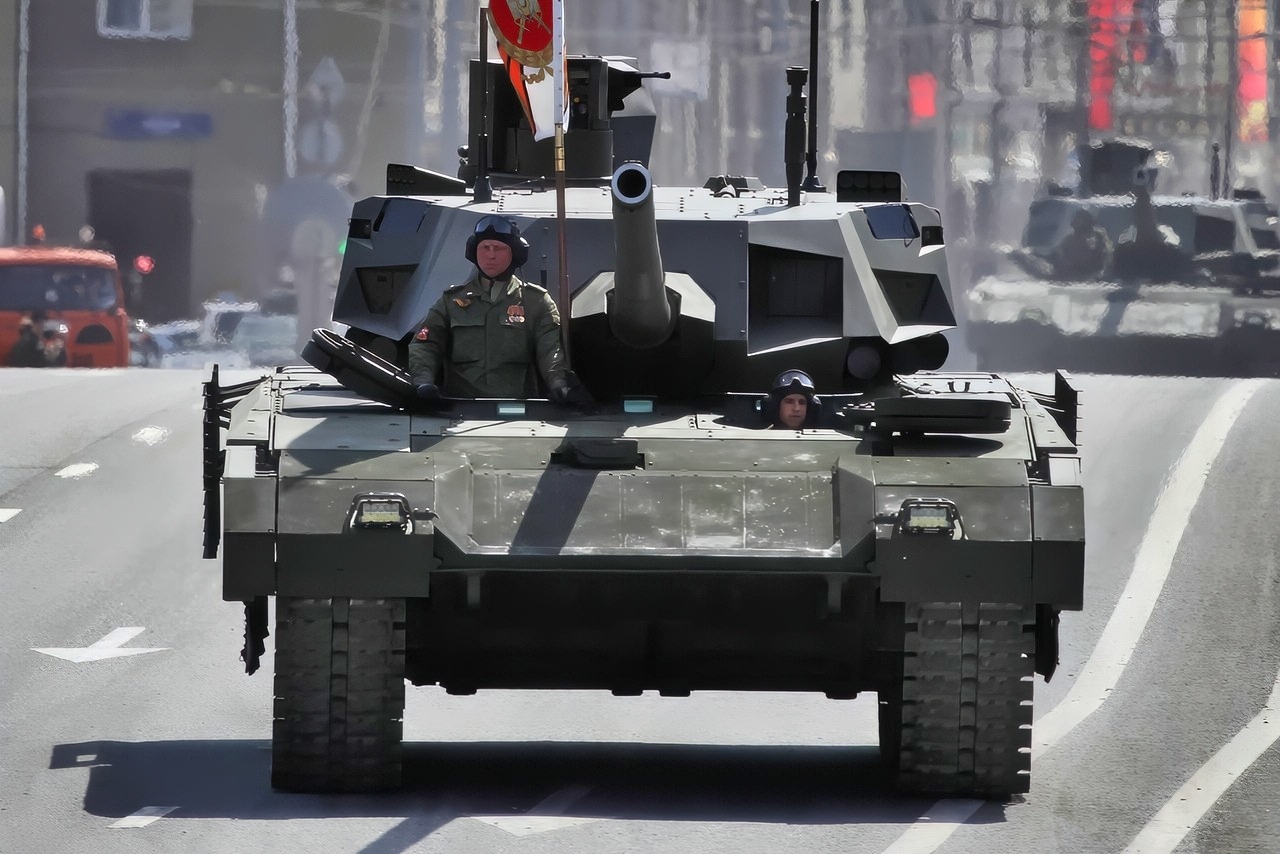
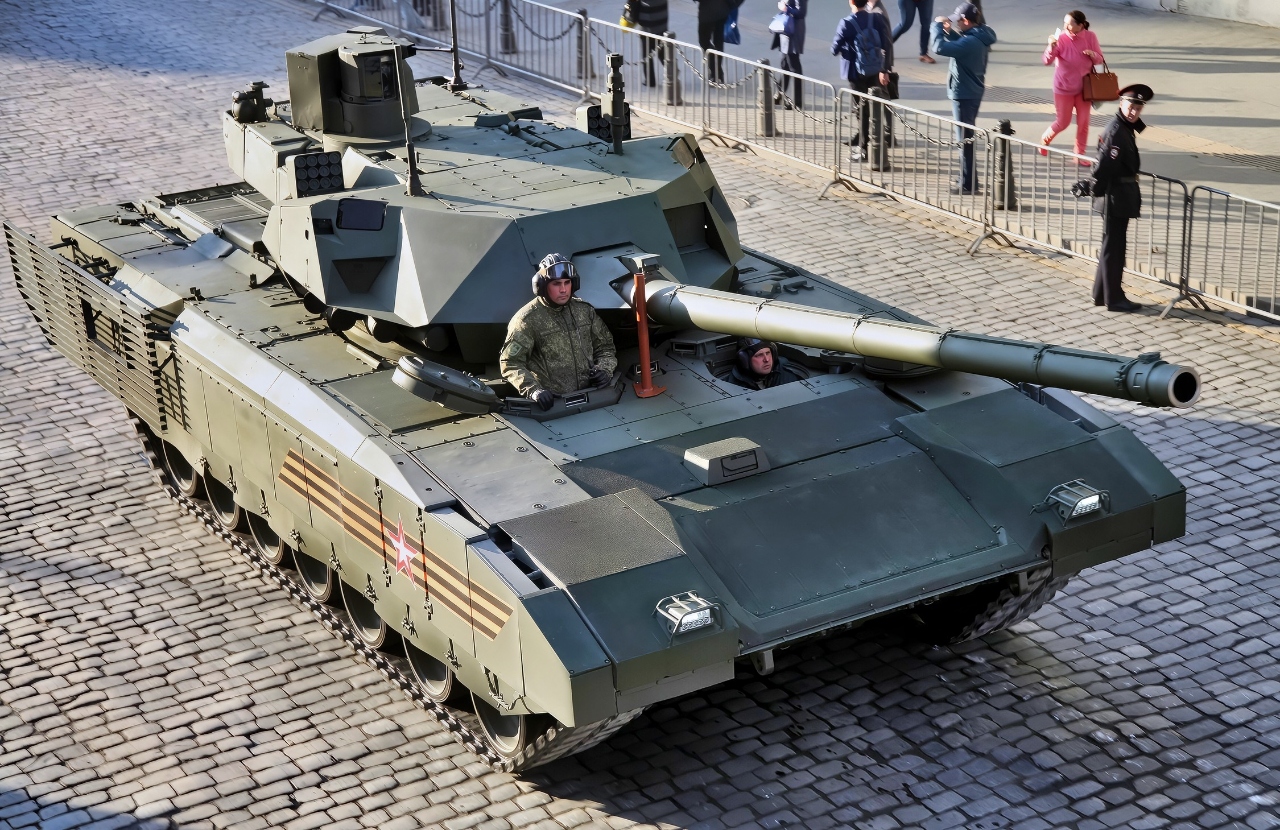
On paper, the T-14 is a compelling concept. The crew sits in a heavily armored capsule inside the hull, physically isolated from the autoloaded ammunition and the turret above. The turret itself is unmanned, reducing silhouette and removing people from the zone that historically kills crews when penetrated.
A new 125 mm smoothbore with an autoloader, modern fire control, and the promise of next-wave kinetic and guided rounds aim to keep lethality competitive.
T-14 Armata Tank Russia. Image Credit: Creative Commons.

T-14 Armata. Image Credit: Creative Commons.

Main battle tank T-14 object 148 on heavy unified tracked platform Armata. Image Credit: Creative Commons.
The tank is wrapped in modular armor with apertures for a hard-kill active protection system designed to smack down incoming anti-tank guided missiles and top-attack threats. Around that sits the digital layer—thermal sights, panoramic commander’s sensors, and a battle-management backbone that, if fielded at scale, would lift the whole armored force’s situational awareness.
The idea, simply put: a tank that sees first, shoots first, and keeps the crew alive even when things go wrong. For a country that sells tanks abroad and leans on armor for deterrence theater, the symbolism mattered as much as the blueprint.
Why It Was Always Going To Be Expensive
Radical designs are pricey even in stable supply chains. T-14 tried to debut everything new at once: a new hull architecture, an unmanned turret, a next-gen autoloader, a new powerpack with modern transmission demands, a bespoke active protection suite, and an all-digital backbone that needs ruggedized computing and reliable optics. None of that was riding decades of high-rate production learning.
Then add Russia’s industrial realities. The hardest parts of modern armor—high-end thermals, precision gearboxes, power electronics, microelectronics for sensors and APS, advanced composites and ceramics—lean on supplier ecosystems that were already thin at home and increasingly constrained abroad. When you’re hand-building early models, unit cost jumps, and when you can’t climb the learning curve to high volume, unit cost stays high.
Even the paint gets expensive when you’re chasing signature management across a novel geometry.
The Powertrain Problem
Tanks live or die on the engine + transmission. The T-14 concept presumes a compact, powerful, and reliable diesel coupled to a transmission that can handle abrupt torque loads, heat, and shock. Getting all three—power, reliability, manufacturability—at once is hard.
Early whispers about heat rejection, gearbox life, and the usual teething found in any new powerpack never fully faded. You can work through that in peacetime with test fleets, depot cycles, and engineering change proposals. It’s far harder to debug a brand-new drivetrain while also trying to ramp production under sanctions, workforce churn, and wartime demand for simpler vehicles you can field today.
Sensors And Optics: The Quiet Bottleneck
An unmanned turret shifts work from brawn to vision. If the commander and gunner aren’t physically in the turret, you must deliver crystal-reliable stabilized sights, resilient panoramics, and high-quality thermal imagers that don’t fog, jitter, or die under recoil and vibration.
That means premium optics, careful integration, and a supply pipeline for coolers and focal-plane arrays—not commodity items, and increasingly gated by export controls. A single missing camera or cooling module can sideline a tank that otherwise looks finished on the factory floor.
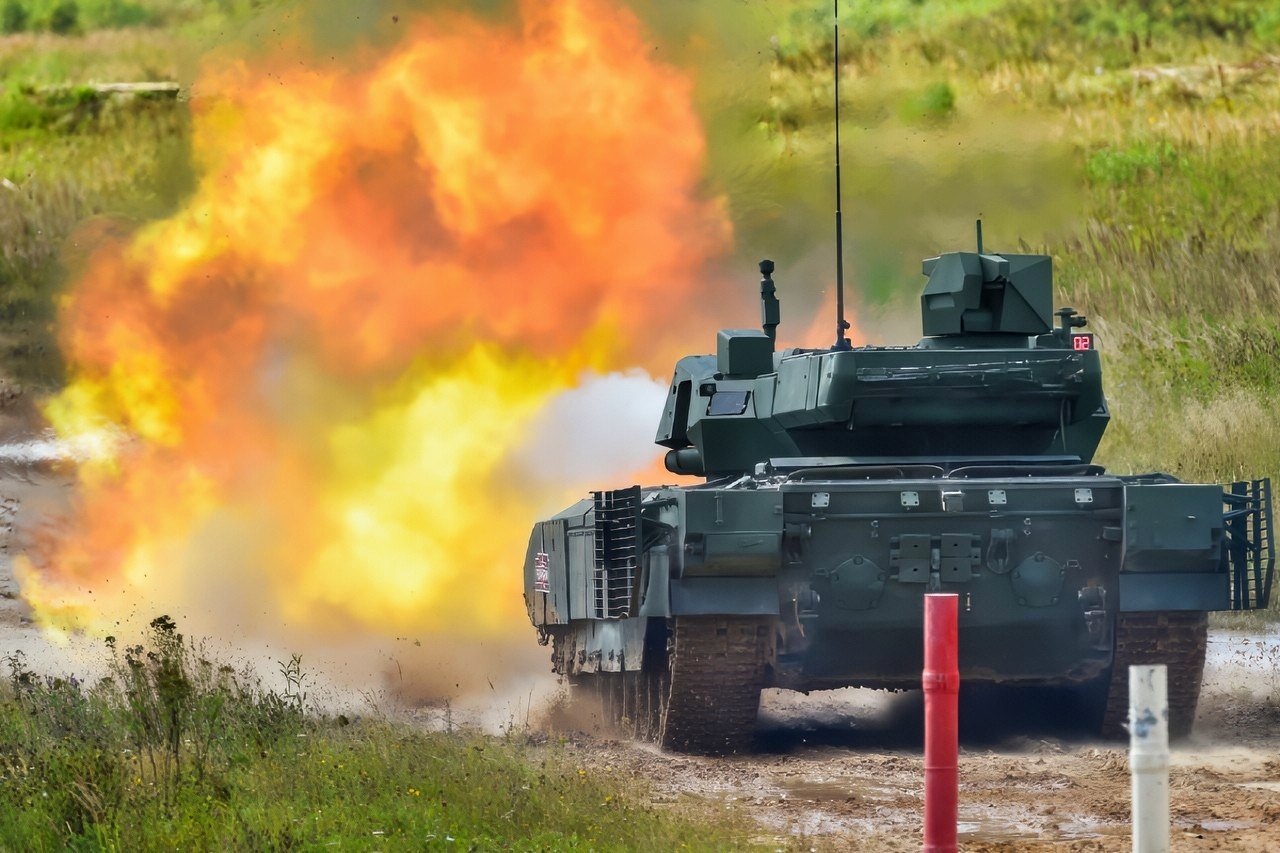
T-14 Armata Tank Russian Army. Image Credit: Creative Commons.
The APS Catch-22
Active protection systems sound like a silver bullet: detect the inbound, launch a countermeasure, stay alive. In practice, APS is a systems-of-systems challenge. Radars and sensors must work in weather and clutter; countermeasures must be fast, safe for nearby infantry, and effective against diverse threats; the electromagnetic emissions must be managed so you don’t become your own beacon; and the maintenance burden must be acceptable in field conditions. Getting all that right is a years-long grind. The T-14’s “shield” could not be treated like a box you bolt on at the end; it is the center of the survivability story—and that makes production, integration, and sustainment slower and costlier.
Great-Power Aims, Wartime Choices
Why didn’t Russia build the T-14 by the hundreds once it appeared on parade years ago?
Because strategy met arithmetic. When faced with wartime attrition, the Russian army has favored upgrading and rebuilding familiar T-72/80/90 variants that depots can push out quickly and crews can digest immediately. Those tanks are cheaper, their parts bins exist, and the training and maintenance ecosystems already know them.
Each T-14, by contrast, consumes scarce engineering hours, bottleneck components, and training resources—while delivering marginal combat value if you only have a few dozen scattered across a front. When commanders need numbers tomorrow, a boutique fleet is a liability.
Production Capacity And Sanctions
A new family of vehicles (Armata chassis was meant to be a whole ecosystem: MBT, heavy IFV, support) requires new tooling, new fixturing, new vendors, and stable contracts. Sanctions and export controls since 2014—and massively expanded after 2022—complicate everything that smells like high-end optics, chips, bearings, or machine tools. Workarounds exist but rarely at volume or quality, and each workaround adds re-engineering and delay. Even when the will and money exist, the supplier that makes your critical sensor cooler or gearbox bearing needs time to scale, quality to hold, and payments to clear. An Armata line that trickles tanks keeps unit costs punishing and leaves the army with a non-standard orphan.
Training, Doctrine, And The Human Factor
An unmanned turret changes how crews fight and feel their tank. Gunners now live through screens; commanders rely on fused feeds; maintenance troops troubleshoot sensors and software as much as linkages and seals. That requires new training syllabi, more simulators, and fresh habits in everything from target handoff to battlefield recovery. In a force mobilized under pressure, it is simply easier to take crews familiar with older tanks and put them back into upgraded older tanks—especially when those tanks share spare parts, tools, and TTPs with what units already know. The more the T-14 diverges from that reality, the harder it is to field in consequential numbers.
The Numbers Game: Quantity Has A Quality
A next-gen tank makes headlines; platoons and battalions win or lose districts. Russia’s war managers have chosen to chase fleet size and replacement tempo over gold-plated capability, pushing T-90M and deep T-72/T-80 rebuilds while the T-14 remains a showpiece.
That’s not because the idea is bad; it’s because the opportunity cost is huge. Every Armata you build is several upgraded legacy tanks you did not, along with the spare engines and sights those units need to keep rolling. In the current fight, availability tonight beats elegance on paper.
Why The Price Tag Stays High
Cost is a symptom of everything above. Low-rate builds lock in learning-curve penalties. Import-substitution and bespoke vendors for sensitive parts charge more until competition emerges (often never). Field feedback arrives slowly because you have too few tanks to generate robust data; that slows design changes that would otherwise cut cost. Meanwhile inflation, mobilization surcharges, and “war-risk” supply premiums creep into every invoice. The result is a vehicle that cannot get cheaper because it cannot get common.
Reputation And Reality In Ukraine
The T-14’s narrative suffered from its own visibility. High-profile parades, early promises of large buys, and breathless claims created a benchmark the program couldn’t meet. When war came, the tanks that mattered were the ones that could be produced in hundreds, maintained by conscripts and contract soldiers, and repaired in muddy parks with cold tools. Whether or not a few T-14s have peered into the theater from the edges is almost beside the point. A weapon’s reputation is shaped by sustained, documented field performance. Without that, the T-14’s image has drifted from “revolution” to curiosity.
The Export Problem
Russia traditionally amortizes development costs by selling abroad. But the T-14 faces an export paradox. The best-resourced buyers want proven systems with assured spares and training pipelines they can lock in for decades; sanctions complicate funding and technology transfer; and wartime demands mean the manufacturer prioritizes domestic needs anyway. Prospective customers see a tank with an uncertain price, unknown operational reliability, and limited numbers at home—exactly the wrong mix for a big foreign military sales program. Without exports, the business case remains thin; without a strong domestic buy, exports are even less likely. It’s a loop.
Why The Concept Wasn’t Wrong
It’s important to separate concept from execution. The T-14’s central ideas—isolated crew capsule, unmanned turret, integrated APS, digital backbone—address real battlefield trends. Drones, top-attack munitions, and networked anti-armor teams punish old design habits. Moving the crew out of the turret makes sense. So does treating active protection as a first-class system rather than an afterthought. In a different industrial context—with richer access to optics, chips, and high-reliability transmissions, and a longer runway for testing—Armata’s philosophy could have produced a formidable production tank.
T-14 Armata: Why It’s Likely To Be A Footnote
Programs become “footnotes” for predictable reasons: too little, too late, too expensive, too alone. The T-14 appears to hit each. The army has not fielded it in numbers; the industrial base cannot cheapen it with scale; the war requires volume now; and complementary force changes (logistics, recovery vehicles, training, doctrine, simulators, depots) haven’t been built around it. Meanwhile, incremental upgrades to older tanks keep the frontline supplied and the factories busy. Absent a political decision to fund a massive multi-year crash program—and the industrial miracles to match—the T-14 risks settling into the role of technology demonstrator: influential on PowerPoints and museum floors, not on campaign maps.
The Opportunity Cost: What Might Have Been
Every ruble skimmed to support Armata is a ruble not spent on sensors, drones, counter-UAS, artillery reconnaissance, and EW—the systems that have defined recent ground combat. The more a force delays those ecosystem investments to chase a boutique tank, the more asymmetric the trade becomes. This is the harshest verdict on the T-14: not that it was a bad idea, but that clinging to the idea too long crowds out more urgent, scalable improvements.
What The T-14 Still Changes—Quietly
Even if the tank itself fades, pieces of Armata will leak forward. The crew-capsule ethos will inform future hulls. Lessons on unmanned turrets—sensor placement, stabilization, fail-safes—will mature. APS research will spill into retrofittable kits for legacy tanks and infantry vehicles. The digital backbone and display logic will show up in mid-life upgrades elsewhere. In that sense, Armata can still matter: not as a fleet, but as a donor of good ideas that arrive later in more practical wrappers.
What Happens Now?
The T-14 Armata was Russia’s attempt to leapfrog a generation—protect the crew, automate the gunhouse, kill the missile, digitize the fight. The leap required a supply chain, test tempo, and budget discipline that never came together.
Faced with the blunt demands of wartime replacement and the choke points of modern optics and powertrains, Moscow chose good-enough in bulk over great in handfuls.
That choice makes sense in the short term—and it likely seals the T-14’s fate as a footnote: the tank that promised a future its makers couldn’t mass-produce.
About the Author: Harry J. Kazianis
Harry J. Kazianis (@Grecianformula) is Editor-In-Chief and President of National Security Journal. He was the former Senior Director of National Security Affairs at the Center for the National Interest (CFTNI), a foreign policy think tank founded by Richard Nixon based in Washington, DC. Harry has over a decade of experience in think tanks and national security publishing. His ideas have been published in the NY Times, The Washington Post, The Wall Street Journal, CNN, and many other outlets worldwide. He has held positions at CSIS, the Heritage Foundation, the University of Nottingham, and several other institutions related to national security research and studies. He is the former Executive Editor of the National Interest and the Diplomat. He holds a Master’s degree focusing on international affairs from Harvard University.
More Military
The YF-23 Black Widow II: Better Than the F-22 Raptor?
The A-12 Avenger II Stealth Bomber: What Navy Aircraft Carriers Almost Had
America’s Big Boeing X-32 Stealth Fighter Mistake Still Stings
The B-52J Bomber Might Never Fly: Here’s Why
K3: The New Tank That Looks Like the B-21 Raider Stealth Bomber


