

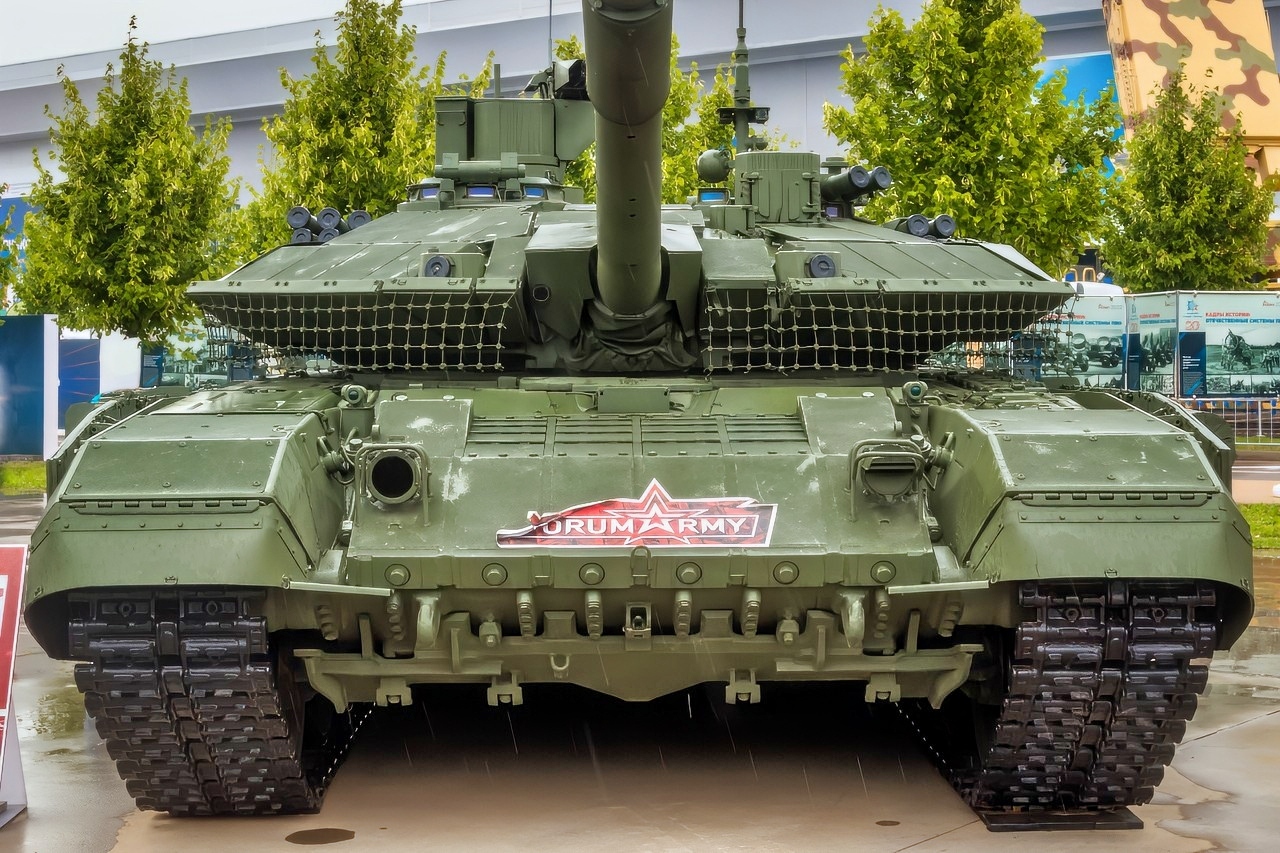
PUBLISHED on August 13, 2025, 10:47 AM EDT – Key Points and Summary – Russia’s production of its most advanced tank, the T-90M “Breakthrough,” has fallen off dramatically in 2025, casting serious doubt on claims of a manufacturing surge.
-After upgrading its existing fleet of older T-90As, the main tank factory, UralVagonZavod, has struggled to produce new builds.
-This production crisis is compounded by reports of poor quality, including bad welds, and deep-seated company issues like lawsuits for unpaid bills, low wages, and corruption.
-Rather than fielding a secret army of modern tanks, Russia appears to be scraping the bottom of the barrel for older, less capable models.
Production Falls Sharply As Russia Struggles To Build T-90M Tanks
Russian supporters claim that production of T-90M ‘Breakthrough’ tanks is at record levels, and that Russia’s tank fleet is being replenished as fast as it is destroyed. A closer look at the numbers delivered shows that production has fallen off dramatically.
Russian tank production is in crisis. Whether or not tanks are still relevant on the drone-infested battlefield is another matter, but claims that Russia could rebuild an effective tank fleet in a few years and threaten NATO seem very far from reality.
T-90M: Putin’s Favorite Tank
The T-90M, which entered service in 2019, is Russia’s only truly modern tank and its premier war machine.
The vast majority of the fleet is composed of much older T-80s and T-72s, supplemented by ancient T-62s and even T-55s resurrected from Cold War storage sites. The T-90M stands head and shoulders above these: with a modern gun, modern armor, and modern electronics, on paper at least a formidable war machine equal to Western tanks.
“It can be said today that the T-90M ‘Breakthrough’ is the world’s best tank,” President Putin stated in a speech quoted by TASS.
The majority of Russia’s tank ‘production’ really consists of refurbished T-72s from storage. But there is one factory that also turns T-90Ms, the UralVagonZavod (“Ural Railway Car Plant”) or UVZ, with a proud history going back to WWII.
The big question is just how many T-90Ms UVZ is making. Batches are dispatched to the front at intervals, occasionally with some fanfare—in March 2024, there was a mini rock concert to celebrate—and Western observers keep a close eye on the factory’s output.
In June, the Conflict Intelligence Team released this estimate:
“According to our estimates, Uralvagonzavod produced 60-70 T-90M tanks in 2022. In 2023, amid efforts to mobilize the defense industry, output may have increased to 140-180 tanks, and by 2024, it may have surpassed 200 units annually, possibly approaching a production rate of 250-300 tanks per year.”
Triple the Devastation
This figure of 300 tanks a year has been accepted uncritically by many, including the Wall Street Journal, among others. Still, no supporting evidence is given, and it is far above other estimates.
For example, a year previously, the International Institute of Strategic Studies (IISS) released a report, ’Russian T-90M production: less than meets the eye’, with a detailed breakdown of known deliveries. The organization projected 60–70 for 2023, with somewhat higher figures for 2024, and estimated “more than 90” for 2025, indicating less than half the Conflict Intelligence Team (CIT) figures.
Sergio Miller, an analyst and former British Army intelligence officer, has kept a close track of the available data, noting every batch as it was delivered. These come at erratic intervals of a few months.
“In total, UVZ only claimed to deliver 100 tanks in 2024,” says Miller. “I have no idea where the high figures quoted by some Western reporting come from. There is no evidence this is the case.”
But if things were bad in 2024, they have since become significantly worse.
“The surprise in 2025 has been the absence of announcements,” says Miller.
As Miller notes, in the whole of 2025 so far, there has only been one reported delivery of a batch of T-90Ms, made on the eve of Victory Day, May 9th. Only six vehicles are visible in images, but Miller says the full shipment was likely 10 vehicles, as usual, enough to outfit one tank company.
Production and Losses
There has been no surge of T-90Ms visible at the front. Warspotting records just 16 T-90Ms lost in 2025 compared to 28 in the same period last year. Far more T-72s and T-62s have been lost in recent months.
There may be a simple explanation for production trailing off so sharply. Rather than being new builds, the ‘new’ T-90Ms seen in 2024 were in fact upgraded T-90As. Approximately 300 of the earlier version tanks were produced. Some were seen in Ukraine in the early stages of the war. Warspotting only confirmed two T-90A losses in the last year.
It is likely that all available T-90As were withdrawn and upgraded to the T-90M standard. In theory, UVZ is capable of producing new T-90Ms from scratch. Miller notes that the first 2017 contract was for 30 T-90Ms, of which just 10 were new builds, the rest being upgrades.
The dramatic fall-off suggests that after they ran out of T-90As to upgrade, UVZ has struggled to make new T-90Ms.
Bad Welds: a Symptom of Deeper Problems for T-90M
The bad weld theory may be supported by a complaint posted on social media by Russian soldiers and picked up by the Ukrainian defence journal Militarnyi. This report included a photo and video featuring the T-90M after an unknown munition hit the left side of the hull, causing the turret welds to break apart.
The vehicle was not penetrated, and the crew survived. A non-penetrating hit like this should be shrugged off, but the turret breaking open disabled the electronics and other gear. According to Militarnyi, the vehicle was likely a write-off and used for spare parts.
The problem was poor welding, either due to unskilled workers or the incorrect weld type. Either way, it suggests quality control issues, and that T-90Ms are not being produced to the expected standard.
This is likely a sign of much deeper problems.
In July, the Magnitogorsk Iron and Steel Works (MNK) launched its third lawsuit against UVZ in two months for non-payment of bills. The amount involved, 70 million rubles, somewhat under $900k, a fraction of the cost of one tank, and might seem tiny by US defence standards. Whether this is due to bureaucratic inefficiency, endemic corruption, or incompetent management is impossible to tell, but it is not a one-off.
In 2016, UVZ lost a $114 million lawsuit brought by creditors Alfa-Bank; the tank makers were only saved from bankruptcy by a state bailout. But even with presumably lucrative government contracts now rolling in, UVZ is in trouble if it cannot pay suppliers for the steel needed to build tanks.
Nor are they good at paying their workers. In 2019, the CEO of UVZ claimed the average salary was 40,000 rubles ($500) per month, higher than the regional average. But in 2020, after cuts, employees reported much lower wages, with a senior workshop operative saying they could make just 30,000 ($376), and then only if they earned the maximum bonus. This is lower than the average for the area.
Worse, wages are not always paid, as another lawsuit indicates. UVZ is fighting a legal action against two employees who released a video appealing directly for help from their CEO. The employees allege that the company fails to pay its full wages to workers, mishandles industrial injuries, and that new equipment is unusable due to being broken upon delivery. Whistleblowers can help root out deep-seated problems, but UVZ’s response was to sue the employees for slander and demand they retract some of their claims (though not the one about pay).
Sample line: “The plaintiff also claims that Andrey Sobakinskikh’s statement about his injury at the enterprise, after which he lay on the floor for an hour and a half, is false, since the ambulance drove through the entrance of the plant 1 hour and 15 minutes after the call”—not perhaps the winning argument that the plaintiff hopes. If you get seriously injured at UVZ, do not count on medical help in that Golden Hour.
Low-level corruption is also a problem. In May, the former head of one of UVZ’s assembly workshops was charged with extorting bribes from people in his team. So, not only are the low wages withheld, but the boss might also want a cut for not sacking you.
UVZ employs more than 20,000 people and launched a major recruitment drive after the 2022 full-scale invasion. Russia suffers from a severe labor shortage, partly as a result of a million or so casualties in Ukraine, and a news report suggests that UVZ is still short of “numerical control machine operators, turners, mechanical assembly workers, welders and other specialties.”
It seems prospective employees do not see UVZ as an attractive workplace, and the volume and quality of production are likely to suffer.
All of which suggests that UVZ is a company struggling to stay afloat, and it would hardly be surprising if it fails to hit tank production quotas.
Invisible Tank Army?
There is an alternative narrative: UVZ is a successful and efficient business, a powerhouse turning out modern tanks day and night, and Russia has a secret force of hundreds of T-90Ms hidden away somewhere. These vehicles are being held in reserve, either for a decisive assault in Ukraine or for a future war against NATO. The tanks have never been seen because Russia is keeping them out of sight, only to reveal them when the time is right.
This theory is, of course, impossible to disprove, like other claims about Russian secret superweapons.
However, everything we see in Ukraine, and at UVZ, tends to suggest that the tank situation really is dire. The Russians are using everything they can get.
“T-72As from storage have started appearing at UVZ,” says Miller. These are early models from the 1980s, moved from storage in Siberia to UVZ for refitting, suggesting that stockpiles of everything more recent have finally been exhausted. “I think they are in trouble and are scraping the very bottom of the barrel.”
Previously, UVZ upgraded T-72B models. The earlier T-72A has inferior armor, an inferior gun, and a less powerful engine. Usually, in wartime, the tanks supplied get steadily better. In Ukraine, Russian soldiers will find themselves issued with increasingly outdated vehicles.
Meanwhile, UVZ maintains its cheerful rhetoric on the company Telegram channel. Still, posts tend to be about their rail car business, the T-34s they built in the Great Patriotic War, or a competition to name a proposed new armored super-vehicle. It will be interesting to see when the next tank shipment is announced.
Tank production is no longer the important measure of military power it once was. Tanks are rarely seen on the battlefield in Ukraine, and when they do appear, they tend to be spotted quickly and dispatched by drones.
The one consolation for Russia is that even if UVZ were building hundreds of T-90Ms a year, it probably would not make any difference.
About the Author: Military Expert David Hambling
David Hambling is a London-based journalist, author, and consultant specializing in defense technology with over 20 years of experience. He writes for Aviation Week, Forbes, The Economist, New Scientist, Popular Mechanics, WIRED and others. His books include “Weapons Grade: How Modern Warfare Gave Birth to Our High-tech World” (2005) and “Swarm Troopers: How small drones will conquer the world” (2015). He has been closely watching the continued evolution of small military drones. Follow him X: @David_Hambling.
Military Matters
The F-22 Raptor Just Keeps Getting Better


Pingback: Russia Makes Biggest Daily Land Gains in Ukraine in Over a Year - National Security Journal
Pingback: Can anybody tell how many new T-90M tanks Russia is building—300 a year or just 10? NATO’s asking for a friend – Ultimele Știri din Europa