


Russia has lost an estimated 1 million soldiers in Ukraine, either dead or wounded. Russia has also lost 116 square kilometers of net territory recently. Russia spent much of 2024 and 2025 making slow incremental gains in Ukraine. Russian advances are now plateauing or reversing. Russia is suffering from enormous attrition rates. Russian assaults are often infantry-heavy infiltration attacks. Ukrainian FPV drones are destroying Russian armor and infantry before they can consolidate.
The Russia – Ukraine War Just Won’t End

Tim Murry, a foreign threats compound contractor, drives a T-72 battle tank into position to serve as adversary targets for a joint service exercise, Emerald Flag, at Eglin Air Force Base, Fla., Nov. 30. Emerald Flag is a multi-service exercise aimed to unify information sharing across joint domain platforms. (U.S. Air Force photo/1st Lt Karissa Rodriguez)
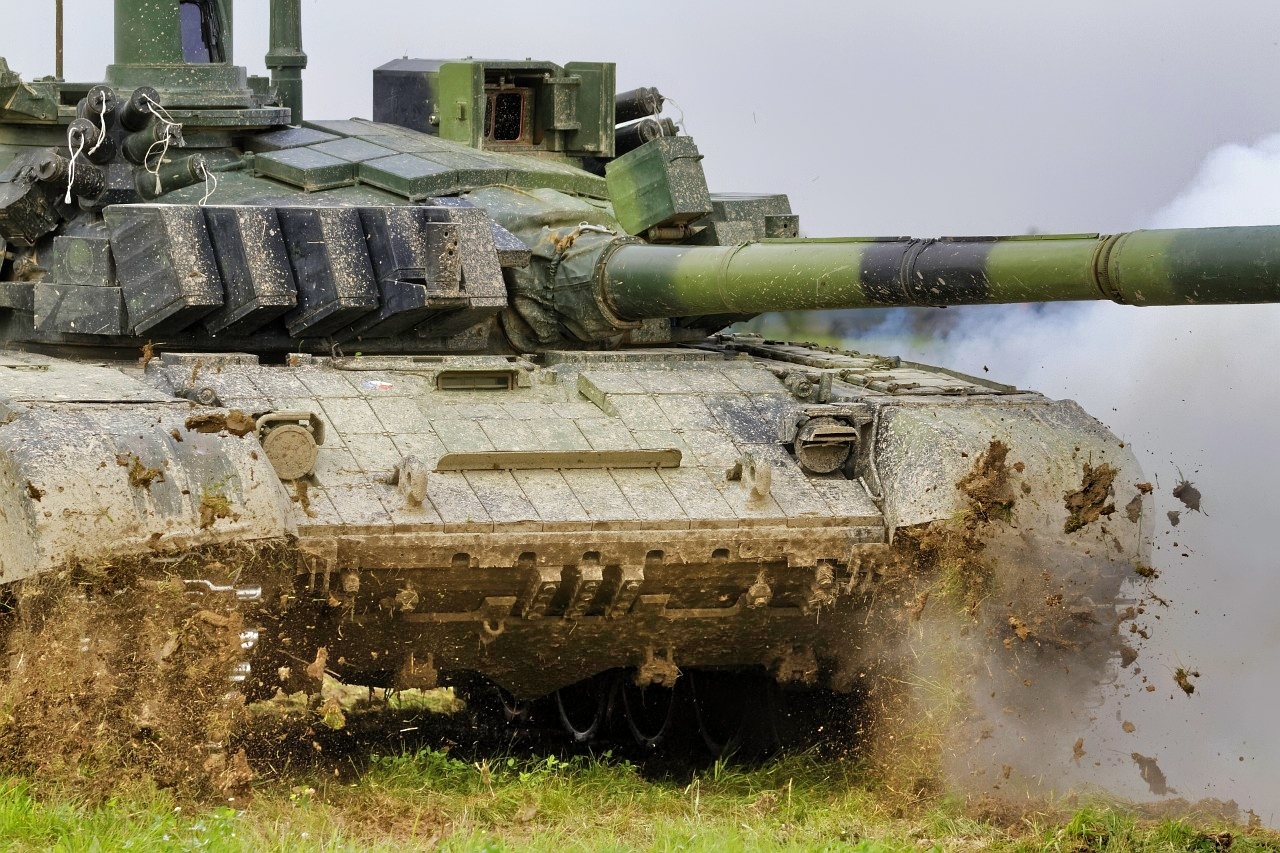
T-72 Tank. Image Credit: Creative Commons.
The Ukraine War appears to be entering a hybrid state of military stalemate paired with diplomatic acceleration. Neither side is capable of an offensive breakthrough, meaning the battlefield is a slogging war of attrition. The front lines are heavily saturated with FPV drones, loitering munitions, ISR quadcopters, and electronic warfare assets. The ability to maneuver in the traditional sense is heavily degraded. So the war has become less about battlefield maneuvers and more about destroying logistics, sensors, and industrial capacity.
Russia Is Losing Territory in Ukraine
Russia has lost 116 square kilometers of net territory. This is important because Russia spent much of 2024–2025 making slow incremental gains. But now those gains are plateauing or reversing. Why? Enormous attrition rates.
Russian assaults are often infantry-heavy infiltration attacks. But small assault groups are repeatedly detected by drones; Ukrainian FPV drones are destroying armor and infantry before they have a chance to consolidate.
Drone Wars
Both sides are flying persistent ISR drones, which means resupply movements are constantly observed and river crossings are increasingly dangerous. The effect has been that the gears of war have ground to a relative standstill.
Men and equipment lack the ability to move effectively. Roads are under drone observation almost all the time. Logistics that are visible are vulnerable. Drones have essentially compressed the battlefield so heavily that concealment and maneuver are dramatically harder.
Robotized War
UGVs (Unmanned Ground Vehicles) have emerged on the battlefield, too. These are no sci-fi humanoid robots, as depicted in Terminator or something similar, but tracked/crawler systems. These UGVs are used for ammunition delivery, casualty evacuation, mine placement, and direct assault.

A Terminal High Altitude Area Defense (THAAD) interceptor is launched from the Pacific Spaceport Complex Alaska in Kodiak, Alaska, during Flight Experiment THAAD (FET)-01 on July 30, 2017 (EDT). During the test, the THAAD weapon system successfully intercepted an air-launched, medium-range ballistic missile (MRBM) target.
For Ukraine, which is suffering from a major manpower shortage and an increasingly severe demographic problem, these robotic UGVs are preserving infantry strength.
Similarly, the drone swarm concept is proving highly viable. Drones are used for ISR and large-scale targeting. Meanwhile, ground drones are performing many of the tasks once conducted by infantry.
This all suggests the early stages of a doctrinal shift, centered on drones: machines are a cheap and persistent way to suppress defenders, allowing humans to enter the space only after resistance has collapsed, and conditions are relatively safe, thereby preserving life and human capital. Ukraine will be remembered as the first major conflict where autonomous systems were materially substituted for human assault forces, almost certainly marking a new era in human warfare.
Putin’s Rhetorical Shift
Putin has maintained a maximalist rhetorical stance through much of the conflict. But lately, his language has shifted to suggest the conflict is winding down, which is unusual for him. The reasons for this may be economic strain.
The military itself is likely exhausted; casualty estimates are enormous, which has increased dependency on lower-quality recruits, foreign volunteers, and convicts. And the recent Victory Day parade was reportedly smaller, with fewer pieces of heavy armor on display. This may indicate Russia is suffering from equipment shortages. But of course, a rhetorical shift does not mean the war is ending—and it does not necessarily suggest the terms on which the war will end.
The Diplomatic Track
The Trump administration has pushed for peace. A 20-point framework, likely focused on ceasefire lines, territorial freezes, and security guarantees, has been proposed. Russia likely wants de facto recognition of occupied territories, with sanctions relief, and Ukrainian neutrality limits.
But Ukraine is in a difficult position; formally surrendering territory would be politically harmful, yet it lacks the ability to retake the territory it has lost.
This could lead to a frozen conflict or an armed ceasefire, something like the Korean Peninsula model, where fighting decreases but no final peace treaty is ever signed, and a heavily militarized border remains. No side seems capable of winning outright, so the war is increasingly likely to become a negotiation over where exactly the line freezes, and the border is erected.
In sum, neither side has a clean pathway to a traditional, decisive military victory, which forces the war to evolve toward a tech-enabled stalemate.
Future conflicts will likely draw heavily from lessons learned in Ukraine, where drones and automation became central to battlefield outcomes.
About the Author: Harrison Kass
Harrison Kass is a writer and attorney focused on national security, technology, and political culture. His work has appeared in City Journal, The Hill, Quillette, The Spectator, and The Cipher Brief. He holds a JD from the University of Oregon and a master’s in Global & Joint Program Studies from NYU. More at harrisonkass.com


Robert K
May 14, 2026 at 3:07 pm
When Vlad loses his ability to instill fear and panic in his own people, he is done for. That day is approaching.
The last time Russia (then known as the USSR) lost anything close to this was just before they turned tail and fled Afghanistan. I strongly suspect this is worse, much worse.
Swamplaw Yankee
May 20, 2026 at 12:47 pm
Wrong! The Op-ed is wrong when it states that the Ukraine lacks the ability to retake all stolen Ukrainian land.
Ukraine just lacks a USA that is willing to reveal every sentence that MAGA POTUS Trump spoke at the Anchorage secret criminal meeting.
This is the same MAGA POTUS Trump that has his own blood children railroading Ukraine to hand over intellectual property rights gained thru the death of Ukrainian kids fighting the USA facilitated Balkanization of independent Ukraine in 2014.
Ukrainian kids knew in 2014 that POTUS OBAMA betrayed the WEST, Ukraine, with his covert, unilateral “GREEN” light facilitation of the Balkanization of Ukraine that OBAMA re-started the 1000 year old Genocide of Ukrainians by Kremlin Muscovy butchers.
Ukrainians kids evolved the drones into the 2016 UAV multi layer technology to prevent the return of a 1000 year old sex-slave trade ethnic Muscovy into Ukraine. Kremlin Muscovy mass abducted million of Ukrainian boys to abuse + then sell for castration by the Muslim Ottoman Sultan. Obama clearly knew that child abuse history, yet joyously facilitated the re-start of this now 15 year old human trafficking criminality.
The USA has disqualified itself from any secret and/or public cuddling with the Kremlin Muscovy elite on any matter relating to Ukraine. Stop the MAGA Trump railroading scam to coerce Ukraine by force of military equipment deprival!! A cheap criminal act that Trump draws the USA into!!
Yes, that worked post 1945 when the USA strong armed the re-arming with FREE arms of the communist Mao army to slowly conquer the USA ally, Nationalist China.