


The Institute for the Study of War reports Russia has lost substantial territory in Ukraine for the first time since the summer of 2024. Russia is now in its 5th consecutive month of losing more soldiers than it can replace. Ukraine’s Defense Minister Mykhailo Fedorov said Kyiv is targeting 50,000 Russian casualties per month. In early 2026, SpaceX cut Russia’s pirated Starlink access. Ukrainian forces advanced 10-12 kilometers in two southern operations over the course of a few weeks. Russian units attempting to reconnect via rooftop antennas exposed their positions and were destroyed. The Kremlin’s nationwide Telegram crackdown — intended to suppress war news from the Russian public — has also crippled frontline Russian communications.
A Change in the Ukraine War
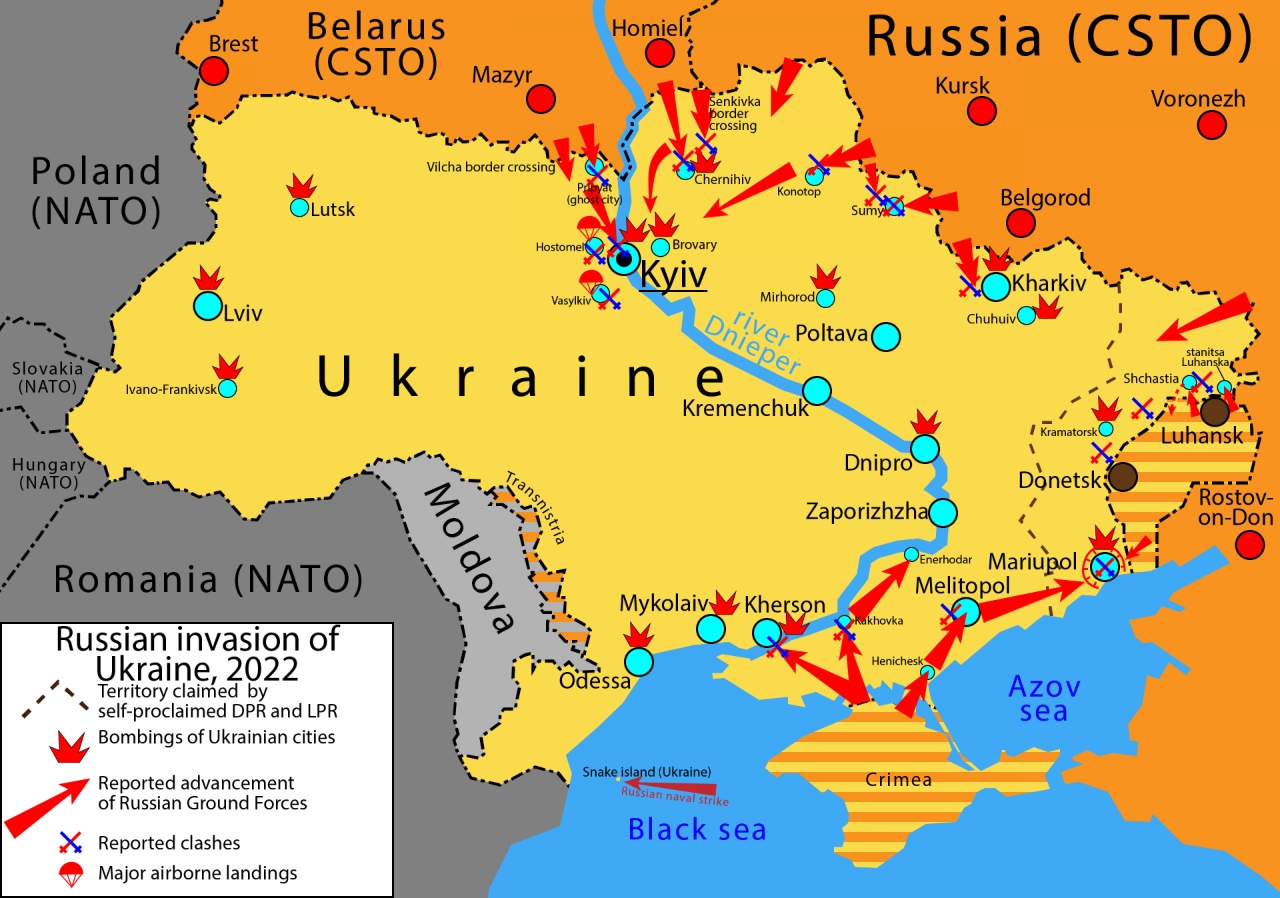
Ukraine War Map. Image Credit: Creative Commons.
A recent report from the Washington, DC-based think-tank the Institute for the Study of War concludes that for the first time since the summer of 2024, the Russian military has lost substantial areas of territory in its efforts to maintain its occupation of Ukraine. This situation on the ground is the coda to a string of successful Ukrainian drone and missile strikes of the past weeks on oil industrial sites and other strategic targets in Russia.
Together with what appears to be the ability of the Ukrainians are now apparently able to strike at will anywhere in Russia at whatever target they wish.
There is no end of “experts” stating that this does not mean that Russia is now officially losing the war across the board. But even the naysayers will admit that Moscow has been unable to achieve any of the strategic goals it set when the invasion of Ukraine began in February 2022.
In the past few months, Kyiv has managed to inflict severe casualties on the Russians, to the point where this is now the 5th month Moscow has suffered more losses in personnel than it can replace by dragooning more manpower. This number was officially announced by Ukraine’s Defense Minister, Mykhailo Fedorov, this past Tuesday.
“All losses are confirmed on video,” Fedorov said in a telegram statement along with an attached video file. “For the fifth month in a row, Russia is losing more than it can mobilize and is gradually choking on its losses. We are steadily moving toward the figure of 50,000 eliminated occupiers per month.”
Fedorov stated Ukraine’s strategic objective was to inflict losses to a level where “further advances [by Russian forces] become unsustainable.”
Now Ukraine has begun to recapture territory to the point that Ukraine’s commander-in-chief, General Oleksandr Syrskiy, highlighted two months ago, when Russia’s losses were becoming increasingly evident. “In February 2026, for the first time since the Kursk offensive operation, Ukraine’s Defense Forces restored control over more territory than the enemy could capture,” he wrote in a 2 March Facebook post.
These and other developments are the latest indications that the tide may be turning against Moscow. Russia’s “Special Military Operation,” as President Vladimir Putin refers to it, continues to falter. As the fifth summer of hostilities is on the horizon, the fortunes of the war appear to still be trending less and less in Russia’s favor.

MSTA-S Russian Army. Image Credit: Creative Commons.
Failure to Communicate
While Ukraine’s proven ability to innovate – particularly its capacity to develop new, longer-range, and more sophisticated drones – is constantly improving, it has not been the only key element in these recent battlefield gains. What has been behind some of Kyiv’s more recent successes is Russia’s growing command-and-control problems within its own military.
In early 2026, US company SpaceX decided to cut the Russian army’s pirated access to the Starlink system. Within a matter of weeks, Ukrainian forces had advanced ten to twelve kilometers in two separate operational initiatives in the southern theatre of operations. In the process, Ukraine recovered the territory that it had lost to Russia months earlier.
Communications failures appear to have played a major role in Russia’s military setbacks. Ukrainian intelligence sources have reported that when Moscow’s access to satellite data and communications was cut, Russian commanders on the southern front were left with inaccurate maps. These maps showed exaggerated Russian gains and failed to reflect the true disposition of Kyiv’s forces.
This resulted in Russian troops being deployed to forward positions without being able to communicate or synchronize their actions. In this scenario, they had almost no situational awareness, and Ukrainian units counterattacked them with little to no warning.
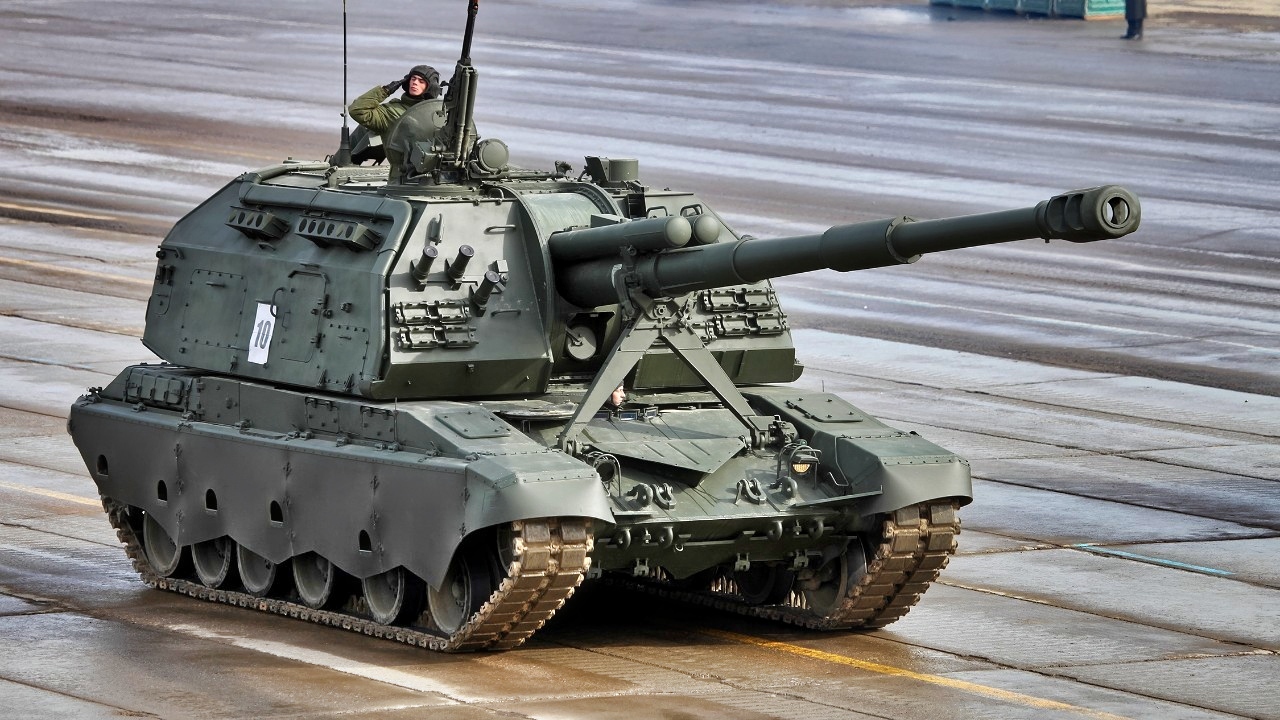
Msta-S Russian Army. Image Credit: Creative Commons.
Starlink to Telegram
When Starlink was cut off, Russian units took actions that only exacerbated their situation. One Russian unit attempted to reestablish contact by using larger rooftop antennas on high-rise buildings.
But those antennas could then be seen from long distances and literally gave away the positions of those Russian units. Trying to reconnect with Starlink only caused their destruction.
But the other, more recent – and the most complained-about and self-inflicted communications problem – was the decision by the Kremlin to launch a massive crackdown on the use of the Telegram platform. Frontline troops had been using the app since the start of the invasion of Ukraine and were regarded by many units as a crucial communication asset.
The Putin regime began blocking Telegram in early 2026 as part of a nationwide campaign to limit internet access for the entire Russian population. The platform blockage was designed to prevent the general public from learning the truth about the dismal progress of the war. But Russian soldiers serving in Ukraine, as well as very popular and vocal Russian pro-war bloggers, also complained increasingly of reduced access and the ability to communicate.
The reports on the situation have revealed a clear cause-and-effect relationship in the first four months of 2026. When Ukrainian units have successfully carried out front-line advances, they have almost always followed what are described as “accounts of Russian informational degradation.”
There have been numerous reports that Russian units have become unable to communicate effectively, and their commanders have become incapable of verifying either orders from superiors or information from subordinates. In almost every one of these situations, the assessment is that, due to these communications blackouts, Russian forces have been unable, time and again, to prevent Ukraine from exploiting vulnerabilities.
Which is a long way of saying that the Putin regime is cutting its own throat with these internet shutdowns. It is so afraid of the man-on-the-street learning about the horrendous losses in the war or reading Telegram channels owned by regime opponents that it is willing to see its own soldiers in the field die as a consequence of that fear. This is largely Putin’s fear for his own survival at any cost.
An essay recently published in The Economist succinctly describes how the constant damage done to Russia by Putin’s ill-conceived war is, in turn, leading to him losing his grip on the country. The result is, the authors point out, that the former KGB Lt. Col.’s “authoritarian system can survive for a long time on fear, inertia, and repression. It still has a monopoly on violence, but has lost its monopoly on shaping the future.”
Nothing illustrates this more than how and why Moscow’s military is now losing territory – and tens of thousands of its own soldiers every month – on the battlefield.
About the Author: Reuben F. Johnson
Reuben F. Johnson has thirty-six years of experience analyzing and reporting on foreign weapons systems, defense technologies, and international arms export policy. Johnson is the Director of Research at the Casimir Pulaski Foundation. He is also a survivor of the Russian invasion of Ukraine in February 2022. He worked for years in the American defense industry as a foreign technology analyst and later as a consultant for the U.S. Department of Defense, the Departments of the Navy and Air Force, and the governments of the United Kingdom and Australia. In 2022-2023, he won two consecutive awards for his defense reporting. He holds a bachelor’s degree from DePauw University and a master’s degree from Miami University in Ohio, specializing in Soviet and Russian studies. He lives in Warsaw.


Swamplaw Yankee
May 12, 2026 at 5:40 pm
The graphic for the 2010-2014 timeline of POTUS Obama doing his Benedict Arnold betrayal of NATO-EU-UK-UKRAINE- THE West, is very missing. The very dates that Barry Obama joyfully facilitated the USA betrayal of the Geopolitical 1946 doctrines of Keenan-Dulles of constraint of the Marriage Partner of the NAZI Hitler pact.
Old blather about 2022 is just old – dated – simplistic.
The real worry – Trump demanding that he has a fake scam to interfere with EU geopolitics. Many inside 2026 USA still give that Trump canard of legitimate theft of Ukraine “con” legitimate public space. Trump blathers Kremlin Muscovy narrative with no punishment!