

Ukrainian forces launched a series of long-range strikes against Russian industrial, energy, and military targets overnight into Sunday, November 15.
The strikes specifically targeted oil refining infrastructure, petrochemical manufacturing facilities, a helicopter manufacturer, and several other sites.
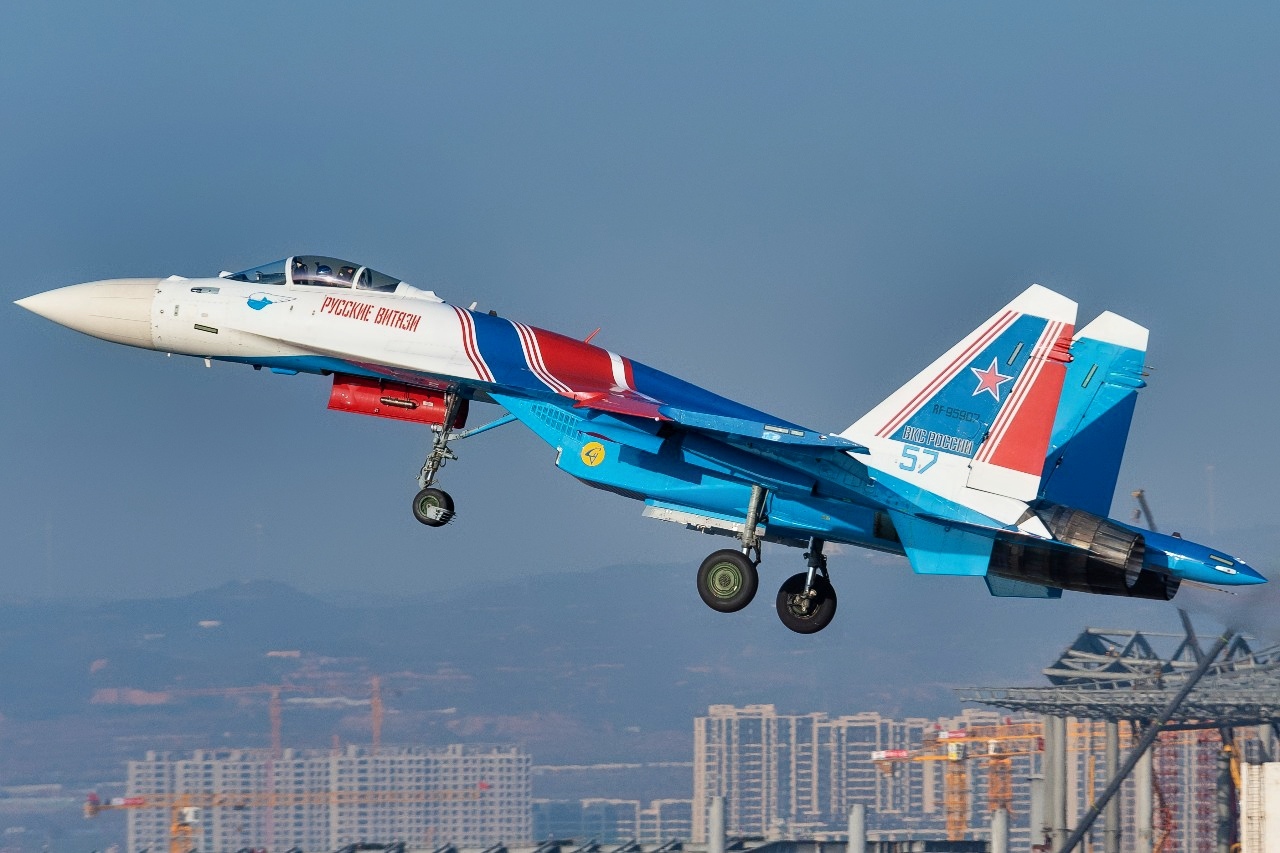
Su-35. Image Credit: Creative Commons.

Su-35 Fighter. Image Credit: Creative Commons.
The attacks reached as far as 1,000 kilometers from the Ukrainian border.
Ukraine’s General Staff revealed that the operation targeted three industrial enterprises in Russia’s Republic of Tatarstan and Bryansk Oblast, damaging facilities involved in supplying fuel and manufacturing materials used by the Russian military.
Russian authorities confirmed the strikes, noting that a major drone attack occurred in Tatarstan and reporting damage to industrial facilities and residential buildings. Several people were injured.
The strikes come as Ukraine continues its long-range strike campaign and Russia bombards Ukrainian cities and energy infrastructure, with U.S.-led efforts to secure a peace deal still struggling to find common ground on territorial issues and the future of European security.
Ukraine Strikes Two Major Industrial Facilities
Ukraine’s General Staff confirmed on Sunday, November 15, that its forces hit the Nizhnekamskneftekhim petrochemical complex in Nizhnekamsk, a major industrial city in Tatarstan. The facility, owned by Russian petrochemical firm Sibur, produces synthetic rubbers and plastics used in civilian manufacturing. Those products, however, are also used to produce military equipment.
Explosions and a fire were reported at the facility.
The TAIF-NK oil refinery, which is also located in Nizhnekamsk, was the second target.
According to Ukraine’s General Staff, the drone strike hit the refinery’s only primary oil distillation unit, the ELOU-AVT-7, and started a fire.
The damaged unit handles the early stage of crude oil processing, making it an essential part of the refinery’s operations.
Damage to that equipment could therefore affect the facility’s ability to produce fuel and other petroleum products, causing further problems for Russia and contributing to the global oil-refining capacity shortage.
The General Staff confirmed that assessments of the damage at both of the facilities are still ongoing.
Nizhnekamsk Mayor Radmir Belyaev also confirmed that the city had been attacked by Ukrainian strikes and reported damage to industrial facilities and an apartment building.

Su-35 Fighter from Russia. Image Credit: Creative Commons.
Residents were reportedly evacuated, and Tatarstan Health Minister Almir Abashev reported three injuries.
In a statement issued Sunday, Russia’s Ministry of Defense said its air defense forces intercepted and destroyed 533 Ukrainian fixed-wing drones between 8 pm Saturday and 8 am Sunday, Moscow time.
The ministry confirmed that interceptions took place in 13 Russian regions, including Tatarstan, Crimea, the Black Sea, and the Azov Sea.
Ukraine Hits Helicopter Manufacturer, Military Airfield
The Ukrainian General Staff also confirmed that its forces struck the Monolit industrial enterprise in Trubchevsk, Bryansk Oblast, which manufactures aircraft, including helicopters, as well as spare parts and other components that are used in civil and military aviation.
In a separate statement published on November 15, the Ukrainian General Staff also revealed that Ukrainian forces had targeted the Akhtubinsk military airfield in Astrakhan Oblast, roughly 650 kilometers from the front line.
The installation is home to the 929th State Flight Test Center, which tests new military aircraft and weapons systems. It is also frequently used by Russian Su-34 aircraft.
According to the General Staff, the strike caused a secondary explosion at a storage facility that contained components for guided air-launched missiles. Ukrainian forces also reportedly struck a PRV-13 mobile radar system.
Additional strikes damaged a Russian drone storage and launch facility near Tsymbulova in Oryol Oblast. Ukraine says that Russian forces used the location to launch attack drone assaults against Ukraine.
Russia’s Oil Industry Under Assault
The Sunday strikes came after a previous Ukrainian strike on November 13 that targeted the Samara oil production and transportation station located in Prosvet, roughly 950 kilometers from the nearest Ukrainian-controlled territory.
The facility receives crude oil through pipelines from Western Siberia and other oil-producing regions across the country.
The facility targeted in Ukrainian strikes blends the oil to produce Russia’s Urals export grade, which accounts for as much as half of the country’s exports.
The strike reportedly damaged six storage tanks and caused a fire.
“The SBU has struck a key node in Russia’s oil infrastructure: the ‘Samara’ Linear Production and Dispatch Station (LPDS),” a November 14 statement reads.
“The ‘Samara’ LPDS is one of the most critical nodes in the Russian oil transport system,” the statement continued, adding that the SBU “continues its systematic campaign to target vital Russian oil infrastructure.”
Ukraine’s long-range strikes have significantly disrupted Russia’s oil industry, forcing the country to limit exports and triggering widespread shortages and fuel sale restrictions in even some of its biggest cities.
Ukraine’s Defense Intelligence Directorate says it estimates more than $23.3 billion in losses to Russia’s oil industry as of late September 2026.
About the Author: Jack Buckby
Jack Buckby is a British researcher and analyst specializing in defense and national security, based in New York. His work focuses on military capability, procurement, and strategic competition, and he produces and edits analysis for policy and defense audiences. He brings extensive editorial experience, with a career output spanning over 1,000 articles at National Security Journal, and has previously authored books and papers on extremism and deradicalization.


