


Key Points and Summary – Chinese state media has claimed a PLA pilot in a J-16 fighter successfully “locked onto” and repelled two U.S. F-22 Raptors, even performing an “aggressive” maneuver just meters above one.
-The report credits an “integrated combat system” capable of detecting stealth aircraft.
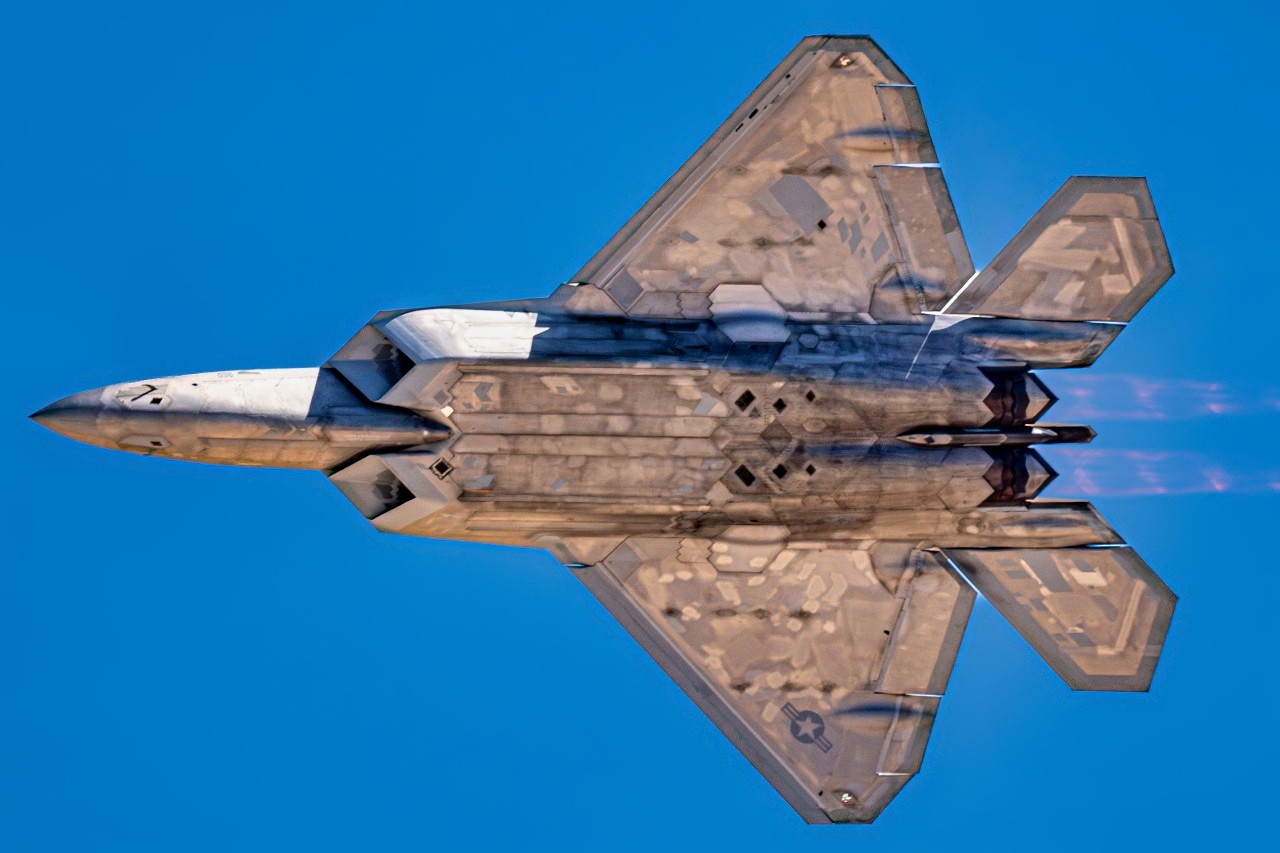
A U.S. Air Force F-22 Raptor performs an aerial demonstration during Aviation Nation 2025 at Nellis Air Force Base, Nevada, April 5, 2025. Aviation Nation is an airshow held at Nellis Air Force Base, showcasing the pride, precision and capabilities of the U.S. Air Force through aerial demonstrations and static displays. The F-22 Raptor performed there to highlight its unmatched agility and air dominance as part of the Air Force’s efforts to inspire, recruit and connect with the public. (U.S. Air Force photo by Staff Sgt. Lauren Cobin)
-However, Western experts are highly skeptical, dismissing the account as likely exaggerated propaganda designed to showcase Chinese anti-stealth capabilities and challenge U.S. air superiority.
-They note the vast technological gap between the non-stealthy J-16 and the F-22, making such a scenario highly improbable.
China’s Claim to Have ‘Locked On’ to F-22 Raptor Likely False
Beijing has announced that one of its People’s Liberation Army (PLA) pilots successfully “locked onto” and repelled a pair of American F-22 Raptor jets in the East China Sea.
Chinese state media alleges that pilot Li Chao of a PLA J-16 fighter intercepted the US jets during a training exercise last year inside China’s self-declared Air Defense Identification Zone (ADIZ).
The report describes Li performing “highly aggressive” maneuvers, including flipping his aircraft upside down just 15 meters above an F-22.
He claimed he then achieved radar lock on both targets and escorted them away.
If accurate, such an encounter would be a major breach of air safety.
“Locking on” refers to using radar or sensors to acquire a fire-control solution, which can be one step away from firing a missile. Western militaries consider it a provocative, near-hostile act even in international airspace.

U.S. Air Force Staff Sgt. Christopher Graham, 3rd Wing crew chief, marshalls an F-22 Raptor on the flight line at Joint Base Elmendorf-Richardson, Alaska, during an elephant walk, May 5, 2020. The large show-of-force demonstrated the wings’ rapid mobility capabilities and response readiness during COVID-19 and also highlighted the ability to generate combat airpower at a moment’s notice to ensure regional stability throughout the North American Aerospace Defense Command Region and Indo-Pacific. (U.S. Air Force photo by Tech. Sgt. Westin Warburton)
Yet many experts doubt the tale. Beijing’s account, released through tightly controlled media, appears designed to showcase the PLA’s technological prowess and to suggest it can now detect stealth aircraft once thought invisible to radar.
Chinese outlets credit an “integrated combat system” that fuses data from satellites, ground radar, and early-warning aircraft to guide fighters like the J-16 toward concealed targets.
Such a system, if effective, would mark a major advance in China’s ability to challenge US air superiority.
But Western defense observers say the claim likely exaggerates or fabricates details for domestic consumption. “A J-16 doing a barrel roll over an F-22 is straight out of Top Gun,” one former Royal Air Force pilot told the online magazine Interesting Engineering. “No American pilot would allow a Chinese jet to get within that distance without reacting,” he continued.
The J-16 itself, derived from Russia’s Su-30 design, is a capable fourth-generation platform fitted with Chinese avionics and sensors, boasting a 12-ton payload and long range.
It is not stealthy, serving instead as a bridge between China’s older fleet and its fifth-generation J-20.

YF-118G Bird of Prey and F-22 Raptor. Image Taken at U.S. Ai Force Museum on 7/20/2025.
By contrast, America’s F-22 Raptor remains the world’s premier air-superiority fighter, blending stealth and advanced sensor fusion. Still, the jet is expensive to deploy and there are only thought to be 143 ready for combat at any given time.
The United States already regularly accuses Chinese pilots of “unsafe intercepts” near Japan and Taiwan, and this narrative fits neatly into Beijing’s ongoing campaign of assertive posturing.
Whether or not a J-16 ever truly “locked onto” a F-22 Raptor, the message is clear: China wants the world to think it could.
About the Author: Georgia Gilholy
Georgia Gilholy is a journalist based in the United Kingdom who has been published in Newsweek, The Times of Israel, and the Spectator. Gilholy writes about international politics, culture, and education. You can follow her on X: @llggeorgia.
More Military
Montana-Class: The U.S. Navy’s Superbattleships That Never Sailed
The F-35 Stealth Fighter Feels Like a Black Hole of Trouble
Russia’s Admiral Nakhimov Kirov-Class Battlecruiser Has a Warning for the Russian Navy
China’s Yuan-Class AIP Stealth Submarine Has A Warning for the U.S. Navy
Mach 6 SR-72 Darkstar Could Soon Be the ‘Fastest Plane on Earth’


