


Summary and Key Points: The T-90M Proryv, hailed by Vladimir Putin as the world’s premier main battle tank, faces an existential crisis on the Ukrainian front.
-Despite Uralvagonzavod shifting to a 24-hour production cycle to output nearly 300 units annually, Russia is losing armor faster than it can be replaced.
-Visually confirmed losses now exceed 200 T-90 variants, many falling victim to the catastrophic “jack-in-the-box” effect caused by its carousel autoloader.
-As the February 2026 Discover update favors “deep-dive” military analysis, this report explores whether Moscow is conserving its remaining T-90M fleet for a future confrontation with NATO in the Baltics.
Russia’s Highly Touted T-90 Tank Has Failed In Ukraine
The T-90 main battle tank is Moscow’s most advanced tank in Russian frontline service. Russian President Vladimir Putin has hailed it as “the best tank in the world.”
“T-90 is the best tank in the world without any exaggeration. ” Our tankmen and the adversary recognize it as the best in the world,” Putin added. “We have to think about new generations of hardware.” The designers know what to make and are already working.”
However, as with many Russian boasts about their equipment, it has proven far from that.
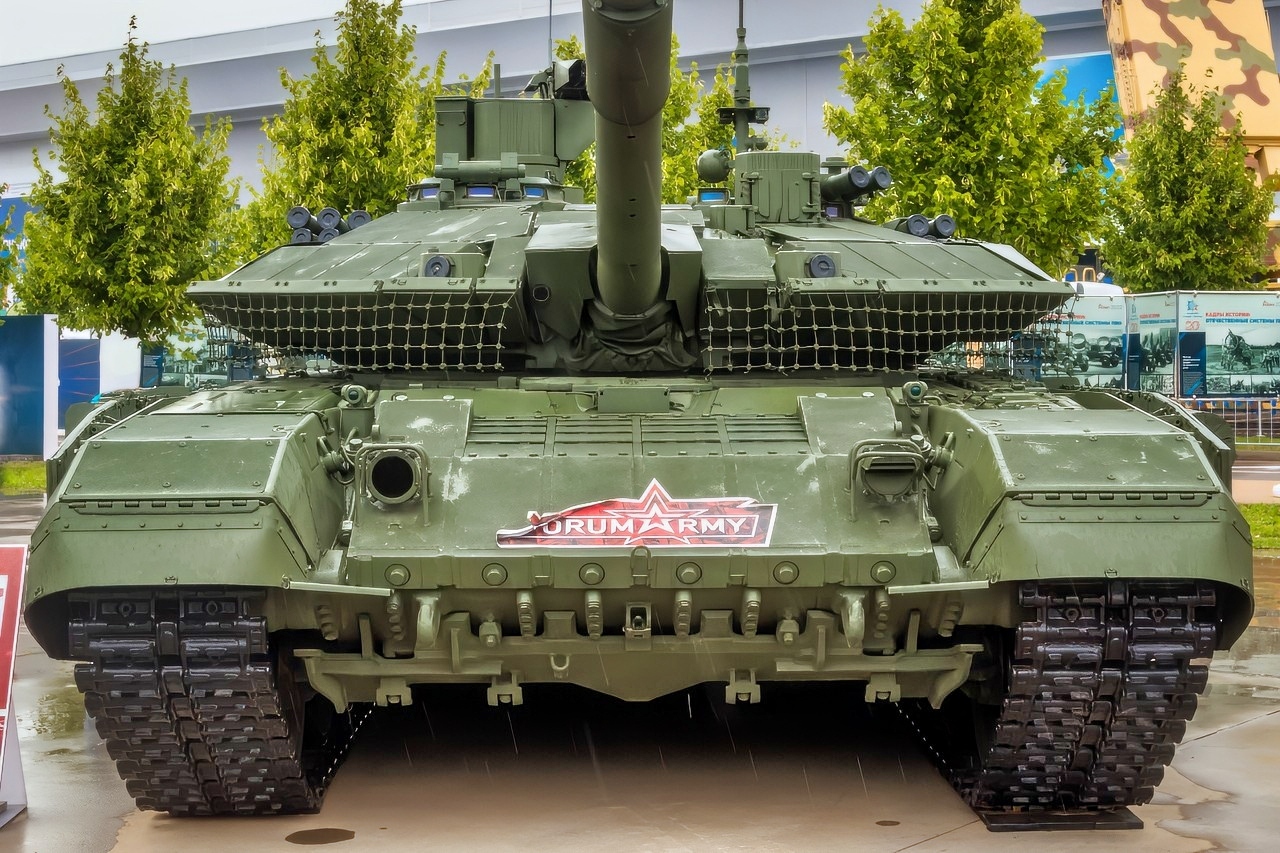
T-90M Russian Army. Image Credit: Creative Commons.
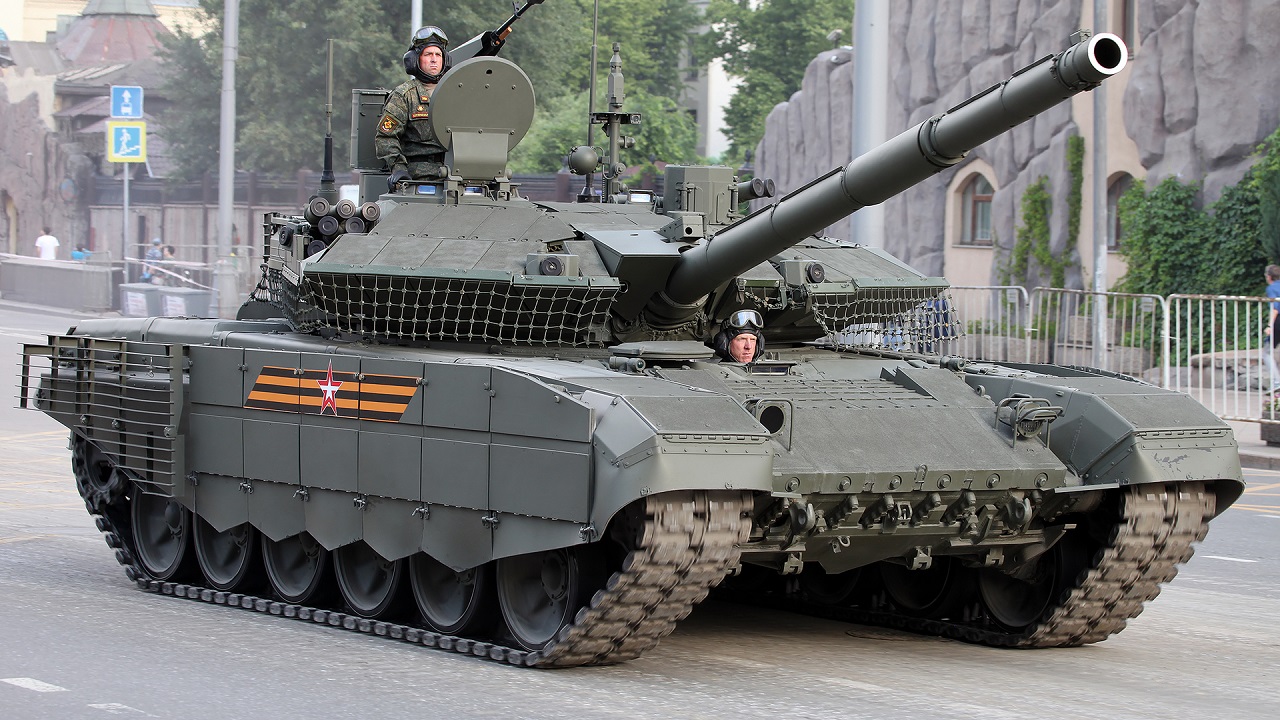
T-90M. Image Credit: Creative Commons.

Russian T-90 Tank. Image Credit: Creative Commons.

T-90M from Russia. Image Credit: Creative Commons.
The latest iteration of the T-90 tank, the “M” model, is being produced in record numbers, but Russia is losing tanks faster than they can be manufactured.
The T-90M tanks, however, are seen less and less on the battlefield, which lends itself to the question, “What is Russia’s overall long-term strategy?
The T-90M “Proryv” represents the most modernized iteration of the T-90 series, offering substantial upgrades over its predecessors.
Designed for high-intensity engagements, it features a newly designed turret with multilayer armor, Relikt explosive reactive armor (ERA), anti-drone screens, and a diesel engine generating 1,130 horsepower.
The tank retains the advanced Sosna-U gunner sight, despite sanctions-induced limitations that have affected other Russian models. The T-90M also integrates a digital fire-control system and enhanced situational-awareness tools, positioning it as Russia’s most capable armored platform currently in serial production.
Production Numbers Are Up, But Battlefield Losses Are Taking A Toll
A new report from the Conflict Intelligence Team (CIT), a group of open-source investigators, states that the expansion occurs amid the near-exhaustion of Russia’s usable tank reserves and an ongoing effort to sustain long-term combat operations.
CIT estimates that in 2022, Uralvagonzavod—the state-owned plant in Nizhny Tagil—produced between 60 and 70 T-90M tanks. In 2023, production is estimated to have surged to 140–180 units, and in 2024, it may have exceeded 200 units, possibly reaching 300 tanks.
This includes both newly built and modernized tanks. The company has reportedly expanded its operations to a 24-hour production cycle, issued tenders for new welding and machining stations, and is pursuing further technical upgrades to support future growth.
“The availability of new armored hulls does not appear to be a limiting factor,” CIT said. “All T-90M tanks currently being produced are newly built.”
However, the Institute for the Study of War (ISW) noted a dual trend: while tank production has surged, the frequency of their deployment on the battlefield appears to be declining.
Since the beginning of the full-scale invasion of Ukraine in 2022, Russia has likely produced between 540 and 630 T-90M tanks.
Russia has lost hundreds of T-90 tanks in Ukraine, with estimates from open-source trackers like Oryx showing 211 T-90 variants (including T-90M, T-90A, etc.) destroyed, damaged, abandoned, or captured, with some figures highlighting over 100 T-90Ms alone by mid-2024, even though Russia had fewer than 70 of these advanced models at the start of the invasion.
While exact numbers vary and are likely to increase, T-90 losses are significant: reports indicate approximately 145 T-90s lost by mid-2025, highlighting their vulnerability despite being modern tanks.
How Does The T-90M Stack Up Against Western Tanks?
Compared with NATO main battle tanks such as the Leopard 2A6 and the M1A2 Abrams, the T-90M offers less armor protection but compensates with agility, electronic countermeasures, and simplified maintenance.
Its cost-efficiency and production scalability are key advantages. Unlike the complex and expensive Armata platform, the T-90M is built on proven engineering, making it easier to scale under wartime pressures.
Historically, this mirrors Soviet Cold War and World War II doctrine that prioritized mass production over individual unit supremacy (See the T-34), a principle revived under current geopolitical constraints.
Russia appears committed to sustaining its heavy armor capabilities well into the next decade. For NATO and Ukraine, this development raises critical questions about armored warfare readiness, deterrence postures, and the future of defense industrial competition.
However, are the Russians holding them back for a massive armored counterattack, or are they planning on using them elsewhere? The Baltic countries of Latvia, Lithuania, and Estonia are targets of Putin’s. He has said he wants NATO out of those countries as a prelude to peace in Ukraine.
T-90s Suffer From An Old Design Flaw
A design flaw in Russian tank design, something the US and other Western nations have been aware of since the first Gulf War, is proving deadly for Russian forces since the invasion of Ukraine began.
Oryx, which has kept pretty accurate data on Russian losses during the Ukraine invasion, has the total tank losses for Moscow at a staggering 4,308, with another 8,735 armored or infantry fighting vehicles.
The design flaw of Russian armored vehicles is causing a “jack-in-the-box” type of scenario where the turrets blow off after a tank suffers even an indirect hit, killing the crew. Photos and videos from Ukraine are chock full of images of burnt-out Russian vehicles with their turrets blown off, littering the landscape.
Sam Bendett, who works as an adviser with the Russia Studies Program at CNA, said to CNN that “Any successful hit quickly ignites the ammo, causing a massive explosion, and the turret is literally blown off.”
It also affects Russian armored fighting vehicles, such as the BMD-4. Many defense officials and analysts say that Moscow should have seen this issue coming decades ago.
Why Are Russian Tanks “Blowing Their Top”?
The flaw in Russia’s armor stems from the way it designed the turret’s internal workings and the location of the ammunition. And back in 1991, the US-led coalition was having similar success destroying Russian-built Iraqi T-72s in the desert.
Western tanks store their ammunition in a sealed compartment with additional ballistic protection, and the loader opens and closes a door through which the ammunition is loaded. He then transfers the tank round into the main gun for firing. That loader is the fourth member of the crew, and if the turret were to be hit, there would be only one round inside the turret, which is inside the gun.
Russian tanks, however, have an autoloader, cutting the crew down to three. However, the ammunition in Russian tank design is stored in a carousel located at the base of the turret. While the design gives the tank a lower profile, making it harder to hit, it also means that up to 40 rounds of main-gun ammunition are stored within the turret. Any hit, even an indirect one, will cause the ammunition to explode.
The results have been deadly. When the turret and its ammunition explode, the turret can be launched to a height of up to two stories. One Russian tank exploded in Mariupol, and the turret landed on the roof of a five-story apartment building.
The flaws aren’t limited to the older T-72 tanks; the newer T-80 and T-90 series of tanks have a similar autoloading system, with ammunition stored inside the turret. While the armor surrounding the tanks has been improved, this flaw persists, and Western analysts point to the Russian military’s refusal to learn from the hard lessons of the Gulf War.
The T-90 is rapidly gaining a reputation as an “endangered species” on the battlefields of Ukraine.
About the Author: Steve Balestrieri
Steve Balestrieri is a National Security Columnist. He served as a US Army Special Forces NCO and Warrant Officer. In addition to writing on defense, he covers the NFL for PatsFans.com and is a member of the Pro Football Writers of America (PFWA). His work was regularly featured in many military publications.


Matthew Parker
February 7, 2026 at 12:35 pm
I find it funny this article comes out now when the exact same article with some slight changes was written in 2022 and 2023 and 2024.
By now there’s not a person who follows the defense industry, military action in Ukraine, or vehicle design that doesn’t know already about the auto loader and the turrets blowing off.
This is an extremely click bait happy article, so one has to think it’s recycled.
Steve would find new material if he went to Ukraine.
I’m sure there’s a story about how Western designed armor worked during the Kursk offensive or how ukrainians are using prop powered aircraft to intercept drones.