


In this war of incessant drone and missile attacks, the Ukrainians have endured many Russian strikes that continue to take a toll on civilian targets.
No target is off limits, even religious sites like churches, cathedrals, and monasteries, which are considered awful war crimes instigated by Vladimir Putin’s forces, are endangered.
While Volodymyr Zelensky’s military has done an admirable job fighting back and eliminating Russian unmanned kamikaze drones and other dangerous projectiles, its air defenses are suffering.

German soldiers assigned to Surface Air and Missile Defense Wing 1 fire the Patriot weapons system at the NATO Missile Firing Installation (NAMFI) during Artemis Strike Nov. 7 in Chania, Greece. Artemis Strike is a German-led multinational air defense exercise. German soldiers Over 200 U.S. soldiers and approximately 650 German airmen will be participating in the realistic training within a combined construct, exercise the rigors associated with force projection and educate operators on their air missile defense systems. (Photo By Officer Candidate Sebastian Apel, Air Defence Missile Group 24)
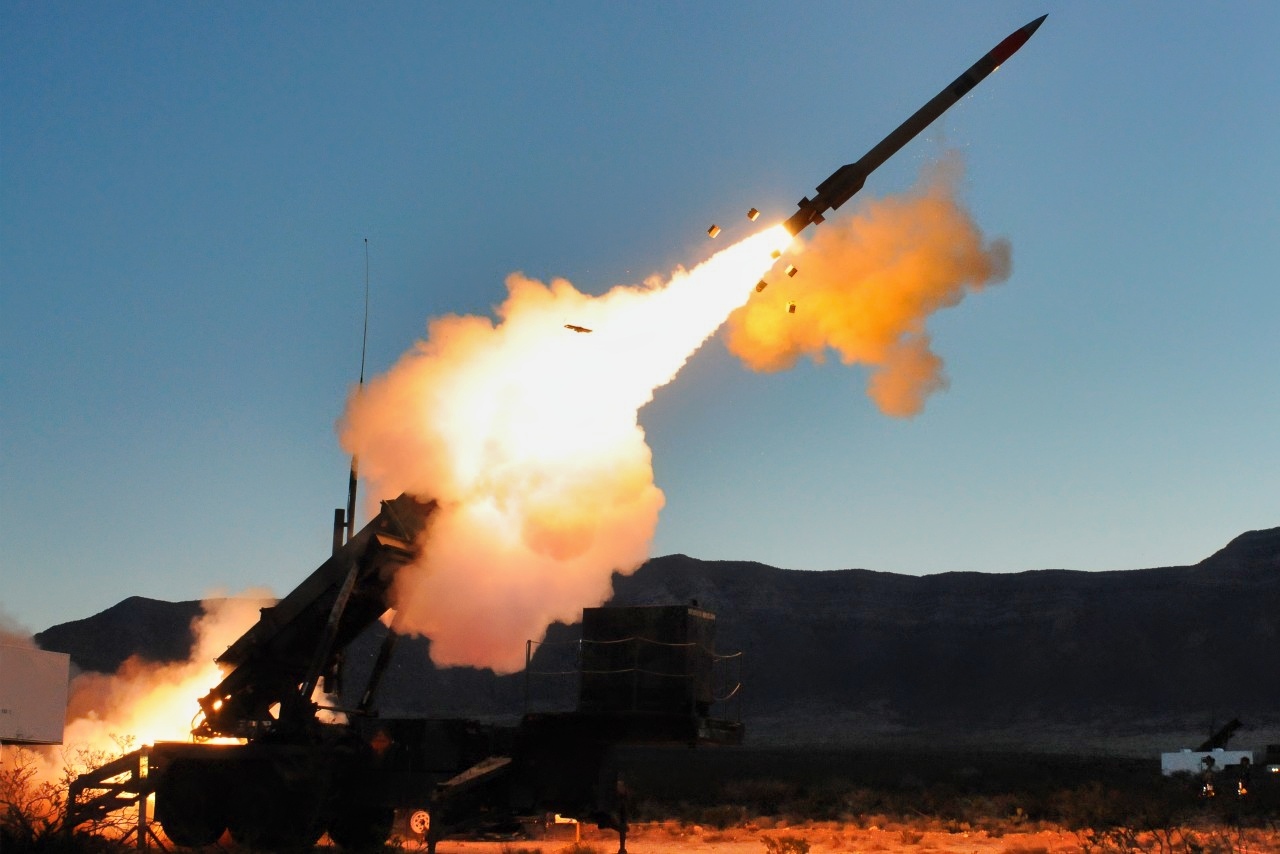
The PAC-3 MSE is a highly sought-after air defense munition due to its advanced capabilities and versatility. As a next-generation interceptor, it offers improved range, speed, and maneuverability, making it an effective counter to a wide range of threats, including tactical ballistic missiles, cruise missiles, and aircraft. (Official U.S. Army photo)
The Patriot Air Defenders Are Running Low on Interceptors
Patriot PAC-3 missile defenders are used around Kyiv and other major cities, but there are not enough batteries to go around.
The defenders are also running low on interceptors that knock out enemy missiles and loitering munitions.
Both Sides Are Struggling With Air Defenders
Russian battle planners are taking note.
The attackers have found that they can now exploit a Ukrainian weakness by sending saturation strikes to areas not protected by missile defenders.
This high-stakes game of tit-for-tat sometimes favors the Ukrainians when they hit Russian energy infrastructure like the Moscow Oil Refinery near the capital on June 16, but Putin has ordered his weapons to strike sensitive sites like religious buildings in Ukraine.
Russia Attacks Daily with At Least 1,000 Drones and Missiles
Moscow is ordering attacks that include more than 1,000 missiles and drones per mission, according to the New York Times.
That is just too much for Ukraine to handle with interceptors and anti-drone weapons stretched to capacity.
Volodymyr Zelensky’s forces must make a difficult decision about the number of enemy projectiles that they can address and eliminate at one time.
The Americans Need New Patriot Interceptors Desperately
Meanwhile, the United States is also running low on Patriot interceptors. These are expensive and time-consuming to produce.
And while a peace framework has now been signed by the Iranians and the Americans, the U.S. defense industrial base can only produce enough Patriot interceptors for its own forces.
The Ukrainians must wait a long time to receive a resupply.
U.S. Gulf Allies Are Also Running Low
It is not only the Americans and Ukrainians who are running short. U.S. Gulf Arab allies also rely on Patriot air defenders to protect their countries’ key targets.
They may also have to get in line for new Patriot interceptors.
Making a Cheaper and Easier to Produce Variant
This has become a global problem. The U.S. Army is asking defense firms to develop a cheaper model of the interceptor that is 80 percent less expensive than the ones they currently use.
The Army thinks this new version could be produced more quickly than the traditional interceptor that takes so long to make.
In April, RTX’s Raytheon signed an agreement with Ukraine to make more PAC-3 interceptors in a $3.7 billion deal. RTX is assembling the advanced GEM-T interceptor in Germany.
“Raytheon is focused on maximizing production capacity, ensuring a steady, reliable supply of these combat-proven interceptors for the U.S. and allies like Ukraine who rely on Patriot to protect their citizens, infrastructure, and sovereignty,” said Raytheon President Phil Jasper in a corporate news release.
“Raytheon is investing heavily to increase GEM-T production to support growing global demand, driven by major internal and partner investments, second‑sourcing initiatives, and the expansion of our global supply chain.”
Will It Be Enough?
Raytheon and RTX are being tight-lipped about how many Patriot GEM-T interceptors they are producing for Ukraine.
This is to keep Vladimir Putin guessing about the number of missile defenders active for Kyiv. The plant would need to run three shifts, 24/7, to keep the Ukrainians supplied with enough interceptors to defend their country.
For U.S. and Gulf allies, the Army has issued a request for proposals for a competitive bid to produce the new, less expensive, and quicker-to-make Patriot projectiles, but this will take a significant amount of time to feed all the hungry mouths.
The Trump National Security Team Denies the Shortage Is a Problem
Secretary of Defense Pete Hegseth denied in an interview over the weekend that low levels of missile stocks were hampering the U.S. military. But he has testified to Congress before that the numbers were dwindling.
Ukraine Recognizes the Problem
Ukraine is particularly troubled about its “magazine depth” for the Patriot interceptors. The country is large, and Russian attacks are extensive.
“A goalkeeper is standing in the goal, and suddenly 10 balls are flying at him at once.
He cannot catch all of them,” Col. Yurii Ihnat, a Ukrainian Air Force spokesman, told the New York Times. “He can catch as many as he has hands and feet, right?”
Dangerous Situation for Ukraine
Russia believes that it can keep attacking Ukraine with impunity and make the country suffer as it tries to fend off these massive saturation strikes.
Drones are cheap and plentiful. Putin also believes his cruise missiles are of high quality, which can avoid traditional air defenses that Ukraine produces indigenously to supplement the advanced Patriot system.
It is not clear how long Ukraine can hold out with such an insufficient supply of Patriot interceptors. There are just not enough projectiles to go around.
It could take months for the Army to produce the cheaper version and for the plant in Germany to keep up with Ukrainian needs.
We will keep an eye on the Patriot magazine depth in Ukraine. Missile and drone attacks will only continue, as this will be a permanent feature of modern war in which the country that can produce the most missiles and drones that can avoid air defenses will have the advantage.
Ukraine will need more Patriot interceptors from the German plant, or it may be staring at a situation in which its most vulnerable targets will continue to be destroyed.
About the Author: Brent M. Eastwood, PhD
Author of now over 3,500 articles on defense issues, Brent M. Eastwood, PhD, is the author of Don’t Turn Your Back On the World: A Conservative Foreign Policy and Humans, Machines, and Data: Future Trends in Warfare, plus two other books. Brent was the founder and CEO of a tech firm that predicted world events using artificial intelligence. He served as a legislative fellow for US Senator Tim Scott and advised the senator on defense and foreign policy issues. He has taught at American University, George Washington University, and George Mason University. Brent is a former US Army Infantry officer. He can be followed on X @BMEastwood.


