


Key Points and Summary – Poland is sharply strengthening its air defenses. The Pentagon’s DSCA approved a major boost to Warsaw’s AIM-9X Block II Sidewinder buy—an extra 120 missiles, lifting the package to $319.2 million.
-In parallel, U.S. Merops anti-drone systems have arrived, offering accurate, low-cost drone detection and defeat along NATO’s eastern flank.

Su-35 Fighter X Screenshot
-These moves follow Russian drone violations of Polish airspace and complement broader upgrades: a potential $1.85B F-35 sustainment case, ongoing pilot training in the U.S., and the rollout of Poland’s 32-jet F-35A “Husarz” fleet.
-Net effect: faster readiness, better short-range air combat punch, and a tighter counter-UAS shield for NATO’s front line.
Poland Is Massively Updating Its Military
The Pentagon’s Defense Security Cooperation Agency (DSCA) has approved a “major increase to an existing missile sale to Poland,” with Poland expanding its purchase of AIM-9X Sidewinder Block II Tactical Missiles, Kyiv Post reported Friday, citing Congressional sources.
It’s one of several new reinforcements of the defenses of Poland this year, especially after Russian drones fell into its airspace in September.
The original Foreign Military Sales (FMS) package had been approved in the summer of 2024 by the Biden Administration and was priced at $219.1 million, but has now had a “significant enhancement.”
The new deal will add 120 AIM-9X Block II missiles, raising the value by $100.1 million to $319.2 million.
The purpose, the DSCA report said, is to“support Poland’s capability to meet current and future threats by providing more flexibility and maintaining its capability to counter regional threats.”
It’s also an opportunity, per the report, for the U.S. to assist an ally.

Su-35 Fighter. Image Credit: Creative Commons.
“This proposed sale will support the foreign policy and national security objectives of the United States by improving the security of a NATO Ally that is a force for political stability and economic progress in Europe.”
The report also stated that the quick turnaround is an example of “the urgency both the Pentagon and State Department place on shoring up NATO’s eastern defenses amid ongoing instability in Eastern Europe.”
Anti-Drone Systems, Too
According to the website Notes From Poland, which cited a social media post from Polish Defense Minister Władysław Kosiniak-Kamysz, new American anti-drone systems have been deployed to Poland, as well.
“American Merops anti-drone systems are already in Poland!” The defense minister wrote. “Along NATO’s eastern flank, systems are being deployed that will enhance our capabilities for detecting and countering drones.”
US Colonel Mark McLellan, assistant chief of staff for operations at NATO Allied Land Command, told the AP this week that the Merops system provides “very accurate detection” of foreign drones.
“It’s able to target the drones and take them down and at a low cost as well,” McLellan said in the story. “It’s a lot cheaper than flying an F-35 into the air to take them down with a missile.”
The system, per the AP, is compact enough to “fit in the back of a midsize pickup truck.” NATO officials also told the AP that the system will also be deployed to Denmark.
Euractiv had reported this fall that the Merops system would be deployed to Poland and Romania. Former Google CEO Eric Schmidt, the AP story said, is among the investors in the Merops company.
Further Enhancements
This follows the report in August by Reuters that the U.S. had approved a potential $1.85 billion sale of F-35 sustainment to Poland. The deal was for “sustainment and related elements of logistics and program support” for the F-35s, and the main contractor will be General Electric Aerospace.
And earlier this week, Army Recognition reported that Poland’s Ministry of National Defence had confirmed that a pair of F-35A Lightning II aircraft for the Polish Air Force had taken flight.
The flight, the report said, “marks visible progress in Poland’s effort to field a modern fifth-generation fleet aligned with NATO standards.” A total of seven aircraft have now rolled out of Lockheed Martin’s assembly line.
“This latest update from Warsaw reaffirms Poland’s determined timeline to field all 32 F-35A stealth fighter jets as contracted under the historic January 2020 agreement signed with the United States,” Army Recognition said.
“The Polish government’s confidence in meeting the planned milestones, despite the program’s complexity and Europe’s heightened security climate, underscores a serious commitment to achieving a next-generation air combat capability by the second half of this decade.”
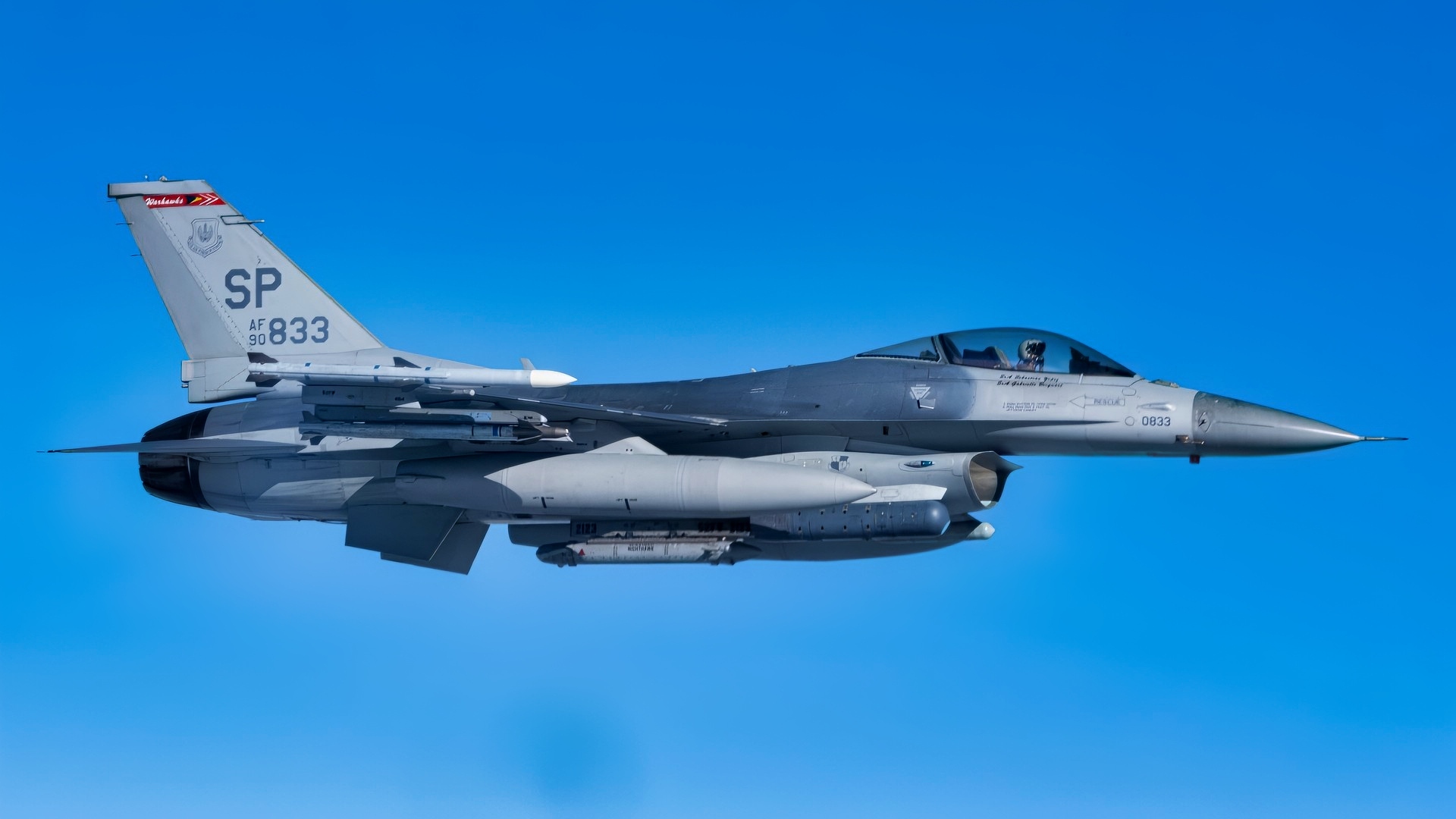
A U.S. Air Force F-16 Fighting Falcon from the 52nd Fighter Wing, Spangdahlem Air Base, Germany, flies during an Agile Combat Employment movement over Poland, Feb. 29, 2024. ACE is a military concept aimed to deny adversaries the advantage of predictability, while concurrently enhancing U.S. Air Forces in Europe’s capacity to respond swiftly to emerging threats. (U.S. Air Force photo by Airman 1st Class Christopher Campbell)
That report also said, citing sources, that jets in U.S. airspace are being used to train Polish air crews at Luke Air Force Base in Arizona and Ebbing Air National Guard Base in Arkansas.
Poland’s F-35 fleet will be called the Husarz squadron and per the Army Recognition story. When an in-country F-35 unit is established, per the report, it will be based at the 32nd Tactical Air Base in Lask.
What It Means For Poland
“For Poland, the expansion represents a strategic investment in modernizing its air-to-air arsenal and equipping its growing fighter fleet – including its incoming F-35s – with one of the world’s most capable short-range missiles,” Kyiv Post reported.
The sale comes amidst an eventful few months on NATO’s Eastern flank, on which Poland is on the front line.
Back in September, Russian drones violated Poland’s airspace, leading to the scrambling of NATO jets and Poland invoking Article 4 under the NATO charter. There were other incursions, in recent months, into both Poland and Romania.
Colby Badhwar, a defense analyst with the research group Tochnyi, told Kyiv Post it was an act of “proactive defense planning” on the part of Poland.
“Russian aircraft continue to probe NATO airspace, so Poland wants to buy more air-to-air missiles for their fighter jets,” Badhwar told Kyiv Post.
On the official F-35 website, under Poland, it says that “our partnership is centered on helping Poland defend against outside threats while strengthening the country from within.” The U.S. and Poland had agreed in 2020 on a Letter of Offer and Acceptance for 32 F-35A jets. That came two years after Poland had announced the establishment of a new fighter aircraft program.
Speaking of Those Missiles
Raytheon announced in June that it had been awarded a $1.1 billion contract from the U.S. Navy to produce AIM-9X Block II missiles. The company described it as the largest contract awarded yet for the program, which would allow the Navy to up production to 2,500 missiles per year.
“This award represents a historic milestone for the AIM-9X program, further emphasizing its importance to the U.S. and partnered nations,” Barbara Borgonovi, president of Naval Power at Raytheon, said in the June announcement. “Through our partnership with the U.S. Navy, we are well-positioned to support this increased demand.”
About the Author: Stephen Silver
Stephen Silver is an award-winning journalist, essayist, and film critic, and contributor to the Philadelphia Inquirer, the Jewish Telegraphic Agency, Broad Street Review, and Splice Today. The co-founder of the Philadelphia Film Critics Circle, Stephen lives in suburban Philadelphia with his wife and two sons. For over a decade, Stephen has authored thousands of articles that focus on politics, national security, technology, and the economy. Follow him on X (formerly Twitter) at @StephenSilver, and subscribe to his Substack newsletter.
More Military
Europe’s New 6th Generation GCAP Stealth Fighter Looks Unaffordable
49 ‘New’ M1A1 Abrams Tanks Were Sent to Ukraine by Australia and America Doesn’t Approve
The U.S. Marine Corps Is Facing a Tough Drone Reality
‘300 Percent More Lethal’: The U.S. Army Is Putting China and Russia on Notice


Jim
November 10, 2025 at 12:36 pm
Poland has a specific history.
A once powerful state, the Polish–Lithuanian Commonwealth, ceased to exist after the late 18th-century partitions of Poland by the three neighboring empires of Russia, Prussia, and Austria.
For over a century, Poland didn’t exist, although, Poles, divided among the three annexing powers above, did retain their Polish language, identity & culture and yearning for nation-state status once again.
In the aftermath of World War One, all three powers above were defeated and the crown jewel of the Versailles Peace Treaty was the reconstitution of Poland.
NAZI Germany invaded Poland in 1939 and together with the Soviet Union divided and annexed Poland once again.
After the war, Poland was recognized, but reduced in size (mostly by takings of the Soviet Union) and fell under the political & military power and domination of the Soviet Union.
Finally, in the 1980’s Poland gained a level of political autonomy and upon the collapse of the Soviet Union in 1991 gained final and complete political & military independence.
This is a long and difficult history for a proud & robust People and their sense of nationhood and their place in Europe.
Poland never wants to repeat the above experience.
So, it makes sense, Poland is arming itself as much as it can.
I don’t begrudge Poland for arming itself and wanting NATO to be a strong deterrence and keep the peace.
Still, Poland must be responsible and realistic along with being in a high state of military readiness & preparation for potential military action.
With great power comes the need for great responsibility, wisdom, and restraint in the face of potential provocation.
The United States counts on Poland to exercise all the above qualities (as does the rest of Europe).
But it would also behoove Poland to have constructive & positive relations with Russia and Belarus… not seek out undue antagonisms and hostility.
How Poland handles all the above going forward will have a great determinative effect on the overall Peace of Europe, now, and in the decades to come.