

Ukraine announced another successful long-term attack on Russian infrastructure on Wednesday, hitting the Taneco oil refinery in Russia’s Tatarstan region, Bloomberg News reported.
The facility is 900 kilometers (560 miles) east of Moscow, according to a map posted to Telegram by the General Staff in Kyiv.
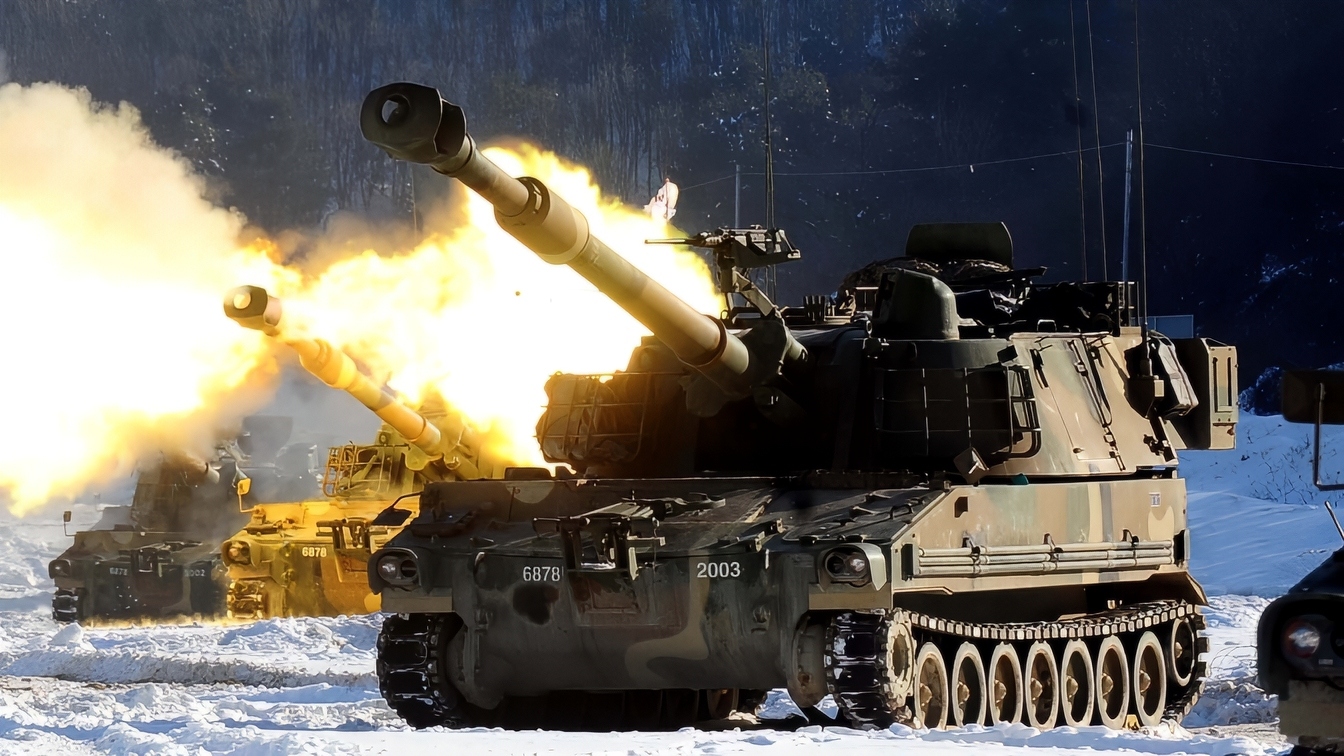
M109 Artillery Creative Commons Photo.
In another strike the same night closer to home, Ukraine struck the Tamanneftegaz oil terminal on the Russian side of the Black Sea.
That terminal, per Bloomberg, has a loading capacity of 20 million tons a year.
Per Bloomberg, the latest attacks bring the total in the current wave of attacks on Russian oil infrastructure this month to “nine oil-processing sites and the key Black Sea port of Novorossiysk.”
The report added that the Taneco plant processes 300,000 barrels a day and supplies eastern Russia.
According to the Kyiv Independent, Ukraine had targeted the plant before, including on August 10.
A Russian Fuel Crisis?
A Euronews report on Thursday reported that Ukraine’s sustained attacks on Russia’s energy infrastructure have “caused fuel shortages so severe that the Kremlin has admitted it.”
This has led to gas lines in the Moscow area, and Russia has even brought back “low-grade fuel” that was previously banned, including the Euro-2, Euro-3 and Euro-4 petrol.
That report said that petrol was available at fewer than three in ten stations across Russia, citing the monitoring app Gdebenz.
Gasoline is available at 28 percent of filling stations in the country as of Wednesday, down from 41 percent just a week before.
Russia, per that report, has put a series of fuel restrictions in place, including “limits on the volume sold per customer, QR-based rationing and odd-even number plate schemes.”
As per Euronews, Russian President Vladimir Putin had described Ukraine’s attacks as “non-critical” in July, and expressed a similar sentiment this week.
“There are no critical consequences from such attacks, there have been none, and there cannot be any. But they do, of course, cause us damage; that is obvious, we understand it, we see it, and we know it,” the Russian leader said this week.
Other measures Russia took include banning petrol and diesel exports last month and importing fuel by rail from Kazakhstan, Belarus, and Morocco. Russia also received a shipment of gasoline from India, Reuters reported earlier this week.
However, some of that imported fuel has not reached customers because, per Euronews, “large volumes of Indian and Moroccan petrol are stuck at Murmansk because suppliers want between 110,000 and 130,000 roubles per tonne, while the state regulator is demanding a price below 78,000 roubles.”
Censorship of Complaints?
Meanwhile, The Daily Telegraph reported from Kyiv that the Kremlin has been censoring Russians’ complaints about the gasoline shortages.
According to that report, a PR stunt was recently staged in which “a group of adoring children” greeted Putin at a petrol station in Novosibirsk, rather than angry motorists.
“Beyond the children’s smiling faces was a reality that Russians are facing every day: an empty petrol station with its price board switched off,” the Telegraph reported.
It’s described as a “second wave” of fuel shortages in Russia, after the one in July.
The Russian president, the newspaper said, is “censoring the outrage felt by ordinary Russians. They now face fines and arrest for daring to complain about the lack of fuel.”
In addition, Putin has taken things a bit further.
“Concerned about social disorder and fuel-related violence, Putin has reportedly deployed Rosgvardia paramilitary units to gas stations in the Moscow region.” Those units have been sent to 13 stations throughout the area.
Meanwhile, when five residents in Volgograd recorded an appeal to Alexander Bastrykin, the chairman of Russia’s investigative committee, about fuel shortages, police detained them, the Telegraph said. The police described their protest as an “unauthorized public gathering.”
Per Kyiv Post, one participant received five days of detention, while another was fined 10,000 rubles (about $118). Something similar was reported in Perm, including a 10,000-ruble fine.
“Russian energy officials discussed fuel supplies in at least 10 regions, including Orenburg, Lipetsk, Tver, Krasnodar, Zabaykalsky, Primorsky, Krasnoyarsk, Oryol, Tuva, and Khakassia,” the Kyiv Post report said of the Russian regions affected.
About the Author: Stephen Silver
Stephen Silver is an award-winning journalist, essayist, and film critic, and contributor to the Philadelphia Inquirer, the Jewish Telegraphic Agency, Broad Street Review, and Splice Today. The co-founder of the Philadelphia Film Critics Circle, Stephen lives in suburban Philadelphia with his wife and two sons. For over a decade, Stephen has authored thousands of articles that focus on politics, national security, technology, and the economy. Follow him on X (formerly Twitter) at @StephenSilver, and subscribe to his Substack newsletter.


