

Key Points and Summary – Russia and Ukraine are both using the Su-25 “Frogfoot” for close air support, but Russia’s Su-25SM3 variant has a “game-changing” advantage: the Vitebsk-25 electronic warfare (EW) suite, which deflects incoming missiles.
-Ukraine’s Su-25M1 lacks this advanced protection, leaving its pilots “far more exposed.”
-This technological gap dictates tactics: Russian pilots can operate more aggressively, while Ukrainian pilots must rely on “clever piloting,” low altitudes, and Western standoff munitions.
-The heavy attrition in this “mutual air denial” environment suggests the Su-25 is in its “twilight,” likely the “last” manned CAS jet of its kind.
Su-25 Frogfoot vs Frogfoot: Ukraine and Russia Fighting With the Same Jet
Despite its origins in the Cold War, the Sukhoi Su-25 remains central to both Russian and Ukrainian close air support (CAS) operations today.
Some, in fact, call it a flying tank and compare it to the legendary A-10 Warthog.
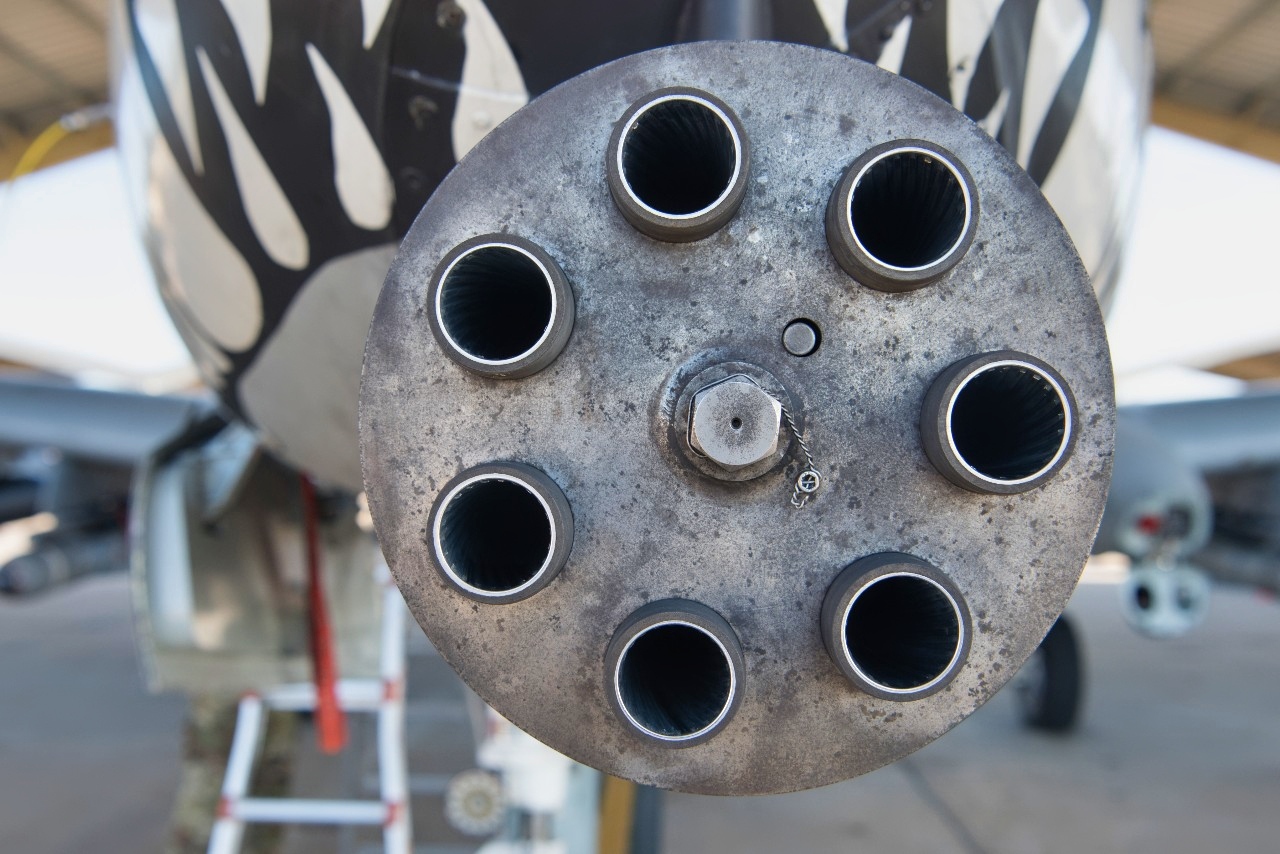
A GAU-8 Avenger 30mm cannon in the nose of an A-10 Thunderbolt II, assigned to the 442d Fighter Wing, at Whiteman Air Force Base, Missouri, April 9, 2021. The GAU-8 is a hydraulically-driven rotary autocannon capable of firing 3,900 rounds per minute with a variety of ammunition types for close air support missions. (U.S. Air Force photo by Senior Airman Parker J. McCauley)

A U.S. Air Force A-10 Thunderbolt II approaches a KC-135 Stratotanker for refueling over the U.S. Central Command area of responsibility, May 31, 2025. The KC-135 is the premier long-term aerial refueling capability for the U.S. Air Force, effectively providing fuel to fixed-wing aircraft operating with the USCENTCOM AOR. (U.S. Air Force Photo by Staff Sgt. John C.B. Ennis)
Russia fields the upgraded SM3 variant, designated the Su-25SM3, with advanced avionics.
Meanwhile, Ukraine continues to operate an earlier modernized version of the aircraft, the Su-25M1 and some other M1K variants, which have fewer defensive upgrades but have been adapted to use modern Western munitions.
The fact that both sides deploy variations of the same airframe is by no means surprising, but it is a testament to the fact that legacy CAS platforms remain useful – and how modern warfare is forcing both sides to use every resource possible to defend their respective airspace.
Meet the “Frogfoot”
The Su-25 was developed in the Soviet Union in the 1970s and entered service in the early 1980s as an armored, low-altitude jet built to deliver rockets, bombs, and cannon fire to support ground forces. Its NATO reporting name is “Frogfoot.”
The design of this aircraft was squarely focused on survivability, featuring an armored cockpit and fuel tanks, and the capacity for a heavy ordnance load—but it also predated modern integrated air defense systems and precision weapons.
It is a product of its time, but with some upgrades, it has proven hugely valuable to both sides in the ongoing conflict in Ukraine.
As Western air forces slowly shifted away from dedicated CAS platforms, opting instead for modern multirole fighters and now drones, Russia extended the Su-25’s service life through a series of upgrades.
Following the collapse of the Soviet Union, Ukraine inherited a fleet of these aircraft and has, over time, upgraded them in different ways.
Russia vs. Ukraine
Russia’s newest version of the aircraft, the Su-25SM3, is a far cry from the Cold War jet it was at the beginning.
It features a digital navigation system and an onboard computer, which improve flight stability, bomb accuracy, and target tracking.
It also integrates the SOLT-25 electro-optical targeting system, allowing pilots to identify and strike targets at night or through cloud cover.
The most important change, however, lies in the Vitebsk-25 electronic warfare suite— a defensive system designed to deflect incoming missiles and automatically launch countermeasures, including flares and chaff.
The upgrade gives the Su-25 a fighting chance when operating in airspace filled with modern man-portable air-defense systems (MANPADS) and radar-guided interceptors.
And, combined with compatibility for modern guided munitions like satellite- and laser-guided bombs, the SM3 is as contemporary as this old platform can get.
Ukraine’s Su-25M1, however, is different. While the airframes are roughly the same age, the upgrades are lighter.
The M1 upgrade program added satellite navigation and modern radios, allowing for better coordination with ground forces, along with modest improvements to the cockpit displays and the jet’s aiming systems.
What it lacks, though, is the comprehensive defensive suite fitted to the Russian variants. The Ukrainian Frogfoot has no equivalent to Russia’s Vitebsk-25, meaning Ukrainian pilots are far more exposed to surface-to-air fire.
In practice, that difference decides how pilots on both sides fly their aircraft. Russia’s frogfoot relies on its stronger protection and improved sensors to push closer to the front lines. Ukraine, however, is unable to compete fully and must therefore compensate through tactics.
That means lower flight altitudes, shorter exposure times, and an increased reliance on Western-supplied precision munitions that allow attacks from a safer distance. So while the Su-25 remains effective on the battlefield, its survival depends on either advanced electronics or clever piloting.
The Last Generation Of Manned CAS?
The conflict in Ukraine may well mark a shift in the era of manned close-air-support aircraft. The presence of both Russian and Ukrainian variants of the Su-25 Frogfoot is undoubtedly a testament to the persistence of Cold War-era design.
Still, it might also be the last example—or at least one of the final examples—of these kinds of aircraft playing a significant role.
Both sides are operating in what analysts call a “mutual air denial” environment—meaning neither force has technically achieved clear air superiority, and both face modern air-defense systems that make low-altitude flight very dangerous.
In this context, drones and stand-off weapons are increasingly dominating the landscape. Ukraine, for example, has used drones and precision munitions for years now, striking Russian positions while avoiding the high-risk profile and presence of older manned aircraft.
Most famously, Ukrainian drones took out millions of dollars of Russian aircraft in Operation Spider’s Web.
The Su-25 is thus clearly in its twilight. Yes, it continues to fly, but as drone manufacturing infrastructure improves, drone-led operations become the obvious answer for all sides. In the future, CAS may no longer involve manned jets like these alone.
This could be their last flight.
About the Author:
Jack Buckby is a British author, counter-extremism researcher, and journalist based in New York. Reporting on the U.K., Europe, and the U.S., he works to analyze and understand left-wing and right-wing radicalization, and reports on Western governments’ approaches to the pressing issues of today. His books and research papers explore these themes and propose pragmatic solutions to our increasingly polarized society. His latest book is The Truth Teller: RFK Jr. and the Case for a Post-Partisan Presidency.
More Military
China Might Have a Way to ‘Swarm’ U.S. Navy Aircraft Carriers
India Leases Russia’s ‘Stealth’ Nuclear Attack Submarines
The Mach 3 SR-71 Blackbird Deserves A Better Fate Than This
The F-14 Tomcat Fighter Was ‘Notoriously Difficult and Costly to Keep Operational’


