


Key Points and Summary – The Soviet Sierra class (Projects 945 and 945A) wrapped a modern attack submarine around a titanium pressure hull to chase depth, speed, and a low magnetic signature.
-That choice bought real tactical advantages—bigger maneuvering room at depth, resilience, and less magnetic vulnerability—but at immense cost in factories, welding tech, and sustainment.
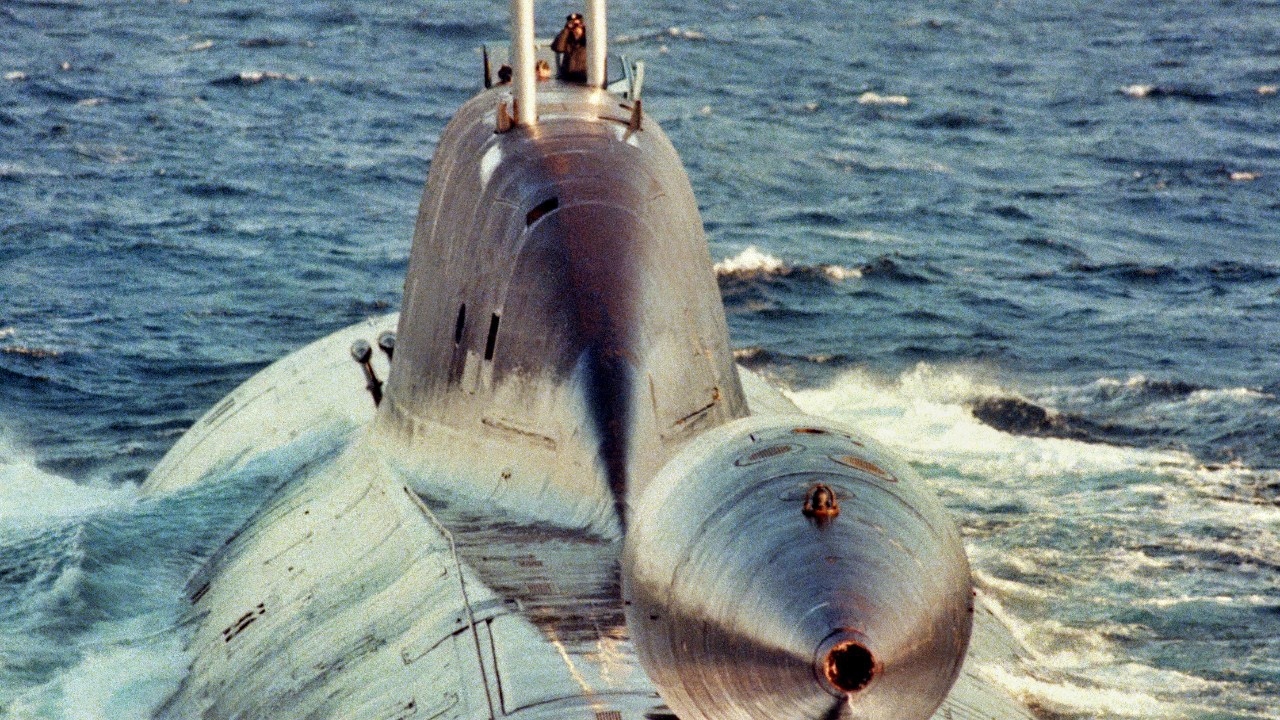
An aerial stern-on view of the Russian Northern Fleet AKULA class nuclear-powered attack submarine underway on the surface. Image Credit: Creative Commons.

Akula-Class. Image Credit: Creative Commons.
-With good sonars, 533/650-mm torpedoes (earlier units), rocket-assisted ASW weapons, and mines, Sierras were built to hunt U.S. submarines and complicate carrier defenses.
-Against Los Angeles-class they traded depth for U.S. quieting; Seawolf-class outclassed them; Virginia-class wins with sensors and stealth.
-The sting that remains: only four were built; two meaningfully serve today.
-Note: all images are of various other classes of Russian submarines, as the pictures for the Sierra-class that are Creative Commons are ancient and dated.
The Sierra-Class: Russia’s Titanium Dagger That Never Became A Sword
The Sierra-class (Projects 945 Barrakuda and 945A Kondor) sits in that tiny club of submarines that feel more like engineering statements than mere warships.
At a glance, they looked like another late–Cold War Soviet attack boat. Under the skin, they were something else—a titanium-hulled bid to out-dive, out-sprint, and outlast the U.S. Navy’s best. They were proof that Moscow would pay in rubles and factory miracles to buy back operational advantages it couldn’t get any other way. And yet, for all the brilliance in the design, only a handful were built.
The Problem Moscow Was Trying To Solve
By the 1970s, U.S. boats were getting frighteningly quiet. The Los Angeles class took the acoustic race into a new gear, and American sonar, training, and weapons were closing the loop. The Soviet answer was to change the geometry of the fight: build boats that could go deeper, tolerate more punishment, shed magnetic signature, and keep enough speed in reserve to control an engagement. A titanium pressure hull answered all of those requirements on paper—if you could master the metallurgy, the welding, and the yard infrastructure to make it real.
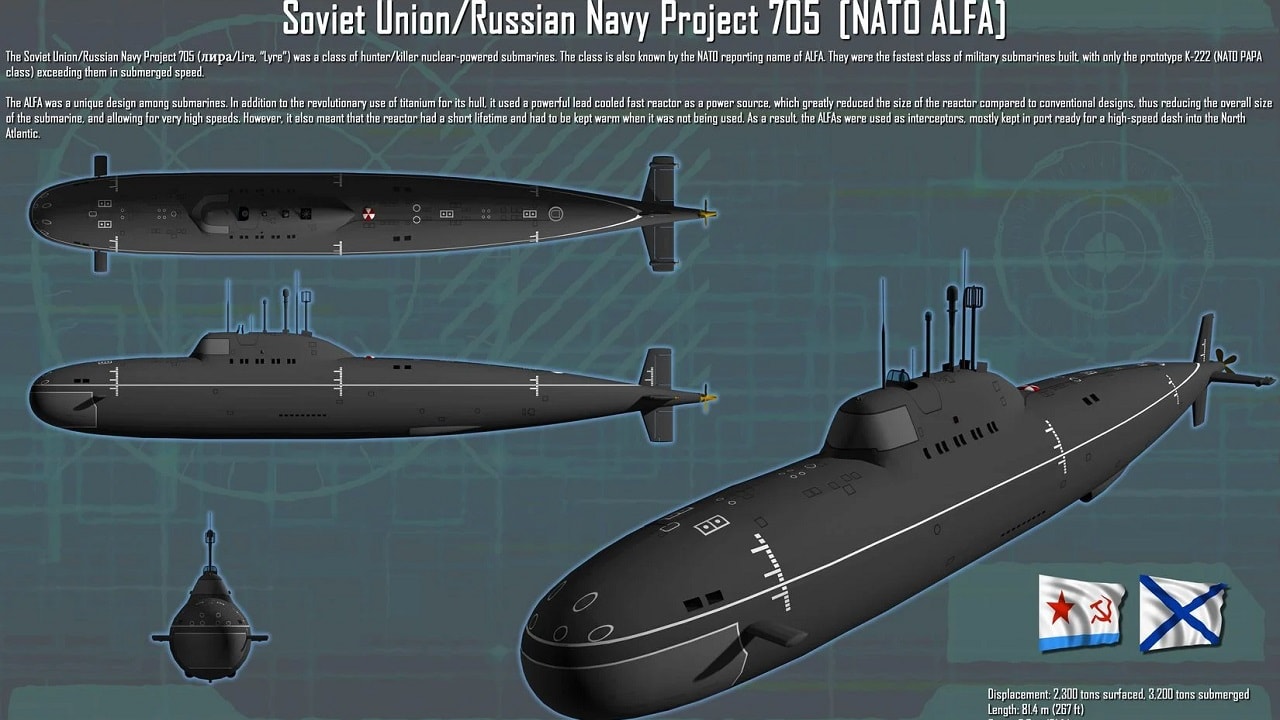
Alfa-Class Submarine. Image Credit: Creative Commons.
That’s the context for the Sierra program: a hunter-killer meant to stalk U.S. submarines, shadow carrier groups, and operate in the high latitudes where depth, strength, and non-magnetic construction complicate Western sensors and mines.
Building A Titanium Answer
Titanium is not a “swap it in” material. The Soviets created enormous controlled-atmosphere welding halls and electron-beam processes to fabricate full-size pressure-hull rings. They trained specialized welders, rewrote inspection standards, and accepted the cost of a supply chain that few nations could sustain.
The payoff was a strong, corrosion-resistant, low-magnetic hull that could be lighter for the same strength—freeing displacement for sensors, weapons, and quieting measures.
The layout followed familiar Soviet logic: a double-hull with anechoic tiles outside and a titanium pressure cylinder within; a single OK-650 pressurized-water reactor; rafted machinery to cut structure-borne noise; and, on later boats, a larger, blunter sail that housed twin escape capsules—a safety philosophy carried over from other high-performance Soviet designs.
The Sierra II-class stretched the class and reorganized the bow around a large spherical sonar, pushing torpedo tubes aft and angling them outboard to make room. The result was a true third-generation attack boat built around sensing and killing submarines first.
What The Sierra Could Actually Do
Start with the envelope. The titanium hull gave the Sierras very high operating depth margins (commonly described as 500 meters–plus) and excellent resistance to corrosion and shock. That depth isn’t just bragging rights—it widens the maneuvering room in a duel and makes certain weapons and sensors less effective. Pair that with high submerged speed from a powerful plant and a clean, stiff hull, and you get a boat that can run the tactics of its choosing more often than not.

Mike-Class Submarine from Russia. Image Credit: Creative Commons.
The sonar suite—centered on the “Skat” family and augmented by towed and flank arrays—gave the class a search picture the earlier Soviet boats lacked. Weapons were carried in quantity (about 40 torpedo-size rounds), and across types: heavyweight torpedoes, rocket-delivered antisubmarine weapons from the tubes, and land-attack cruise missiles in some fits.
Sierra-class I boats mixed 533 mm and 650 mm tubes; the later Sierra II, with its bigger bow array, standardized on 533 mm launchers and relied on improved weapons and fire-control rather than brute tube diameter.
Either way, a Sierra could tailor its loadout to the patrol—heavy torpedoes for sub hunting, mixed rocket-torpedoes for reach, mines for chokepoints, and conventional or nuclear warshots as doctrine required.
And beyond the combat numbers, there were the day-to-day advantages: little or no deperming thanks to the low magnetic signature; fewer corrosion headaches; and structural margins that aged well in harsh northern waters.
How It Stacked Up Against Los Angeles, Seawolf, And Virginia
Against Los Angeles (SSN-688): The early LAs set the U.S. standard for speed and carried excellent sonars for their era, but their true advantage was quiet—especially in the Improved 688 boats with better isolation and a towed array.
On depth and survivability, the Sierras likely had an edge; on acoustic discretion, the Americans kept theirs. In a duel, the side that hears first usually wins; titanium doesn’t change that equation unless you can also close the quieting gap.
Against Seawolf (SSN-21): Seawolf was America’s “money no object” answer to the late Soviet threat: very deep, very fast, extremely quiet, with a massive magazine and (unlike Sierra) a pump-jet propulsor.
Here the U.S. flipped the Soviet play: matched or exceeded the Sierra’s envelope while keeping a decisive edge in noise control and sensors. On paper and under the sea, Seawolf outclassed Sierra, at least according to most experts I have talked to over the last decade or so.
Against Virginia (SSN-774): Virginia is a different creature—optimized for stealth, sensors, modular payloads, and littoral reach rather than headline speed or depth.
Even so, her acoustic discretion and processing power mean she would generally dictate the terms of an encounter with a Sierra.
Where Virginia doesn’t chase eye-popping depth or sprint speed, she wins with what modern undersea warfare actually rewards: being the first to detect and classify, networking that information, and firing modern weapons with high confidence.
Put simply: Sierra pursued performance margins; the U.S. boats invested in acoustic invisibility and sensor fusion. That philosophical split defined the endgame of the Cold War underwater—and still does.
The Sierra-Class Sting: A Brilliant Class Built In Tiny Numbers
If the design was so good, why so few? Because the same choices that produced the Sierra’s advantages also strangled its scale.
Cost And Complexity. Titanium plate, controlled-atmosphere welding, giant EB facilities, specialized NDI—the price per hull was staggering.
Industrial Bottlenecks. Only select yards could handle the material and the processes. When schedules slipped—or budgets did—there was no easy way to surge production.
Maintenance And Repair. Wartime repairs or even deep depot work on titanium are not simple “open the shop” tasks. You need specialized tooling and time. For a navy with global aspirations and tight budgets, that’s a forever tax.
History’s Timing. The Soviet Union collapsed just as the class might have reached steady state. Money ran out; priorities shifted to more economical designs.
The result: two Sierra I and two Sierra II boats made it to the fleet, with later follow-ons canceled or scrapped on the ways. A dagger, not a sword.
What Endures—And What Faded
Two Sierra IIs, Nizhny Novgorod and Pskov, have cycled through overhauls and still surface in Northern Fleet exercises. They remain impressive machines and hard problems for any adversary. But the legacy of the class is larger than two hulls.
Sierra-class proved that the Soviets could field operational titanium attack boats in meaningful numbers—just not in the numbers that change a force balance. It pushed bow sonars bigger, taught a generation of designers and crews about deep operations, and forced the U.S. to keep its foot on the quieting pedal.
What faded is the idea that titanium-hulled attack boats can form the backbone of a navy. The economics never penciled out, even for a command economy.
The United States got to the same—or better—combat outcomes with high-grade steels, relentless acoustic discipline, and world-class sensors and weapons.
Russia learned the same lesson the hard way: when budgets tightened, Akulas and then more conventional designs kept the undersea force alive. Sierra remained the exotic.
That’s the Sierra-class story in a sentence: a triumph of materials science and willpower, built for a knife fight that increasingly turned on who could whisper the quietest, not who could dive the deepest. Marvel at it. Respect it. And understand why there were so few.
About the Author: Harry J. Kazianis
Harry J. Kazianis (@Grecianformula) is Editor-In-Chief and President of National Security Journal. He was the former Senior Director of National Security Affairs at the Center for the National Interest (CFTNI), a foreign policy think tank founded by Richard Nixon based in Washington, DC. Harry has over a decade of experience in think tanks and national security publishing. His ideas have been published in the NY Times, The Washington Post, The Wall Street Journal, CNN, and many other outlets worldwide. He has held positions at CSIS, the Heritage Foundation, the University of Nottingham, and several other institutions related to national security research and studies. He is the former Executive Editor of the National Interest and the Diplomat. He holds a Master’s degree focusing on international affairs from Harvard University.
More Military
No, You Can’t Make the A-10 Warthog Stealth
‘Flying Dorito’ A-12 Avenger II Aircraft Carrier Stealth Bomber Nightmare Had to End
The U.S. Navy’s Big F-15N Sea Eagle Fighter Mistake Still Stings


Merlin C
December 4, 2025 at 12:36 am
Nice article, GPT.