

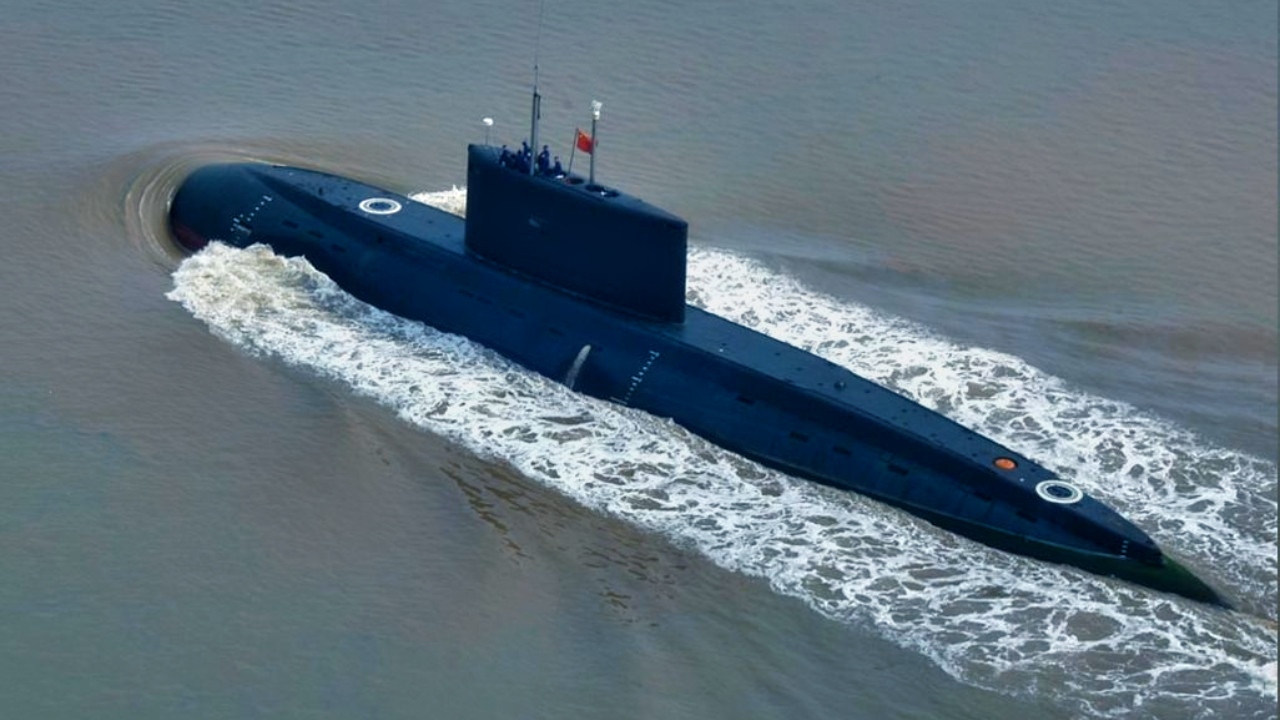
Russia’s Kilo-Class in 4 Words: The Black Hole Submarine – The Russian Kilo-class diesel-electric submarine, nicknamed the “Black Hole” by NATO for its stealth, has been a successful and widely exported Soviet-era design.
-The latest variant, the Project 636.3 “Improved Kilo-II,” is armed with torpedoes, mines, and Kalibr land-attack cruise missiles, a capability Russia has used extensively against targets in Syria and Ukraine.
-The final boat of this class, the Yakutsk, was reportedly accepted by the Russian Navy in June 2025 for its Pacific Fleet.
-While formidable and quiet, these boats are being replaced by the newer, though troubled, Lada-class submarines.
Meet the Kilo-Class Submarine
To a civilian, the word “kilo” is short for “kilogram” (or “kilogramme” if you’re a citizen of a British Commonwealth country), the base unit of mass in the metric system, equivalent to 2.2046 pounds in the avoirdupois system of measurement.
To a military member, particularly a member of NATO, “Kilo” can mean one of two things: (1) the letter “K” in the NATO Phonetic Alphabet, or (2) our current subject at hand, the official reporting name of a deadly Cold War era Soviet submarine, the Kilo-class diesel-electric boats.
Kilo-Class Initial History and Specifications
Designed in 1980 by Rubin Central Design Bureau, headquartered in Leningrad (now known as St. Petersburg), and entering into operational service with the Soviet Navy that same year, the original version of the Kilo-class submarine was known to the Soviets themselves as the Project 877 Paltus (“Halibut”). It was built between 1980 and the mid-1990s, designed for anti-submarine and anti-ship warfare, as well as for protecting naval bases, coastal installations, and sea lanes, and for conducting general reconnaissance and patrol missions.
The Paltus was superseded in the mid-1990s by the Project 636 Varshavyanka (which NATO designated the “Improved Kilo-class”), and again in the mid-2010s by the Project 636.3 (“Improved Kilo-II”). On or about June 12, 2025, the final ship of the 636.3-class, the Yakutsk, was officially accepted by the Russian Navy and designated for its Pacific fleet.
The Type 636.3 iterations of the Kilo-class subs have the following tech specs and vital stats:
Displacement: 2,950 tons surfaced; 3,950 tons submerged and fully laden
Hull Length: 73.7 meters (242 feet)
Draft: 6.3 meters (20 feet 8 inches)
Beam Width: 9.9 meters (32 feet 5 inches)
Test Depth (aka Safe Operating Depth): Maximum 300 meters (980 feet); practical operational depth of 240 meters (790 feet)
Operational Range: 7,500 miles when snorkeling at 7 knots; 400 miles when submerged at 3 knots
Endura
Crew Complement: Some sources say 60 (16 commissioned officers and 44 enlisted sailors [matrosiy]; others say 52 (13 officers and 47 seamen)
Armament:
Six 533mm (21-inch) forward torpedo tubes, with a capacity for
18x torpedoes with six in the torpedo tubes and 12 stored on the racks; OR
24x mines; OR
4x Kalibr land-attack cruise missiles
8 x 1 9K310 “Igla-1” surface-to-air missile (SAM) launchers, armed with 9M313 missiles
The powerplant consists of two diesel generators, the main propulsion motor, a fuel-economic motor, and a single shaft, driving a seven-blade fixed-pitch propeller; this propulsion package enables the boats to attain a top speed of 11 knots whilst surfaced and 20 knots submerged.
Kilo-Class Submarine, As the Black Hole
The Kilos have a reputation for being among the quietest diesel-electric submarines in the world.
As Army Recognition elaborates (yes, Army Recognition also covers naval technology), “Their hull is coated with a special rubber anechoic coating, which reduces the sonar signature and enhances the stealth features of the vessel, making them extremely difficult to detect.”
Operational History in Brief
The Kilos are certainly a battle-proven class of submarine. According to Eric Wertheim of the US Naval Institute publication Proceedings, “Russia’s Improved Kilo II–class submarines first conducted long-range attacks against Islamic State targets in Syria during 2015. Since 2022, Russian Black Sea Fleet 636.3 submarines have made extensive use of the Kalibr missile to attack Ukraine.”
On August 14, 2013, one of the Indian Navy’s Kilo-class submarines, the INS Sindhurakshak, caught fire after an explosion in a Mumbai dockyard. It took firefighters several hours to douse the blaze, with 18 Indian Navy sailors tragically losing their lives.
The submarine sank in dock, making it the only known total loss of a Kilo-class sub as far as we can ascertain (if any of our dear readers know of additional Kilo losses, please let us know in the Comments section).
NOTE: The Indian Navy officially designates its Kilos as the Sindhughosh-class, which translates to “Roar of the Sea.”
The Future of the Kilos
Out of 75 Kilos built, an estimated 57 remain in service worldwide (Type 877s and 636s alike); besides Russia and India, current users include the navies of Algeria, China, Iran, Myanmar, Poland, Romania, and Vietnam.
The Russian Navy is in the process of replacing the Kilos with the fourth-generation Project 677 Lada-class (NATO reporting name: “St. Petersburg” class) subs, which we shall cover in the following article in this series.
About the Author: Christian D. Orr, Defense Expert
Christian D. Orr is a Senior Defense Editor. He is a former Air Force Security Forces officer, Federal law enforcement officer, and private military contractor (with assignments worked in Iraq, the United Arab Emirates, Kosovo, Japan, Germany, and the Pentagon). Chris holds a B.A. in International Relations from the University of Southern California (USC) and an M.A. in Intelligence Studies (concentration in Terrorism Studies) from American Military University (AMU).


Pingback: Russia's Lada-Class Submarine Program Might Finally Be 'Sunk' - National Security Journal