

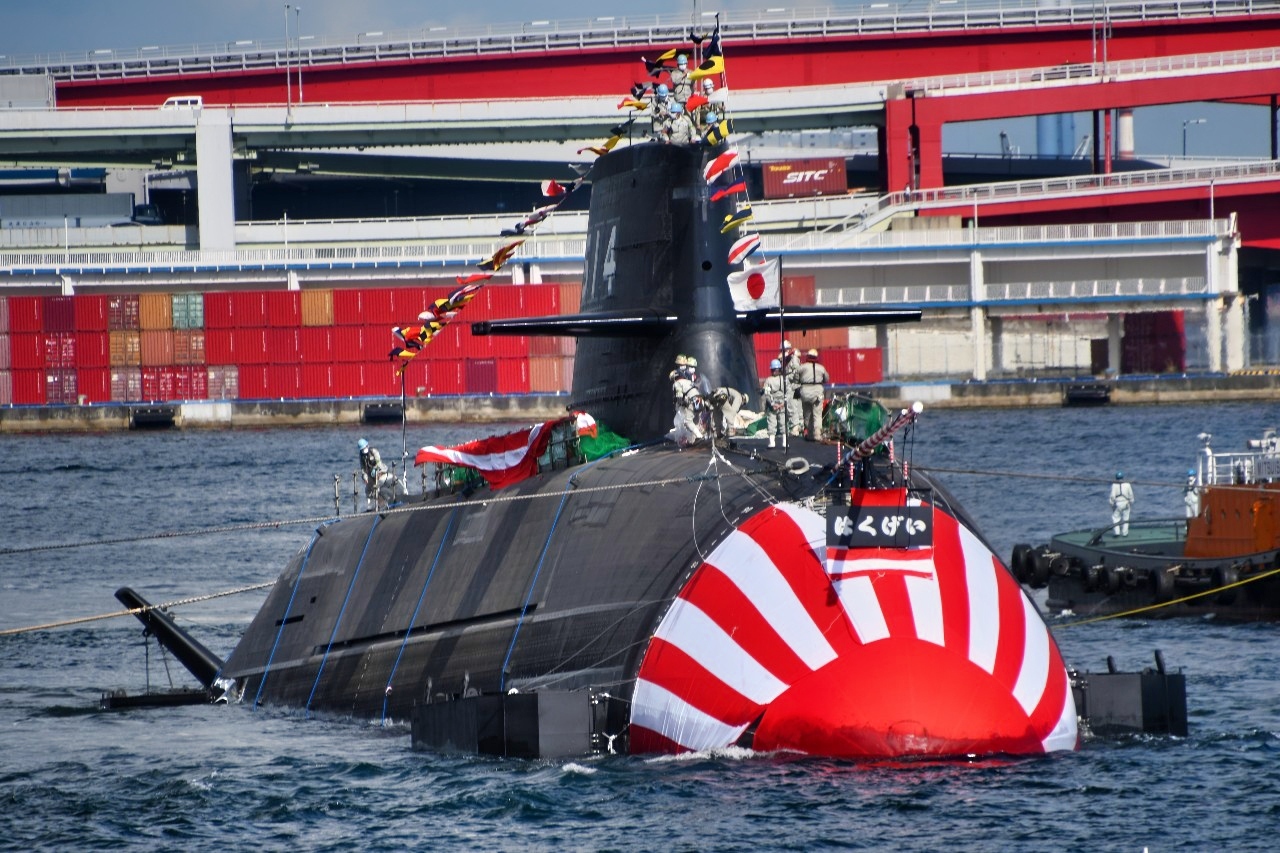
Key Points – Japan’s Taigei-class (“Big Whale”) diesel-electric attack submarines, with four completed by 2025 including the recently commissioned JS Raigei, represent a significant leap in conventional undersea warfare capability, primarily aimed at deterring China and North Korea.
-Their standout feature is the standard use of advanced lithium-ion batteries, providing extended submerged endurance and enhanced stealth without needing a separate Air-Independent Propulsion (AIP) system.
-Equipped with the sophisticated Oki ZQQ-8 sonar suite, Type 18 torpedoes, and Harpoon missiles, the Taigei-class submarines, built on schedule by Mitsubishi and Kawasaki, are crucial to Japan’s maritime defense strategy in the Indo-Pacific.
Japan’s Taigei-Class Explained
The Taigei-class submarine is the newest class of attack submarines for the Japanese Maritime Self-Defense Force (JMSDF). Built as a replacement for the aging Sōryū-class submarines, the Taigei-class offers a number of improvements and helps Japan maintain a posture of deterrence in its seas. Recently, the fourth boat in the class, the JS Raigei (SS-516) entered into service, with four more to follow in the coming years.
While not as capable and devastating as America’s SSBNs, the Taigei-class is a vital cornerstone in Japan’s maritime defense strategy.
Development and Design
The development of the Taigei-class began in the early 2000s as part of Japan’s strategic initiative to modernize its submarine fleet. The JMSDF has long prioritized technological superiority and stealth in its undersea forces, and the Taigei-class reflects this commitment. The first submarine of the class, JS Taigei (SS-513), was ordered in 2017, laid down in 2018, launched in 2020, and officially commissioned in March 2022. It was constructed by Mitsubishi Heavy Industries in Kobe.
The second vessel, JS Hakugei (SS-514), was built by Kawasaki Heavy Industries and launched in 2021. The JS Jingei (SS-515) and JS Raigei (SS-516) were completed in 2025 and 2025, bringing the fleet up to four completed vessels. These submarines are part of a broader plan to maintain a fleet of at least 22 operational submarines, ensuring Japan’s ability to monitor and respond to regional threats.
In terms of design, the Taigei-class submarines are slightly larger than their predecessors, measuring approximately 84 meters in length with a beam of 9.1 meters and a draught of 10.4 meters.
They displace around 3,000 tons when surfaced and are crewed by about 70 personnel. The hull is constructed from high-strength steel, allowing the submarine to operate at greater depths and withstand higher underwater pressure. To enhance stealth, the hull is coated with acoustic absorbent materials, and the internal structure includes a floating floor system that minimizes noise transmission. The use of an X-shaped rudder configuration, which was also present in the Sōryū-class, provides superior maneuverability, especially in shallow or confined waters.
What Makes Japan’s “Big Whale” so Special?
One of the most notable advancements in the Taigei-class is its propulsion system, which utilizes lithium-ion batteries. This technology was first introduced in the final two boats of the Sōryū-class and has now become standard in the Taigei-class. Lithium-ion batteries offer several advantages over traditional lead-acid batteries, including higher energy density, faster charging times, longer submerged endurance, and reduced maintenance requirements.
Unlike Air-Independent Propulsion (AIP) systems, which require periodic snorkeling to recharge batteries, lithium-ion systems allow for extended silent operation underwater, significantly enhancing the submarine’s stealth and operational flexibility.
Additionally, the Taigei-class is equipped with a sophisticated suite of sensors and combat systems. It features the ZPS-6H radar for surface and low-level air search, and the Oki ZQQ-8 sonar suite, which includes bow-mounted, flank, and towed array sonar systems. These sensors provide comprehensive situational awareness and enable the submarine to detect and track enemy vessels and submarines with high precision. The combat management system integrates data from all sensors and controls the submarine’s weapons, ensuring rapid and accurate responses to threats.
In terms of armament, the Taigei-class is outfitted with six 533 mm torpedo tubes capable of launching the Type 18 heavyweight torpedoes, which are among the most advanced in the JMSDF’s arsenal. These torpedoes are designed for both anti-submarine and anti-surface warfare. Additionally, the submarine can launch UGM-84 Harpoon anti-ship missiles, giving it the capability to strike surface targets from underwater. This versatile armament allows the Taigei-class to perform a wide range of missions, including sea denial, intelligence gathering, and special operations support.
The Taigei-Class and Japan’s Naval Strategy
The Taigei-class plays a crucial role in Japan’s maritime defense posture. The submarines are deployed from key naval bases such as Yokosuka and Kure, enabling rapid response to potential threats in the East China Sea and Western Pacific. Their stealth and endurance make them ideal for intelligence, surveillance, and reconnaissance missions, as well as for maintaining a persistent presence in contested waters.
As regional tensions continue to rise, particularly with the expansion of naval forces by neighboring countries, the Taigei-class enhances Japan’s ability to deter aggression and protect its maritime interests.
When compared to the Sōryū-class, the Taigei-class offers several improvements. While the Sōryū-class initially used lead-acid batteries and later adopted lithium-ion batteries in its final two boats, the Taigei-class standardizes this technology across the fleet. The new class also features improved sonar systems, enhanced stealth materials, and a slightly larger displacement, all of which contribute to greater operational effectiveness. These enhancements reflect Japan’s ongoing efforts to maintain a technological edge in undersea warfare.
Japan plans to build at least eight Taigei-class submarines, with four already active or under construction as of 2025. These submarines are expected to remain in service well into the 2040s, forming the backbone of Japan’s submarine fleet. There is also speculation that future variants may incorporate capabilities for deploying unmanned underwater vehicles (UUVs) or artificial intelligence-assisted combat systems.
The Taigei-class is vital for Japan’s naval defense strategy. It underscores Japan’s increasing focus on maritime security and its response to China’s rapidly growing naval presence. The Taigei-class complements the strategic objectives of alliances like the Quad (comprising Japan, the United States, India, and Australia) and AUKUS, which emphasize undersea dominance and interoperability in the Indo-Pacific.
About the Author
Isaac Seitz, a Defense Columnist, graduated from Patrick Henry College’s Strategic Intelligence and National Security program. He has also studied Russian at Middlebury Language Schools and has worked as an intelligence Analyst in the private sector.
Fighter Jet Fails


Pingback: Japan's Sōryū-Class 'Blue Dragon' Submarine Is a Naval Powerhouse - National Security Journal
Pingback: Japan's Taigei-Class 'Big Whale' Submarine Simply Summed Up in 4 Words - National Security Journal
Pingback: Russia's Kilo-Class Submarine Summed Up in 4 Words - National Security Journal