


On June 7, 1981, Israel launched Operation Opera. Eight F-16s and six F-15s flew more than 1,000 kilometers at low altitude across Jordan, Saudi Arabia, and Iraq to reach the French-built Osirak nuclear reactor outside Baghdad. The aircraft dropped 16 bombs and destroyed the reactor in minutes. Ten Iraqis and one French engineer were killed. Every Israeli pilot came home. The raid established what became known as the Begin Doctrine — Israel would not allow a hostile regional power to acquire nuclear weapons. When Saddam Hussein fired Scud missiles at Israeli cities during the 1991 Gulf War, the doctrine looked vindicated.
Israel Won’t Allow Anyone Else to Have Nuclear Weapons In the Middle East

An Israeli F-15I Ra’am assigned to the 69th Squadron launches for a sortie in support of exercise Juniper Falcon May 7, at Uvda Air Base, Israel. Juniper Falcon 17 represents the combination of several bi-lateral component/ Israeli Defense Force exercises that have been executed annually since 2011. These exercises were combined to increase joint training opportunities and capitalize on transportation and cost efficiencies gained by aggregating forces. (U.S. Air Force photo/ Tech. Sgt. Matthew Plew)

Israeli Air Force 69th Squadron – Operation New Order: F-15I jets eliminating Hezbollah and Hassan Nasrallah.

Israeli Air Force 69th Squadron – Operation New Order: F-15I jets eliminating Hezbollah and Hassan Nasrallah
In the late 1970s, Israeli political and military leadership became convinced that Iraq’s fledgling nuclear program was an existential threat.
More than just a civilian power project, it was believed that the Osirak reactor, a French-built facility outside the capital, at Baghdad, could be used to further Iraqi nuclear ambitions to the detriment of Israel.
Both the French and Iraqi governments insisted that it was purely for peaceful purposes — and, technically speaking, it was for research rather than for producing weapons, but in Jerusalem, there was little faith that Saddam Hussein’s government could be trusted not to leverage the infrastructure for conflict with Israel.
The line of thinking was not without a certain logic. Iraq had fought Israel in the previous Arab-Israeli wars, and Saddam was known to use blatantly anti-Israeli rhetoric.
Furthermore, Israeli intelligence was worried that even if the Osirak reactor itself could not immediately produce nuclear weapons, the knowledge gleaned from that project could be used to further Iraq’s nuclear weapons know-how.
That belief would eventually crystallize into the Begin Doctrine, the policy that Israel would not allow a hostile regional power to acquire nuclear weapons.
Israel attempted to find a diplomatic solution, sabotage, and clandestine disruption of the reactor, all to no avail.

F-16I Sufa Fighter. Image Credit: Creative Commons.
In 1979, equipment for the reactor was damaged during an explosion in France, and in tandem, some of the scientists associated with the Iraqi side of the program were targeted.
Though Israel never officially claimed responsibility for the attacks, Mossad has been suspected of being behind the attacks.
The French Connection
France was placed in an awkward position. Paris had extensive strategic and economic ties to Iraq, but also believed that sufficient safeguards were in place to prevent the reactor program from furthering a weapons program.
Paris also believed its role as a provider and overseer of the program enabled it to reliably monitor Iraqi developments. Israel disagreed, however.
In 1980, the Iran-Iraq War erupted and would consume the attentions and military capabilities of Baghdad and Tehran for nearly a decade. But that same year, Iranian aircraft attacked Osirak in an attack called Operation Scorch Sword.
Though the Iranian planes damaged part of the facility, the reactor was not destroyed.
The following year, Israeli leadership believed their window of opportunity was rapidly closing. When Osirak became “hot,” bombing the site would risk spreading radioactive material over a wide area, increasing the chances of nuclear and political fallout.
Operation Opera
In 1981, Israel launched Operation Opera, also known as Operation Babylon.
Four pairs of Israeli F-16s, accompanied by three pairs of F-15s, flew over 1,000 kilometers across Jordan, Saudi Arabia, and Iraq at very low altitude, avoiding radar. They strike Osirak in quick succession, dropping a total of sixteen bombs.
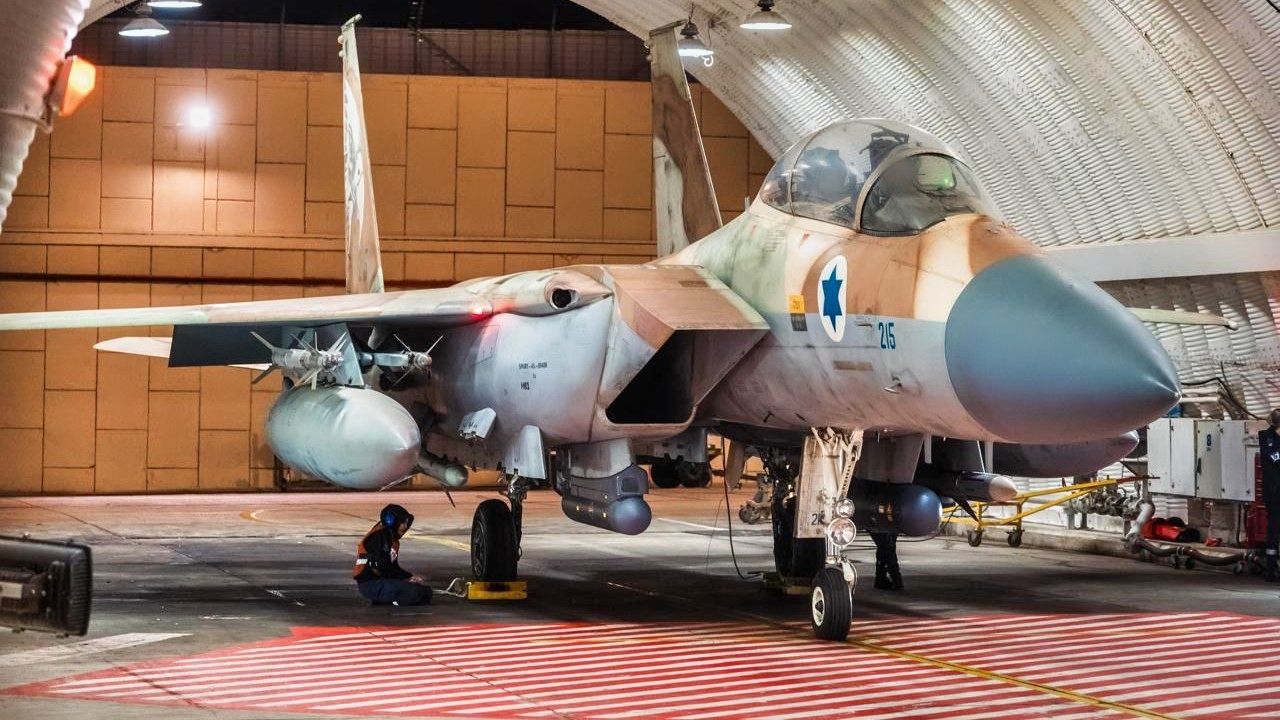
F-15I Fighter Israeli Air Force. Image Credit: Creative Commons.

F-15I Ra’am from Israel. Image Credit: Creative Commons.
Though the raid lasted only minutes, it destroyed the Osirak reactor.
Ten Iraqis were killed, as well as one French civilian engineer, but no Israeli aircraft were damaged, and no pilots were lost. It was a complete success.
The Reaction Abroad
Paris was incensed. A citizen of France had been killed, and French prestige had taken a hit, and Paris viewed the raids as an attack on a lawful civilian nuclear program.
Though France initially considered rebuilding the factoring and continuing cooperation with Iraq, the pressure of the Iran-Iraq War, financial issues, domestic and international pressures, as well as growing controversy around the program, all contributed to its demise. By 1984, the project was essentially dead.
For Iraq, Operation Opera was a massive embarrassment, particularly for Saddam Hussein. But the then-ongoing war with Iran overshadowed the loss of the reactor.
Lasting Effects
Inside Israel, the operation was viewed as a strategic success, though it was incredibly divisive at the time domestically.
The operation was seen in a slightly different light, however, after Saddam invaded Kuwait in 1990 and launched Scud missiles at Israeli cities during the Gulf War.
Many Israelis believed the region would have looked incredibly different had Iraq possessed nuclear weapons at that time, with the very real possibility of parts of Israel being transformed into a wasteland.
More broadly, however, the raid had a significant and lasting effect on Israeli policy within the region, and the Begin Doctrine became one of the clearer examples of Israeli strategic thinking.
Countries in the region would not be allowed to acquire a nuclear weapons capability if it appeared they would leverage that capability to Israel’s detriment.
More than forty years later, Operation Opera remains at the nexus of arguments over preventive war.
MORE – $9,000,000,000 in U.S. Navy Nuclear Aircraft Carriers Were ‘Sunk’ By France
MORE – The Great Oil Shortage Is Coming for Donald Trump
About the Author: Caleb Larson
Caleb Larson is an American multiformat journalist based in Berlin, Germany. His work covers the intersection of conflict and society, focusing on American foreign policy and European security. He has reported from Germany, Russia, and the United States. Most recently, he covered the war in Ukraine, reporting extensively on the shifting battle lines in Donbas and writing about the war’s civilian and humanitarian toll. Previously, he worked as a Defense Reporter for POLITICO Europe. You can follow his latest work on X.


