


Key Points and Summary – Russia’s Su-57 stealth fighter program is being crippled by a “double-whammy” of sanctions and corruption.
-Western sanctions have blocked the import of critical microchips, forcing the military to accept delivery of the jets without their essential 101KS-N electro-optical targeting systems, leaving them incapable of all-weather surveillance.
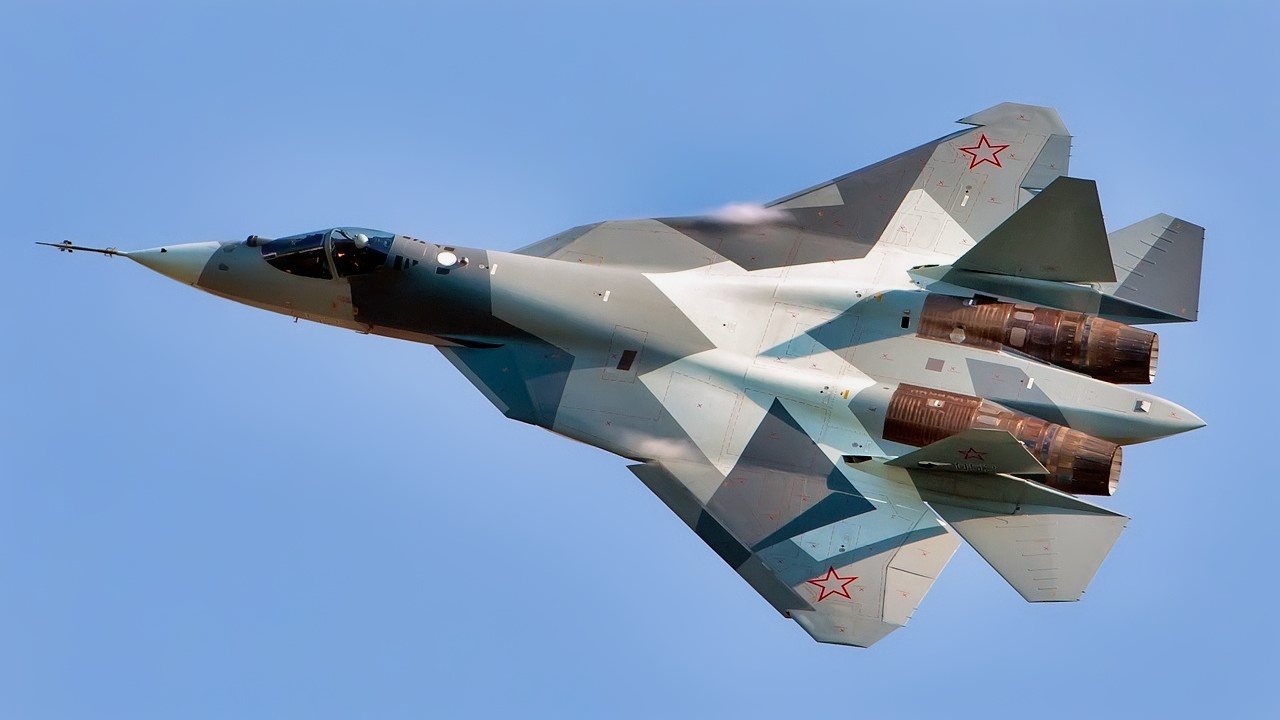
Russia PAK-FA or Su-57 Felon. Image Credit: Creative Commons.
-Compounding this technological failure, corrupt procurement practices have allegedly led to the Russian Ministry of Defense paying twice for these hobbled, incomplete aircraft.
-The situation leaves Russia with a combat-ineffective flagship fighter that it also cannot successfully export to fund its own survival.
Russia’s Su-57 Felon
WARSAW, POLAND – Despite numerous design studies, experimental concepts, one flying prototype, and proposed joint developmental efforts with friendly nations, Russia currently has only one 5th-generation fighter aircraft model in production.
This aircraft is the Sukhoi Su-57, which first flew at the end of January 2010, and is the only fighter ever produced in Russia to be classified as a stealthy design.
The introduction of this type has progressed slowly, with a very low initial production rate. Ten prototypes were initially built, and slightly more than 20 aircraft have been delivered to operational units of the Russian Aerospace Forces (VKS).
The other, more advanced Russian fighter aircraft, such as the Su-35S and Su-34, have seen extensive use in the Ukraine theatre.
But they have also experienced far greater losses than ever anticipated, particularly the Su-34.
This is one of the main reasons that the Su-57 has been held back from major engagements against the Ukrainian Air Force (PSU) and its air defense units.
Russian industry cannot afford to have the reputation of this aircraft so besmirched by being downed willy-nilly over the battlefield, as so many other Russian fighter types have.
When the Su-57 was pressed into service, it was kept far from any frontline engagements, according to UK government intelligence reports from early 2023.
Damage to Export Prospects
One of the chief motivations for the Russians trying to avoid losses of the aircraft in the Ukraine war is that they need an export order – preferably a large one – to breathe some financial life into the program.
High hopes had been pinned on a potential sale to India, where the Su-57 had been competing with the American F-35 and other Western models.
However, India had decided not to select either one and opted for the safe choice of buying more of the French-made Dassault Rafale fighters that it had already procured, 36 of which it had acquired more than a decade ago.
The only country that has confirmed interest in procuring the aircraft is Algeria, which is scheduled to take delivery of the Su-57 by the end of this year.
Algeria would become the first country in the world to import a 5th-generation fighter that is not the F-35, and the first nation in Africa or the Arab world with such a weapon system in its inventory.
However, there are concrete reasons to question whether this aircraft will ever be delivered to any customer – foreign or domestic – equipped with all the on-board systems that are part of its original configuration.
Sanctions Are Truly Damaging the Su-57 Felon
On August 16, Ukrainian intelligence analysts reported that the program was experiencing severe difficulties.
This is due to the Russian industry no longer being able to procure many of the electronic components needed to manufacture critical on-board systems for the aircraft.
According to documents reviewed by the Ukrainian media outlets, the Russian Ministry of Defense (MoD) paid more than $37 million per aircraft under a 2019 production agreement with Sukhoi and the Russian United Aircraft-Building. Corporation (OAK).
But these Su-57s were delivered minus the 101KS-N electro-optical targeting subsystem. This meant that a central subsystem was omitted from the aircraft but was still formally approved through contract amendments.
The 101KS-N is a directed IR countermeasures (DIRCM) and targeting module that is part of the 101KS sensor suite. The system is designed to provide all-weather surveillance and passive infrared targeting of ground objects.
The module utilizes the technology and design concepts associated with the Infrared Tracking System (IRST) module and the Sapsan targeting pod, both developed by the Ural Optical-Mechanical Plant (UOMZ).
The latter was widely displayed at international trade shows in the early 2000s.
One 2021 UOMZ estimate valued the targeting pod at more than $4 million each, but MoD negotiators successfully negotiated the price down to around $3.2 million.
Even at the lower price, auditors are reported to have discovered inflated overhead and unrelated, as well as fraudulent, expenditures embedded in the contracts.
Procurement practices exacerbated these corrupt practices. The MoD signed off on Su-57 deliveries that were priced as completely-equipped aircraft, and then the MoD paid separately for the targeting pods a second time.
An audit conducted in 2025 of the Komsomolsk-na-Amure Aircraft Plant (KNAAZ), Russia’s largest aircraft manufacturer and the production facility for the Su-57, revealed endemic problems with co-mingled accounting between military and civilian contracts.
Problems with defense production in Russia have been attributed to the impact of sanctions on procuring critical Western electronics. In 2024, an investigation into Mikropribor, an avionics module supplier for the Su-57, revealed that the loss of Western microchip imports had disrupted production and delayed deliveries.
This has been the pattern since the war in Ukraine began – and the damage being done to Russian defense production only continues to grow. The Kremlin suffers a “double-whammy” – weapons are sent into the field that are not fully functional.
At the same time, they cannot be sold for export to support their continued production. The situation is likely to worsen as time passes.
About the Author: Reuben F. Johnson
Reuben F. Johnson has thirty-six years of experience analyzing and reporting on foreign weapons systems, defense technologies, and international arms export policy. Johnson is the Director of Research at the Casimir Pulaski Foundation. He is also a survivor of the Russian invasion of Ukraine in February 2022. He worked for years in the American defense industry as a foreign technology analyst and later as a consultant for the U.S. Department of Defense, the Departments of the Navy and Air Force, and the governments of the United Kingdom and Australia. In 2022-2023, he won two awards in a row for his defense reporting. He holds a bachelor’s degree from DePauw University and a master’s degree from Miami University in Ohio, specializing in Soviet and Russian studies. He lives in Warsaw.
More Military
Study This Photo: Boeing Just Dropped New F/A-XX Fighter Image
J-20 vs. F-35I Adir: Which Fighter Would Win?


