


Article Summary and Key Points – Defense expert Caleb Larson breaks down the brutal arithmetic of Russia’s war in Ukraine: more than a million casualties and at least 13,000 armored vehicles lost, with open-source trackers recording over 200 T-90s destroyed, damaged or captured.
-Yet he explains why Moscow’s tank force is far from exhausted.
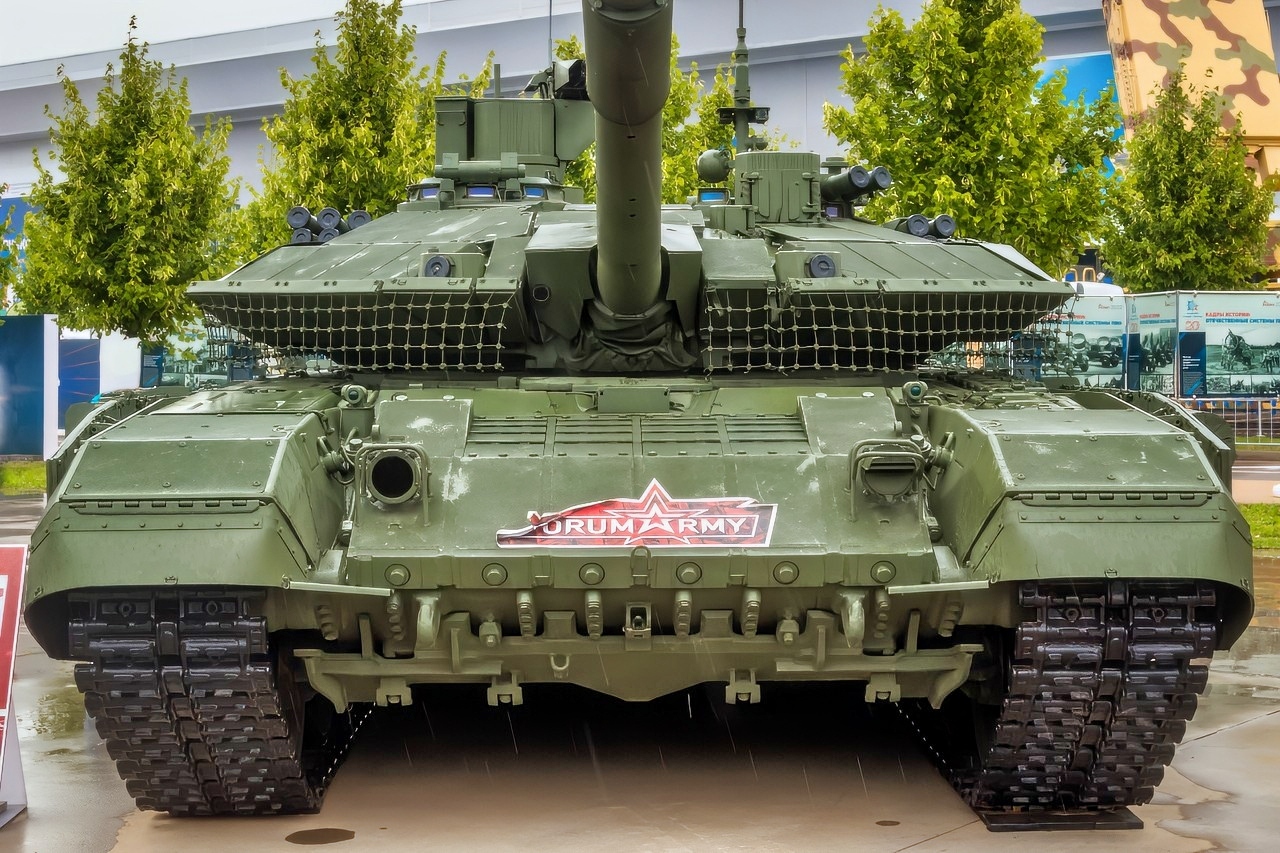
T-90M Russian Army. Image Credit: Creative Commons.
-Under pressure from FPV drones and artillery, Russian commanders have shifted from massed armor to light vehicles, preserving remaining tanks while industry refurbishes and builds more.
The result is grim: fewer tank losses, continued incremental gains, and a Kremlin willing to trade lives for tiny slices of Ukrainian territory.
T-90 and More: Russia’s Tank Losses in Ukraine Tell a Very Different Story in 2025
The losses Russia has managed to absorb in Ukraine are astonishing. Estimates of the number of Russian troops killed, injured, or missing in combat exceed one million — lives exchanged for minuscule Russian territorial gains in Ukraine.
Russia has managed to sustain its push in Ukraine through exceedingly generous signup bonuses for recruits — sometimes worth close to a decade of pay — and other perks like debt forgiveness, advantageous government loans, and reserved university places for family members.
But equipment losses have been steep as well, thanks in large part to Ukrainian innovations in leveraging the unique capabilities of explosive-laden FPV drones, which have literally and metaphorically ripped through Russian equipment with seeming ease.
Tabulating Losses: The T-90 Gets Hammered
Oryx, a website that uses open-source evidence to document Russian and Ukrainian equipment losses, keeps close tabulations.
Information published by Oryx tells a statistical tale of losses on both sides of the front line.
Oryx puts the losses of Russian armored vehicles, which include tanks and a variety of other armored platforms, at nearly 13,600 — a figure that is assuredly an undercount, as not all losses are visually documented. Across four T-90 tank variants, Russia has lost over 200.
The vehicle losses Oryx tallies include those damaged, destroyed, abandoned, or captured. But it does beg the question, how long can Russia sustain these staggering losses?
At what point will there no longer be enough legacy Soviet armored vehicles to pull out of storage to replace losses in Ukraine?

Russian T-90 Tank. Image Credit: Creative Commons.
Though many armchair generals and talking heads have predicted the imminent collapse of Russia’s ability to sustain and replace losses, the Kremlin’s vehicle losses have actually dipped, and it could maintain its forces for many months to come.
A Sign of New Tactics
Beginning in the summer of last year and continuing into 2025, Russia has relied increasingly less on armored vehicles for its assaults on Ukrainian positions, including tanks.
Instead of massed armored formations, anchored by main battle tanks like Russia’s T-90, Russia has instead often opted for a dispersed, more mobile assault force.
Unarmored or unarmored civilian vehicles repurposed as ersatz troop transports, as well as ATVs and motorcycles, have instead powered Russian assaults on Ukrainian positions.
As one academic put it, last summer saw Russian forces assault dug-in Ukrainian defensive positions in “glorified golf carts,” a tactic that reflected the equipment squeeze on Russian forces and evidence of a shortage of armored vehicles with which to transport troops.
While unarmored vehicles give their occupants virtually zero protection from FPV drones or other battlefield threats, they do allow Russia, on occasion, to move quickly and take Ukrainian defenders by surprise.
One helmet video of Russian forces dropping off a medical team demonstrates the inherent dangers: in less than a minute, the team is targeted, unsuccessfully, by an FPV drone and Ukrainian artillery.

Russian T-90M Tank. Image Credit: Creative Commons.
While these decidedly less armored formations certainly pose a threat to their occupants, the tactical decision has been a boon for Russia’s armored formations: since last summer’s tactical shift, T-90 losses — and indeed, losses across multiple armored vehicle categories — have dipped.
This sag in losses is partially a reflection of the staggering number of vehicle losses Russia has sustained — and how the Kremlin has been forced to alter the composition of its mechanized formations.
As the Conflict Intelligence Team has noted, “OSINT analysts estimate that about 200 tanks were lost in the first five months of this year [2024]. Extrapolating this figure to the entire year gives an estimate of 480 tanks annually—half as much as the number lost in 2024.
Thus, the reduction in losses, combined with the current production pace and the ongoing modernization of older tanks, will allow the RuAF to maintain the current level of armored vehicle supply for at least several more years. Moreover, if the loss trend for this year remains unchanged, the size of the Russian tank fleet may even increase by several hundred units per year, despite ongoing combat operations.”
Russia’s Tank Problem In Ukraine
Even with triple shifts in place to keep vehicle production and refurbishment ahead of losses, and the industrial repurposing of some of Russia’s industrial equipment to feed military needs, keeping production rates aloft will be a distinct challenge for Russia.
And even with the adjustment of mechanized assaults away from armored vehicles and the inherent dangers for the Russian occupants, Russia nonetheless has made steady, if limited, advances in Ukraine.
Despite the flurry of recent pronouncements about a peace plan for Ukraine, fighting will continue until an agreement is signed — a prospect that is far from likely.
For the time being, Russia grinds its forces forward, seemingly content to exchange tiny slivers of Ukraine for thousands of troops maimed and killed every week.
About the Author: Caleb Larson
Caleb Larson is an American multiformat journalist based in Berlin, Germany. His work covers the intersection of conflict and society, focusing on American foreign policy and European security. He has reported from Germany, Russia, and the United States. Most recently, he covered the war in Ukraine, reporting extensively on the war’s shifting battle lines from Donbas and writing on the war’s civilian and humanitarian toll. Previously, he worked as a Defense Reporter for POLITICO Europe. You can follow his latest work on X.
More Military
Montana-Class vs. Yamato-Class: It Would Have Been the Ultimate Battleship Battle
The Littoral Combat Ship Might Be the Navy’s Biggest Mistake Ever


Swamplaw Yankee
November 26, 2025 at 12:29 pm
The PRC CCP has how mant tanks? It can ship all of them by rail in a week into ukraine.