

As the war in Iran drags on, a new front is poised to open, one that would see the shuttering of another important waterway: the Bab el-Mandeb Strait.
The Houthis, the Yemeni Shia rebel group backed by Iran, declared in a bombastic video statement that they would blockade the passage in retaliation for Saudi strikes on Yemen’s airport at Sanaa, in the Yemeni capital.
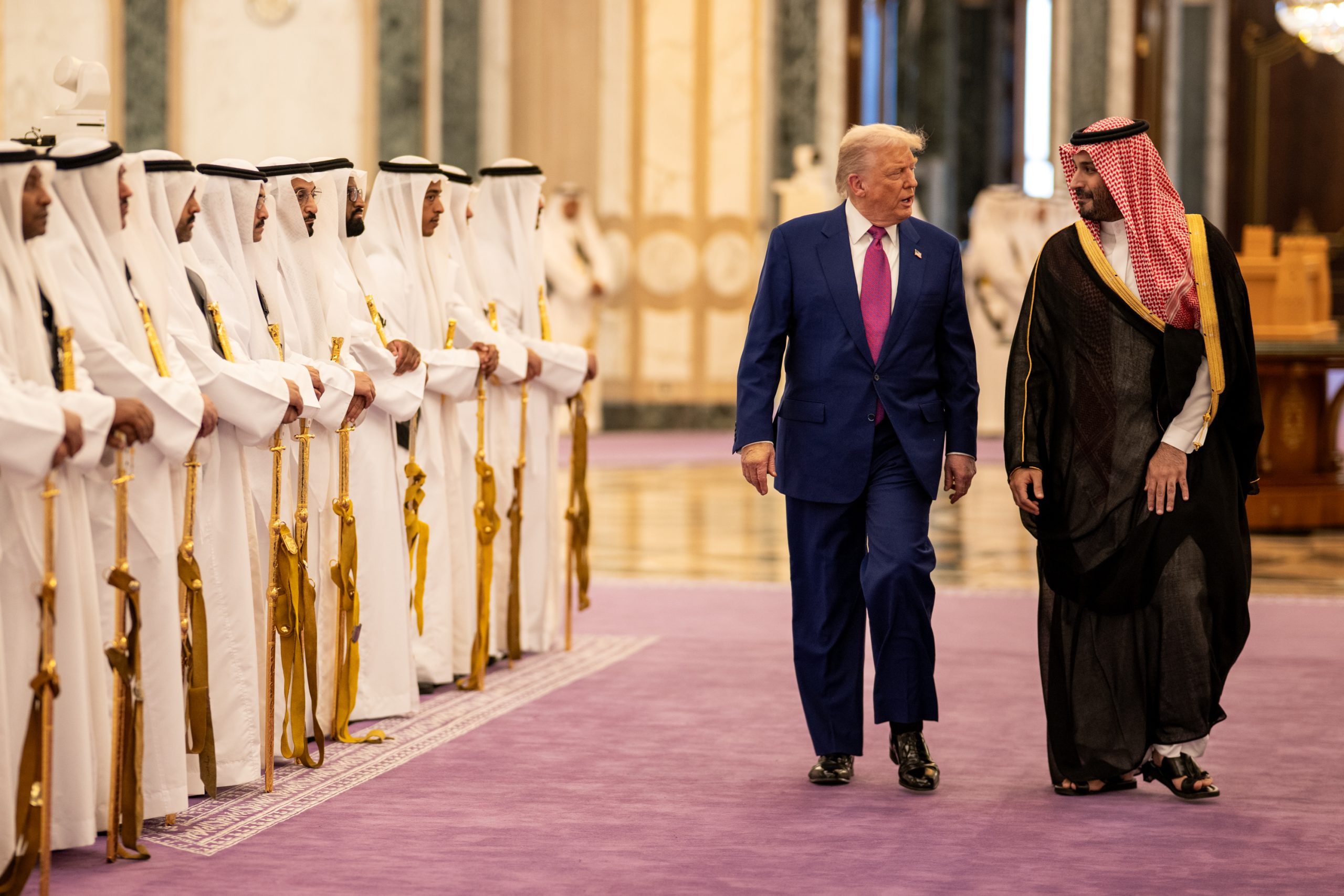
President Donald Trump participates in a welcome ceremony with Saudi Crown Prince Mohammed Bin Salman Al Saud at the Royal Court Palace in Riyadh, Saudi Arabia, Tuesday, May 13, 2025. (Official White House Photo by Daniel Torok)
That maritime chokepoint that divides Yemen’s southwest coast from Africa is an important conduit for Saudi Arabia, allowing cargo ships and tanker traffic to exit the Red Sea and sail outward into the Indian Ocean and onward to ports around the globe.
In their statement, the Houthis declared “a maritime embargo against the criminal Saudi enemy, based on the equation of ‘an eye for an eye,’ effective immediately,” adding that there would be a general mobilization of Houthi forces.
The Bab el-Mandeb Strait
Although Iran’s throttling of the Strait of Hormuz has repeatedly garnered attention since the war there erupted in February with the decapitation strike against Iranian political and military leadership, there is another important, though perhaps lesser-known waterway in that part of the world that plays a similarly important role to regional economies as well as international shipping: the Bab el-Mandeb Strait.
That narrow body of water is just 26 kilometers, or about 16 miles, wide at its narrowest point. And while the strait facilitates access to the Mediterranean and Indian Oceans via the Red Sea, its importance for the global oil trade has been overshadowed by the greater volume of oil handled by the Strait of Hormuz.
But as that latter waterway struggles to uncork the Iranian stopper there, the Bab el-Mandeb Strait has increased in importance, particularly for Saudi Arabian oil exports.
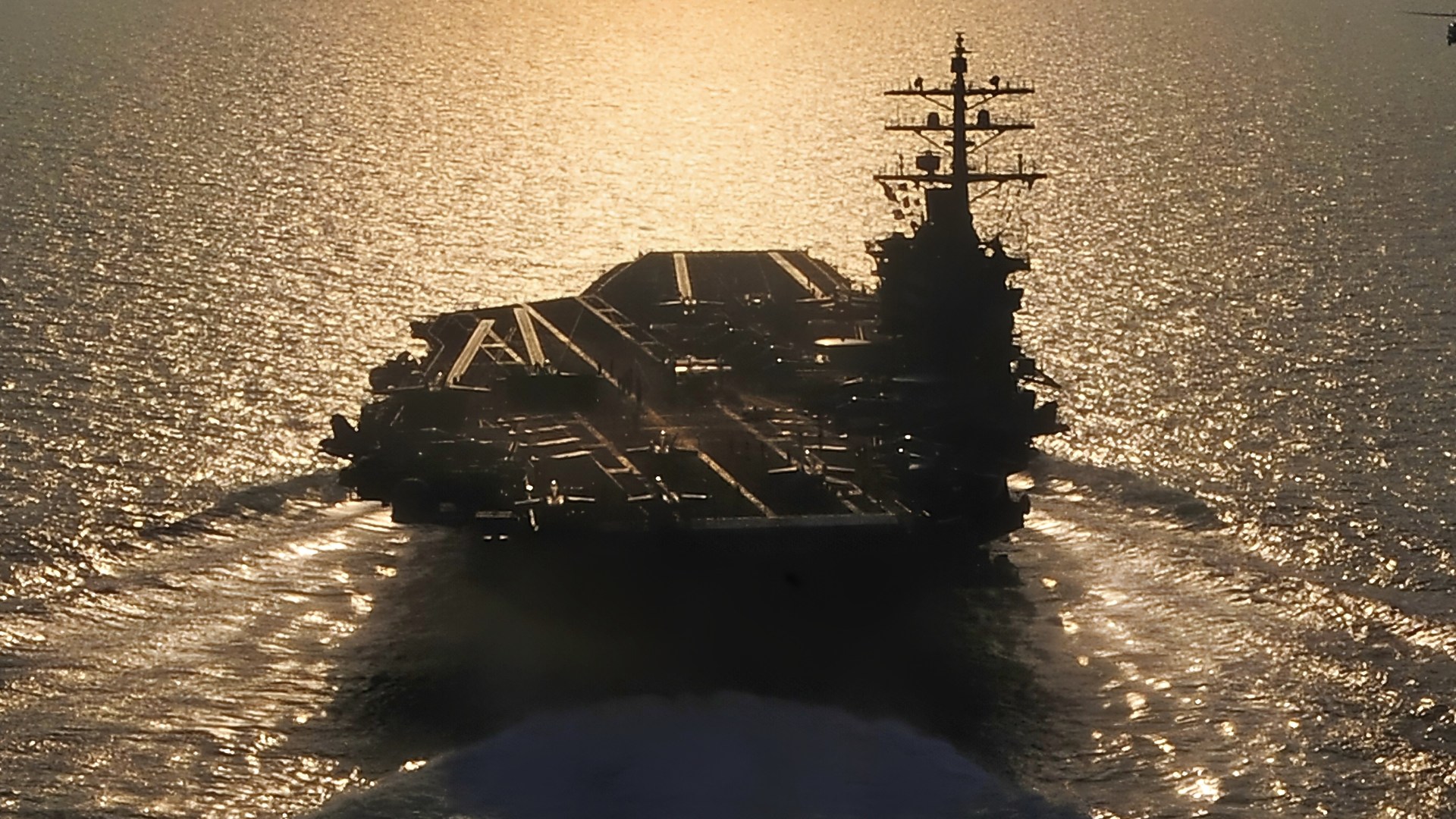
120710-N-RY232-571 MEDITERRANEAN SEA (July 10, 2012) – An SH-60F Seahawk from the Nightdippers of Helicopter Anti-Submarine Squadron (HS) 5 flies alongside Nimitz-class aircraft carrier USS Dwight D. Eisenhower (CVN 69), July 10. Dwight D. Eisenhower is on a regularly scheduled deployment in support of Maritime Security Operations (MSO) and Theater Security Cooperation (TSC) efforts in the U.S. 5th and 6th Fleet areas of responsibility. IKE deployed as part of Eisenhower Carrier Strike Group (CSG), which includes CSG 8, IKE, guided-missile cruiser USS Hue City (CG 66), guided-missile destroyer USS Farragut (DDG 99), guided-missile destroyer USS Winston S. Churchill (DDG 81), USS Jason Dunham (DDG 109), the seven squadrons of Carrier Air Wing (CVW) 7, and Destroyer Squadron 28. (U.S. Navy photo by Mass Communication Specialist 2nd Class Julia A. Casper/Released)
Shipping data indicates that Riyadh pivoted to its Red Sea port of Yanbu, surging exports there after the closure of Hormuz.
That bottleneck has presented Yemen’s Houthi rebels with an attractive opportunity, one that they hope will hit their rival hard, and where it hurts most.
It is an expansion of a war that has become costly, both in lives lost, in the price of oil — and in the United States, where this war’s price tag has been hotly debated in Congress.
The Rising Costs of War
During testimony given to the Senate Appropriations Committee, American Secretary of Defense Pete Hegseth detailed the costs of the war in Iran thus far: $37.5 billion.
Testifying before Congress, the secretary headed a broader push by America’s men in uniform to request additional funding from Congress for the war, an ask that totaled around $80 billion.
Although lawmakers and the secretary were seemingly aligned in recognizing that stocks of crucial precision munitions, particularly interceptor missiles for Patriot air defense systems, had dipped to dangerously low levels, the sides offered disparate explanations for the shortfall.
While Hegseth placed blame squarely at the feet of the previous Biden administration, Democrats questioned why the Pentagon chose to retrain some unspent funding from last year’s One Big Beautiful Bill Act.
A Tripartite Alliance?
Secretary Hegseth also provided details on China and Russia’s cooperation against American war aims in Iran, acknowledging that they are coordinating efforts intended to help Iran and stymie American military operations.
“There’s definitely adversary alignment. Attempts to do so, and there are many ways that we deter that, some of which are, and the depth and extent of it ought to remain classified, and it should,” Hegseth explained. “But there are ways in which both of those countries are, at different levels, enabling some of the things Iran is doing.”
Purchased at discounted rates due to the risk inherent in purchasing Iranian oil, which is widely sanctioned by the United States, the European Union, and others, China had been the number one purchaser of Iranian oil before the outbreak of war.
Russia, too, sees Iran as an ally against a common enemy.
Hostilities Continue
The United States and Iran have exchanged fire for nearly two weeks, leaving the previously signed memorandum of understanding between Tehran and Washington in tatters.
The number of American personnel killed or wounded in fighting related to operations in Iran is, according to the Department of Defense, hovering just under 500, a figure that is made up mostly of wounded, not killed.
Despite the reeruption between the United States and Iran, a fragile cease-fire between Israel and Lebanon remains, though Israel has conducted strikes and operations against Hezbollah, the non-state terrorist organization that operates within Lebanon.
About the Author: Caleb Larson
Caleb Larson is an American multiformat journalist based in Berlin, Germany. His work covers the intersection of conflict and society, focusing on American foreign policy and European security. He has reported from Germany, Russia, and the United States. Most recently, he covered the war in Ukraine, reporting extensively on shifting battle lines in Donbas and writing about the war’s civilian and humanitarian toll. Previously, he worked as a Defense Reporter for POLITICO Europe. You can follow his latest work on X.


