


China’s DF-100 Cruise Missile Threat Can’t Be Ignored: “If you think Iran’s missiles are a problem, wait until the U.S. Navy has to deal with China’s missiles.” That’s what a former U.S. Navy commanding officer told me when I asked him about the threats Navy warships faced in the Pacific around the First Island Chain.
I was taken aback by his blunt nature: “China has so many different missile platforms, I don’t even think the U.S. Navy can keep track of them all now, let alone defend against them. But they need to focus on the cruise missile threat, which gets forgotten about a lot.”
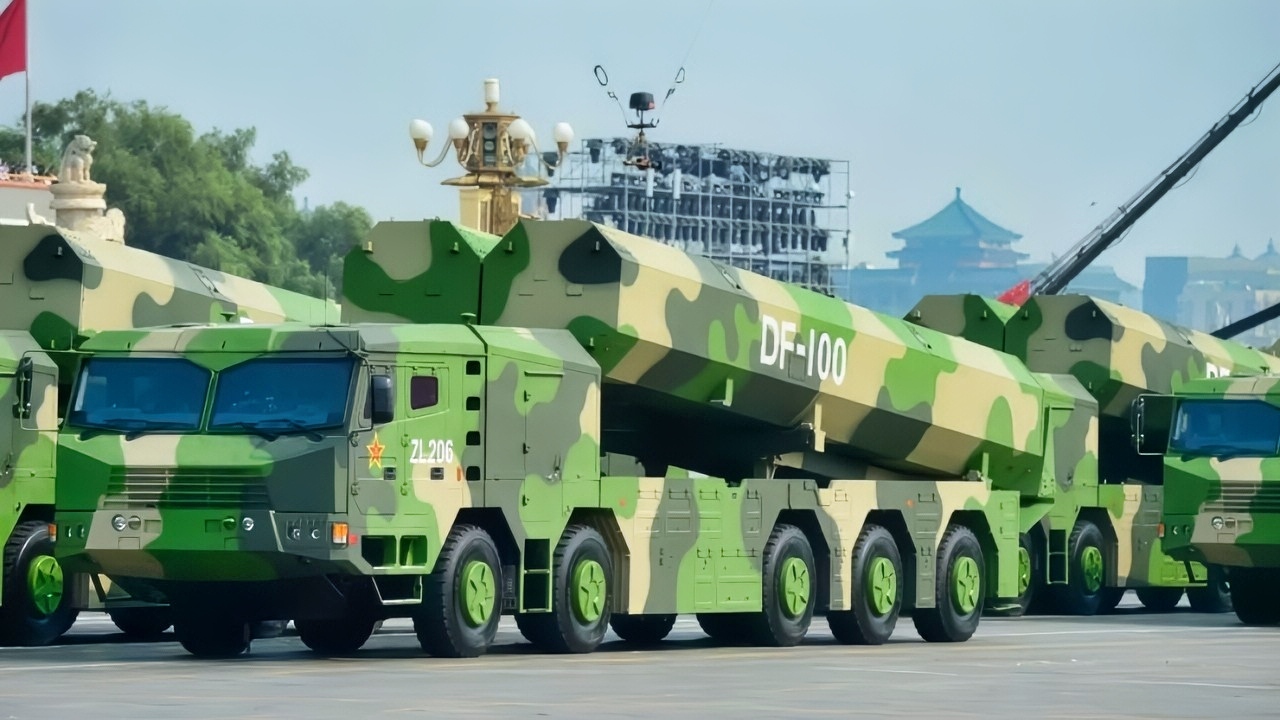
DF-100 Missiles: X Screengrab.
China’s DF-100 Cruise Missile Is a Problem
Ok, that was tough, but he does have a point. Most of the attention paid to China’s ability to sink American warships has gone to the ballistic carrier-killers, the DF-21D, the DF-26, the DF-27, weapons that arc up toward space and come screaming back down on a target.
The DF-100 is a different kind of threat, and in some ways a more insidious one.
It is a supersonic cruise missile, an air-breathing weapon that flies fast and far under its own power, and at a range of up to 4,000 kilometers, it can reach the American hub at Guam and threaten the bases and ships the United States would depend on in any Pacific war.
For a weapon that important, the Chinese military has kept it remarkably hidden, which is exactly why the rare footage Beijing released of it in 2025 was worth paying attention to.
A Secretive Weapon Breaks Cover
The DF-100 made its public debut rolling through Beijing during the 2019 National Day parade, and for years afterward, it remained one of the more obscure systems in the Chinese arsenal, photographed in its launch canisters but rarely seen in operation.
That changed in August 2025, when Chinese state television aired nearly two minutes of footage showing the missile being fired, only the second time China had released video of the weapon since its debut. The clip showed a Rocket Force brigade conducting a drill and offered fresh visual detail on the missile’s deployment and launch sequence, timed deliberately ahead of a major military parade.
The decision to lift the veil was itself a message. China had kept the DF-100 unusually secret, releasing footage of it only twice in six years, so the choice to suddenly showcase it read as calculated signaling, a demonstration of long-range strike power aimed at both domestic audiences and foreign adversaries. When a country that hides a weapon for six years abruptly decides to show it off, the display is part of the weapon’s purpose.
Mach 4 Across The Western Pacific
What the DF-100 brings to the fight is a combination of speed and reach that is unusual for a cruise missile.
It is credited with a range of 3,000 to 4,000 kilometers and a sustained cruising speed of around Mach 4, with some assessments putting its terminal speed as high as Mach 5. That is far faster than the subsonic cruise missiles most militaries field, and the distance it can cover places a large swath of the Western Pacific within its reach.
The geography is the point. At 4,000 kilometers, the missile can reach across the First Island Chain and deep into the Second, meaning the American installations that anchor the U.S. position in the region fall within its envelope. The DF-100’s reach extends to strategic installations such as Guam, the critical logistics and airpower hub that the United States would lean on in any conflict over Taiwan, as well as bases in Japan and South Korea. A weapon capable of holding Guam at risk forces American planners to treat even their rear-area hubs as front-line targets.
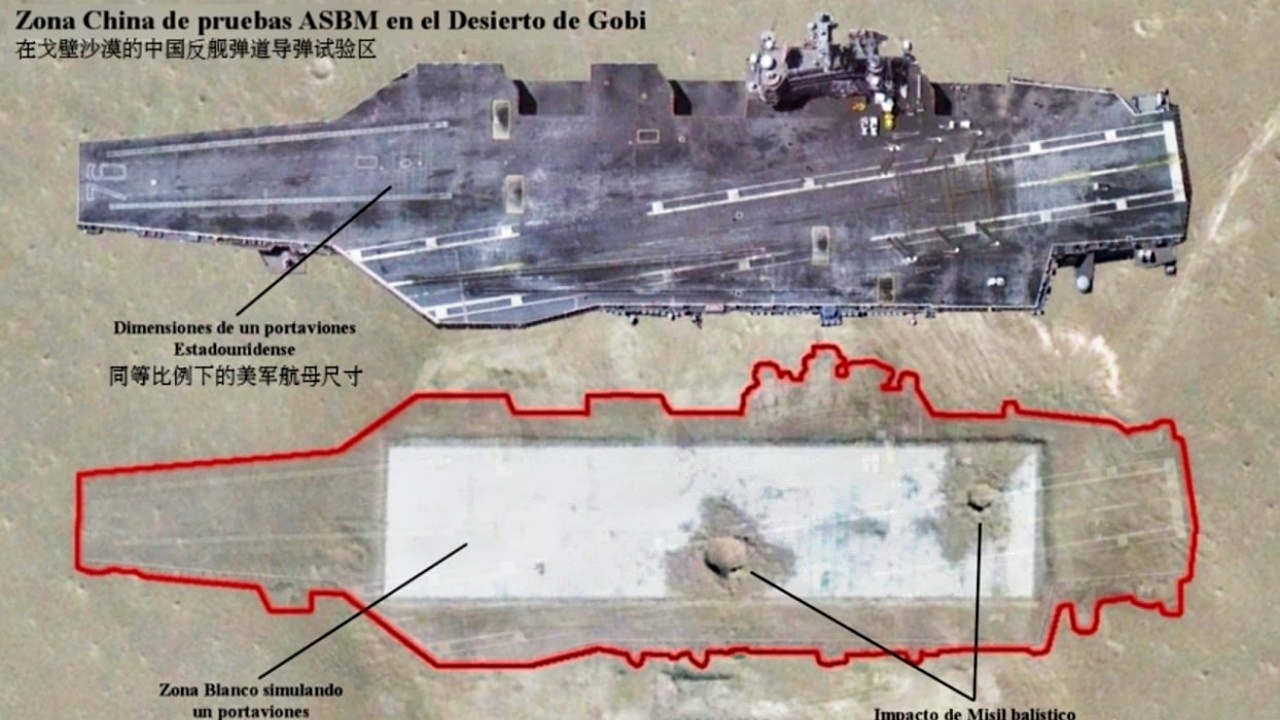
DF-26 China Missile Attack on Fake Aircraft Carrier Cut Out. Image Credit: Chinese Weibo Screenshot.
The missile flies an unusual profile to achieve that range. Rather than skimming low like a traditional cruise missile, it climbs to a cruise altitude of 30 to 40 kilometers before a high-speed terminal glide, a near-space trajectory that minimizes atmospheric drag and lets the ramjet-powered weapon sustain supersonic speed over thousands of kilometers. A solid rocket booster gets it off the launcher and up to speed, then the air-breathing engine takes over for the long cruise. According to a 2020 assessment from the U.S. Air Force’s China Aerospace Studies Institute, the DF-100 was fielded with the PLA Rocket Force’s 656th Brigade in Shandong Province, placing it firmly in operational service rather than development.
In 2 Words: Cruise Missiles
The reason the DF-100 deserves attention separate from the ballistic carrier-killers is that it attacks through a different lane, and defending against it requires different tools. A ballistic missile follows a high, predictable arc that early-warning radars can detect and track from a great distance, giving defenders at least some time to react. A supersonic cruise missile flies a flatter, powered trajectory and arrives fast, compressing the time available to detect, decide, and intercept.
That compression is the heart of the threat. The missile’s combination of supersonic speed and a relatively low radar profile drastically reduces the response time available to air defenses, narrowing the interception window to a matter of seconds. Its multi-mode guidance package, which blends inertial navigation, terrain matching, scene matching, and satellite positioning, gives it the accuracy to hit a precise aim point at the end of that fast approach. Defenders accustomed to plotting the long arc of a ballistic missile face a weapon that gives them far less warning and far less margin.
The strategic value multiplies when the DF-100 is considered not in isolation but as one element of a coordinated strike. The missile is built to arrive in waves and overwhelm layered defenses, and its real danger emerges in a saturation attack that mixes ballistic missiles, hypersonic glide vehicles, drones, and supersonic cruise missiles all at once. Each type forces defenders to cover a different lane, and the combination is designed to exhaust interceptors and open gaps.
A defense optimized against ballistic threats can be picked apart by the cruise-missile component, and vice versa, which is precisely the dilemma the DF-100 is meant to create.
The Carrier-Killer Question
The DF-100 is frequently described as a carrier-killer, and the claim deserves both attention and a measure of caution. Several assessments conclude that the missile can engage large naval vessels, with its guidance allowing it to strike both fixed and moving targets, and that its ability to threaten warships places aircraft carrier strike groups operating in the Western Pacific at increased risk. If the DF-100 can reliably find and hit a maneuvering carrier, it adds a fast, long-range cruise-missile dimension to the anti-ship threat that the ballistic carrier-killers do not cover.
The honest caveat is that the anti-ship role is the less proven part of the DF-100’s resume. The weapon is most confidently described as a land-attack system aimed at fixed targets, bases, bunkers, logistics hubs, and reinforced structures, and references to naval targeting often carry a telling qualifier: engaging slower-moving vessels. Striking a carrier maneuvering at sea is a far harder problem than hitting a runway, because it requires finding the ship and feeding the missile a continuously updated targeting solution across thousands of kilometers of ocean. The DF-100 may well have a genuine anti-ship capability, but the carrier-killing label is best treated as a real ambition that remains unproven against a maneuvering target rather than a demonstrated certainty.
The Bomber That Extends The Reach
The DF-100’s threat grows considerably because of its launch capabilities. On the ground, it rides a high-mobility transporter-erector-launcher, an 8×8 or 10×10 vehicle that can hide in caves or behind buildings between launches, making it difficult to find and target. But the more worrying development is that China has been arming its H-6N bomber with the missile, and air launch extends its reach beyond 6,000 kilometers by carrying it most of the way to the target before release.
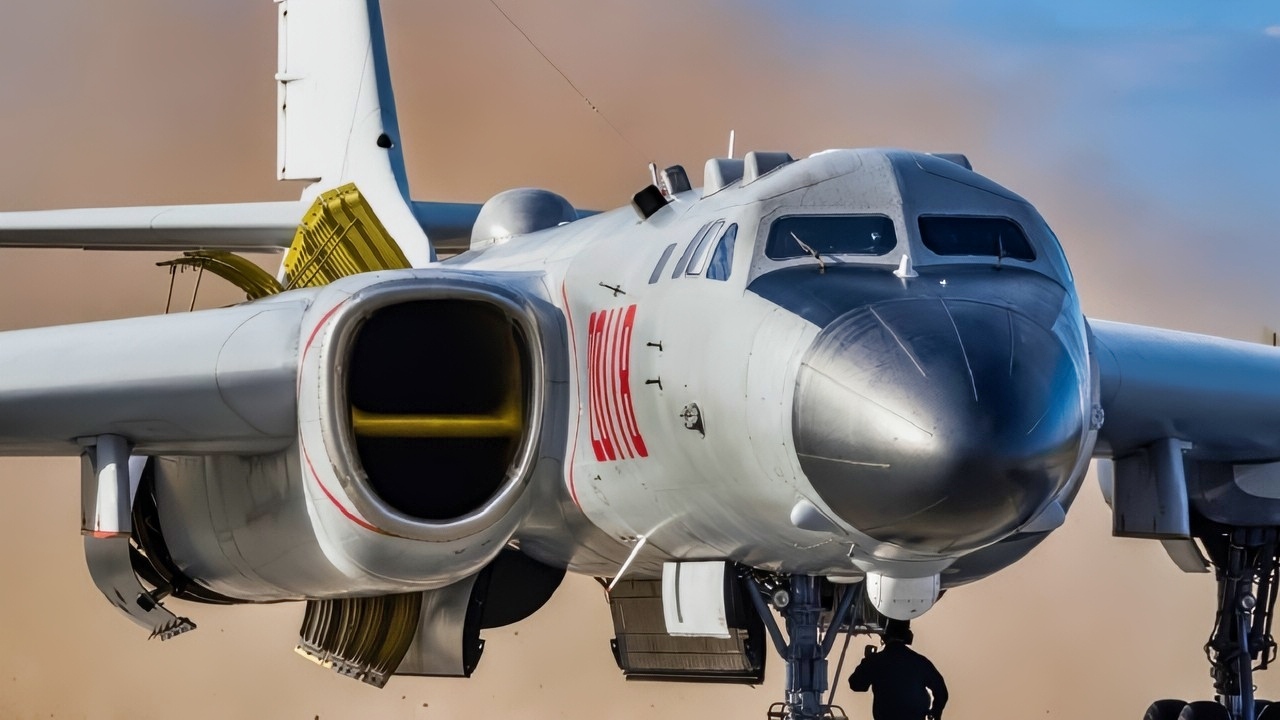
H-6 Bomber from China. Image Credit: Creative Commons.
The air-launched version introduces attack angles that a ground-based system cannot. A ground launcher emits light, heat, and acoustic signatures that American satellites and sensors can detect shortly after launch, giving defenders a cue to act.
An H-6N bomber, by contrast, can maneuver into firing positions that are far more difficult to defend, enabling strikes on carriers and bases from directions the defenders may not be watching. Countering it would require a layered, multi-domain network of drones, surveillance aircraft, satellites, and radar nodes able to track both the bombers and the ground launchers and ideally destroy the missile near the moment of launch, a demanding and expensive set of requirements.

PLAAF Xian H-6M makes a turn over central Changzhou.
One Piece Of A Much Larger Arsenal
The DF-100 does not operate alone, and its significance lies partly in how it fits a vast and growing Chinese missile force built to keep the U.S. military at arm’s length. The PLA Rocket Force fields an enormous and varied inventory of short-range, medium-range, and intercontinental missiles, layered with ground-launched cruise missiles and now supersonic cruise weapons. The DF-100 slots into that architecture as the fast, long-range cruise-missile component, adding variety that complicates the defender’s task.
That variety is the strategic intent. The more types of weapons an attacker can throw at a target, and the more axes and speeds they arrive from, the harder it becomes for any single defensive system to cope, and the faster the defender burns through a finite supply of interceptors.
The DF-100 is valuable to China not just for what one missile can do but for the dilemma it adds to an already crowded threat picture, forcing American defenses to account for a Mach 4 cruise missile on top of everything else aimed at Guam and the carriers that would steam toward a Pacific fight.
MORE – The USS Gerald R. Ford Aircraft Carrier Fire Was Far Worse Than Anyone Knew
MORE – The JAS 39 Gripen Is Coming for Russia
About the Author: Harry J. Kazianis
Harry J. Kazianis (@Grecianformula) was the former Senior Director of National Security Affairs at the Center for the National Interest (CFTNI), a foreign policy think tank founded by Richard Nixon based in Washington, DC. Harry has over a decade of experience in think tanks and national security publishing. His ideas have been published in the NY Times, The Washington Post, The Wall Street Journal, CNN, and many other outlets worldwide. He has held positions at CSIS, the Heritage Foundation, the University of Nottingham, and several other institutions related to national security research and studies. He is the former Executive Editor of the National Interest and the Diplomat. He holds a Master’s degree focusing on international affairs from Harvard University.


