

Commercial tanker traffic through the Strait of Hormuz has fallen to its lowest level in weeks as renewed US-Iran fighting raises security concerns for shipping companies. Reuters has reported that many vessels are delaying voyages or disabling their AIS tracking systems while transiting the region. The slowdown reflects more than war-related disruptions—it illustrates how even a limited military conflict at a single maritime chokepoint can reverberate through global energy markets, naval operations, and international diplomacy.
Why the Strait Matters
The Strait of Hormuz is a narrow waterway connecting the Persian Gulf to the Gulf of Oman. Roughly 20 percent of top global oil and LNG exports normally transit the strait, which serves as a critical export route for Saudi Arabia, the UAE, Kuwait, Iraq, and Qatar. So even modest disruptions can ripple through global energy markets.

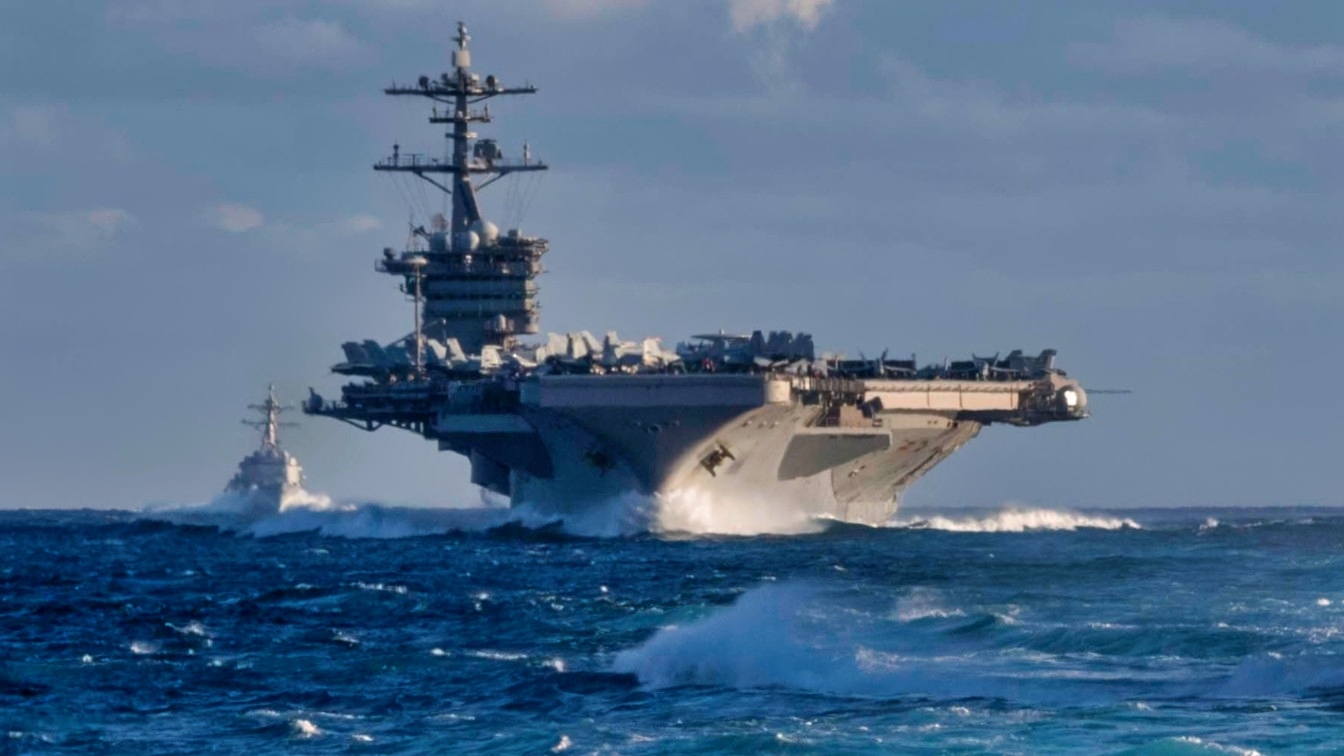
Arleigh Burke-class guided-missile destroyer USS Michael Murphy (DDG 112) sails alongside Nimitz-class aircraft carrier USS Abraham Lincoln (CVN 72) on Dec. 8, 2025. USS Abraham Lincoln (CVN 72), flagship of the Abraham Lincoln Carrier Strike Group, is underway conducting routine operations in the U.S. 7th Fleet area of operations, demonstrating the U.S. Navy’s long-term commitment to a free and open Indo-Pacific. (U.S. Navy photo by Mass Communication Specialist 3rd Class Nathaly Cruz)

USS Ronald Reagan (CVN 76), USS Kitty Hawk (CV 63), and USS Abraham Lincoln (CVN 72) cruise side-by-side in the Philippine Sea June 18, 2006, during exercise Valiant Shield 2006. The joint exercise consists of 28 naval vessels, more than 300 aircraft, and approximately 20,000 service members from the Navy, Army, Air Force, Marine Corps and Coast Guard. (U.S. Navy photo by Chief Photographer’s Mate Spike Call) (Released)
Traffic is falling now because of multiple factors, including renewed US strikes against Iranian military infrastructure, Iranian missile and drone attacks, IRGC threats against commercial shipping, reported boarding/interdiction of merchant vessels, and heightened insurance risks. Shipping companies are responding as expected by delaying departures, rerouting where possible, waiting outside the Gulf, and reducing overall traffic. Unlike military vessels, commercial operators simply avoid risk whenever possible.
Going Dark
Many commercial vessels are reportedly disabling or limiting their Automatic Identification System (AIS) transmissions, or going “dark.” Under normal circumstances, AIS broadcasts identity, location, speed, and course. But crews are disabling their AIS to reduce visibility to hostile actors, complicate targeting, and lower the risk of interception. The tradeoff is greater navigational uncertainty and more complicated maritime monitoring.
Implications for Global Markets
The trade in oil is as important as its production. Even if oil continues to be pumped, it must still reach customers. Reduced tanker movement means slower exports and delayed refinery deliveries, leading to tighter inventories and supply uncertainty. Markets can tolerate temporary disruptions, yes, but longer interruptions begin to affect supply chains.
Yet prices still haven’t surged. Instead, oil prices remain relatively restrained. Why? Possible explanations include the expectation that diplomacy will resume or the belief that Hormuz may reopen soon. Existing inventories also provide a temporary cushion. However, markets often react before shortages become visible. And if traffic remains depressed, inventory drawdowns could eventually place greater upward pressure on prices.
Military Implications
Beyond economics, the slowdown also reflects changing naval realities. The US Navy remains present. But escorting every commercial tanker simultaneously is operationally impossible. Warships can protect individual vessels, escort convoys, and deter some attacks, but they cannot eliminate every threat across an entire strategic waterway. Asymmetric threats, including drones, anti-ship missiles, and small fast attack craft—which underpin Iran’s strategy in the region—allow relatively modest forces to complicate commercial shipping even in the presence of a superior navy.
Another military wrinkle: dark commercial traffic complicates maritime awareness. Without routine AIS signals, naval commanders must increasingly rely upon radar, electro-optical sensors, intelligence, and visual identification. Every unidentified vessel requires additional attention. This, in turn, slows decision-making while increasing the risk of misidentification, accidental engagement, and surprise attack. Maintaining an accurate picture of the maritime environment becomes considerably more difficult.
Diplomatic Pressure
The slowdown also strengthens negotiating leverage. Every day, shipping remains disrupted, economic pressure increases, insurers face higher costs, governments must confront energy concerns, and markets become more anxious. That creates incentives for outside mediators, like Qatar and Pakistan, to push the US and Iran back towards negotiations. The condition of the shipping lanes functionally becomes entwined with the diplomatic bargaining process.
Ultimately, the Hormuz slowdown illustrates how modern conflicts target economic systems, not just military systems. Iran does not need to defeat the US Navy or Air Force in a conventional battle; Iran just needs to impose meaningful costs, in this case, raising the perceived risk of transit through one of the world’s most important maritime chokepoints.
This alone is enough to alter commercial behavior, increase insurance costs, and disrupt global supply chains. For the US, this episode highlights the limits of naval power. Even the world’s most capable fleet cannot guarantee uninterrupted commercial shipping through vital straits.
About the Author: Harrison Kass
Harrison Kass is a writer and attorney focused on national security, technology, and political culture. His work has appeared in Tablet, City Journal, The Hill, The Spectator, and The Cipher Brief. He holds a JD from the University of Oregon and a master’s in Global & Joint Program Studies from NYU. More at harrisonkass.com.


