

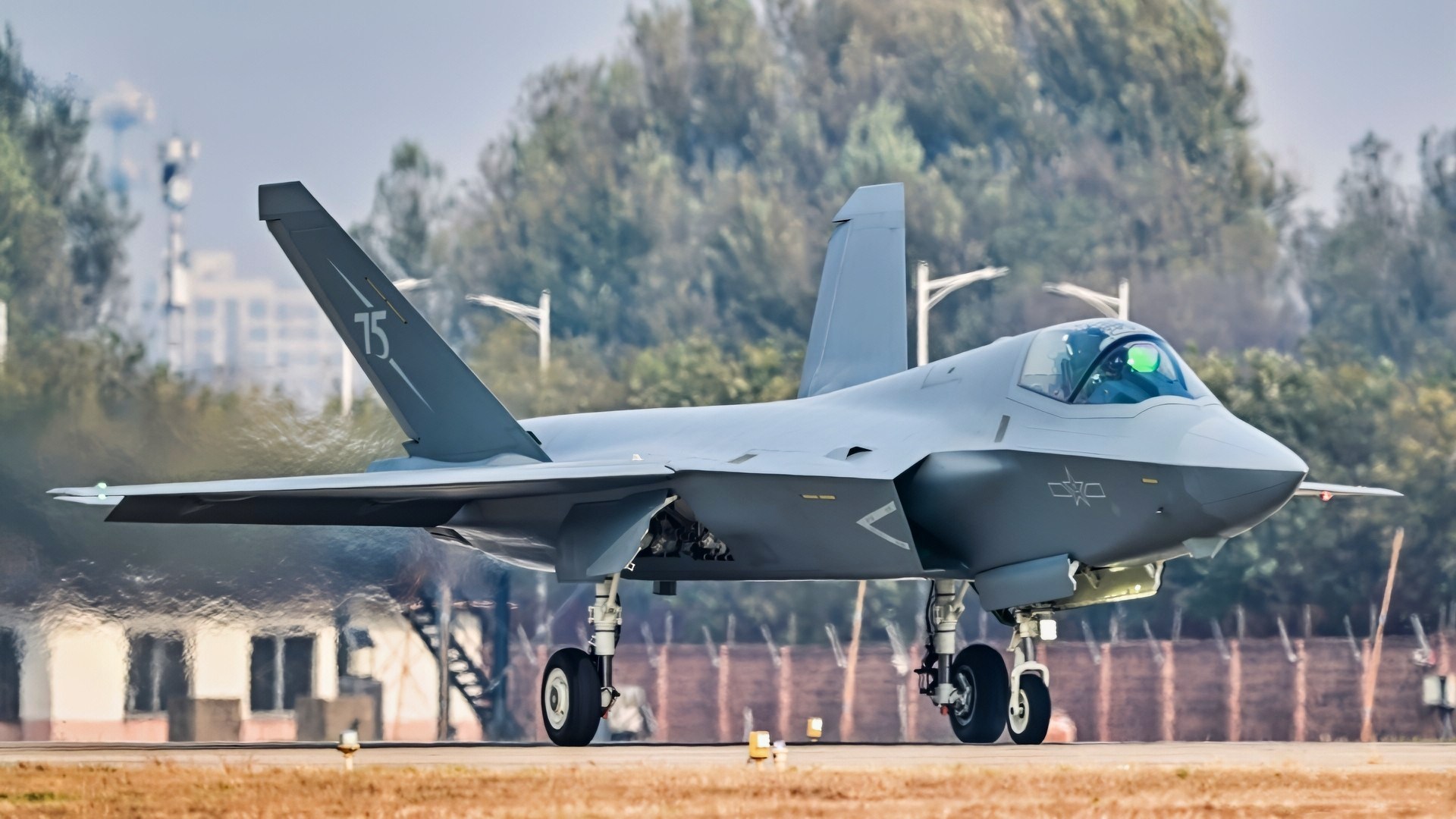
Summary and Key Points: China’s Shenyang J-35 stealth fighter is transitioning into mass production, with estimates projecting up to 300 units by 2030.
-Designed as a carrier-borne strike platform for the Fujian (CV-18), the J-35 provides the People’s Liberation Army Navy (PLAN) with a fifth-generation, twin-engine capability to challenge the U.S. F-35 Lightning II.

J-35 Fighter Chinese State Media Photo.
-Featuring a 12-missile “beast mode” and long-range PL-15 missiles, the J-35 serves as a multi-domain command node capable of guiding surface-to-air weapons.
-While the U.S. and allies maintain a quantitative edge with over 1,200 F-35s, the J-35’s $55 million unit cost allows Beijing to rapidly saturate the Indo-Pacific battlespace.
China’s J-35 Stealth Fighter Build-Up: 57 Built, 200–300 a Year Possible by 2030
China has been producing the J-35 stealth aircraft in increasing numbers.
China has produced more than 57 J-35s to date. Current estimates indicate an annual output of 70-100 units. However, manufacturing is expected to ramp up significantly, potentially reaching 200–300 units by 2030, according to industry estimates and reports
This has set off alarm bells across the oceans as aviation analysts worry that the US and our allies won’t be able to match stealth aircraft against the Chinese.
The carrier-based variant of the Shenyang J-35 stealth fighter, which is expected to enter service and mass production around 2026, is poised to significantly influence the future of naval warfare, regional power dynamics, and defense technology in the Indo-Pacific and beyond.
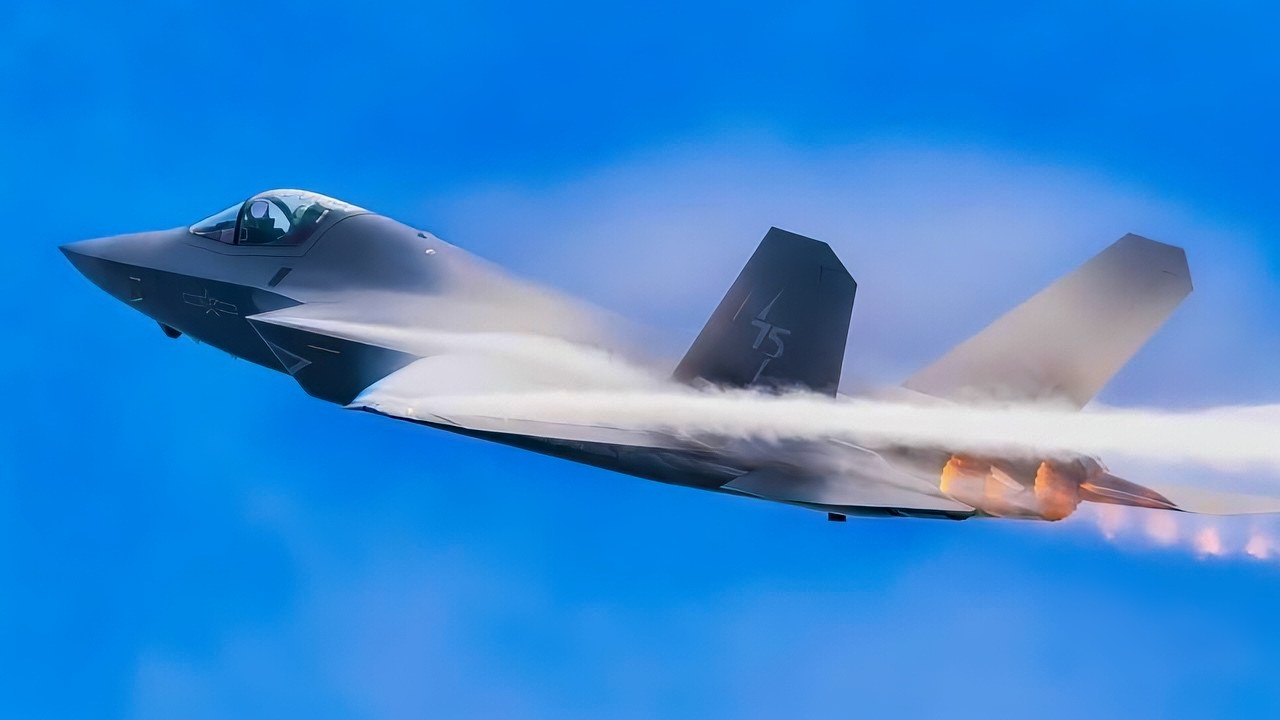
J-35A Fighter in the Clouds. Image Credit: Chinese Weibo.
Designed to operate from the Fujian and subsequent Chinese aircraft carriers using electromagnetic catapults, the J-35 provides the People’s Liberation Army Navy (PLAN) with a fifth-generation, twin-engine, carrier-borne strike capability, aiming to challenge the United States’ long-standing monopoly on carrier-based stealth aviation
China’s Aircraft Carrier-based Fighter, The J-35
China’s J-35 is a carrier-based fighter built to fly off China’s aircraft carriers.
The J-35 traces its roots back to the Shenyang Aircraft Corporation’s FC-31, a prototype aircraft with some stealth features that first flew in 2012. A land variant of the J-35 is called the J-35A.
The FC-31 was initially conceived as an export stealth fighter but evolved into the J-35 as a test and research platform for a carrier-based fighter.
Around a decade later, the first iteration of the J-35 took flight. It featured folding wings and robust landing gear for tight storage and hard landings on aircraft carriers. China recently made its first-ever catapult takeoffs from its new carrier.

J-35 China Weibo Screenshot.
The Chinese Government-backed Global Times states that the J-35 is markedly different from its predecessor, the J-20, in its coverage of the J-35’s arrival. The Chinese paper compares the J-20 to its J-35 and says the newer J-35 is lighter, faster, similar to an F-35, and engineered for “strong surface attack capabilities.”
“The J-35A has a different design than China’s first stealth fighter jet, the J-20. The J-20, with a canard wing configuration, is a heavy fighter jet with a focus on air superiority missions comparable with the US’ F-22, while the medium-sized J-35A uses a tailplane wing configuration similar to the US’ F-35 that also has strong surface attack capabilities,” The Global Times says.
The China Daily reported that Wang Yongqing, chief researcher at the Aviation Industry Corp of China’s Shenyang Aircraft Design and Research Institute, said the J-35A provides what he described as “systems coordination” or “multi-domain coordination” in combat.
“It [the J-35A] can lock on the targets, share the targets’ position with other weapon systems, such as surface-to-air missiles, and even use its own radar to guide other weapons to bring the targets down,” he told the state-run newspaper in an interview published on May 13.
The J-35 Fighter’s Capabilities Explained
“Our adversaries will definitely use their stealth aircraft or low-observable cruise missiles to penetrate our air defense networks,” Yongqing Wang explained, without naming any specific countries.
“The J-35A has significant advantages in terms of first detection, first strike, and securing operational advantages,” Wang said.
He added that in combat against previous generations of aircraft, “the J-35A can remain outside the effective detection range of the enemy, achieving one-way transparency of the battlefield situation and possessing overwhelming advantages that disrupt traditional air combat patterns,” the Global Times states.

China’s New J-35 Stealth Fighter

China New J-35 Fighter on Aircraft Carrier. Image Credit: Chinese Weibo.
However, everything known about the J-35 variants is limited to what China has released. We don’t yet know the aircraft’s true capabilities, especially its stealth properties, but they are supposedly trying to sell 40 or so J-35As to Pakistan, something that nation seems to be avoiding for the moment.
How Would The J-35 Influence Naval Aviation
The J-35 is designed to operate in highly contested airspace, employing its low radar cross-section and advanced electronic countermeasures to neutralize high-value targets such as AWACS and aerial tankers.
With its 12-missile “beast mode” capability (including long-range PL-15s), it will be a key component in China’s Anti-Access/Area Denial (A2/AD) strategy, allowing the PLAN to project power farther from its coastline and threaten US carrier groups.
The introduction of the J-35, in combination with the catapult-equipped Fujian (CV-18), significantly increases operational efficiency. It enables a shift from defensive air patrols to complex, multirole strike operations, including precision ground strikes and maritime interdiction.
Unlike the high-cost F-35, the Chinese claim that the J-35 is designed to be produced in large numbers at a lower cost ($55–70 million per unit), enabling China to quickly saturate the battlespace with stealth platforms. This capability allows China to close the technological gap with the US by matching qualitative improvements with quantitative superiority.
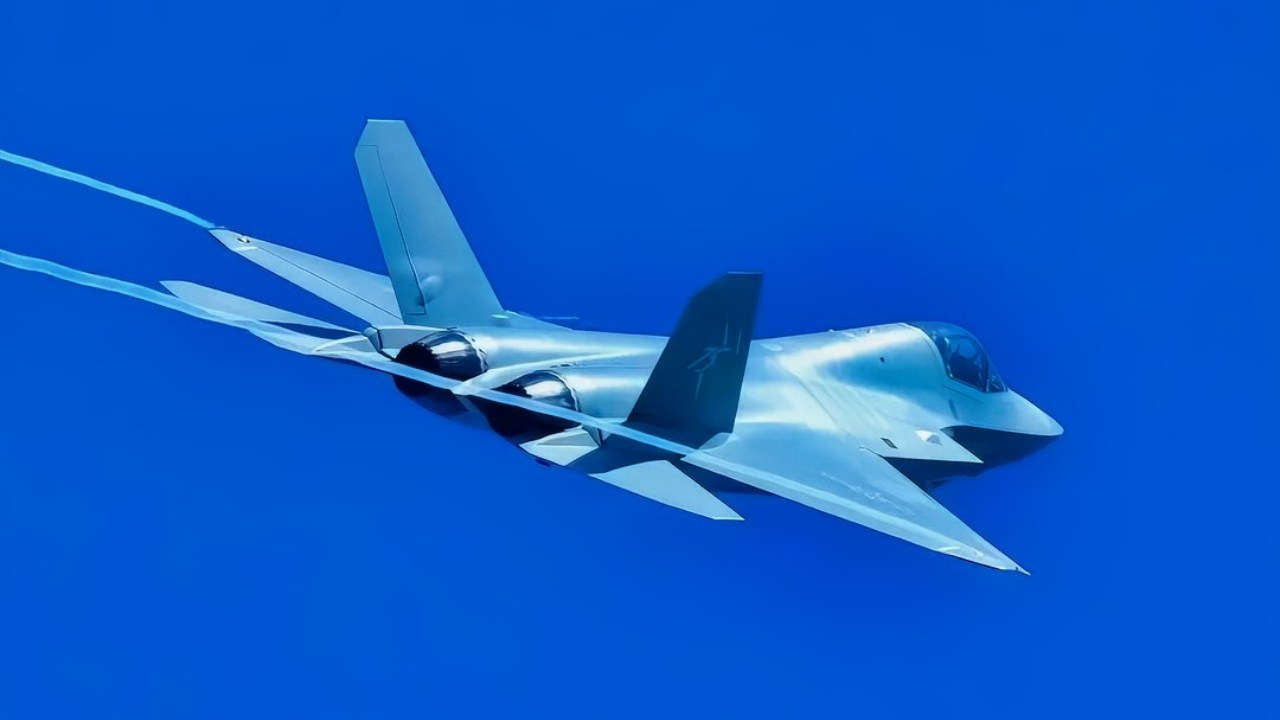
J-35A Fighter from China. Image Credit: PLAAF
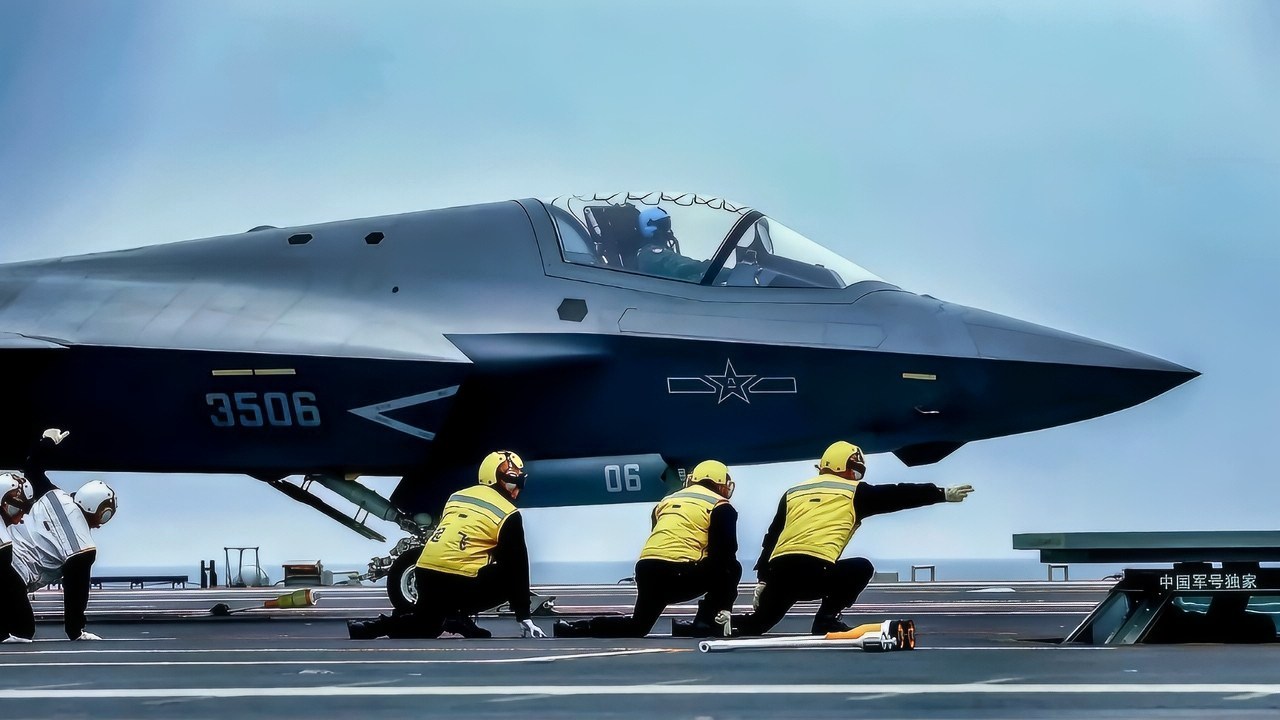
China J-35 Fighter. Image Credit: Chinese Navy/PLAN.
The J-35 leverages a “one aircraft, multiple variants” strategy, using a common airframe for both the PLAN (carrier) and PLAAF (land-based J-35A). This approach streamlines maintenance and logistics and, most importantly, enables rapid, iterative upgrades of avionics and weapons systems, potentially allowing the J-35 to evolve fast and cheaply.
J-35 Stealth Fighter Numbers Are Still Far Below The F-35
While China’s numbers are growing rapidly and the J-35 carrier-based fighters are indeed a formidable force, one should note that the US operates 187 F-22 Raptors and that over 1,200 F-35s have been built.
While the F-22 is out of production, the new NGAD F-47 has already entered limited production. And in terms of production, the F-35 isn’t being outproduced.
Lockheed Martin produces a stable rate of 156+ F-35s per year and delivered a record 191 F-35s in 2025, despite being constrained by a backlog of aircraft requiring software upgrades. In 2024, 110 F-35s were delivered, and the stable production rate of 156+ is expected to continue.
US Allies Also Operate The F-35
Of course, not all F-35s are stationed in the Indo-Pacific, but the numbers show our allies are well stocked with F-35s, which keeps deterrence high.
Japan already operates the F-35A, in addition to the US aircraft stationed there. The number of US F-35s fluctuates due to aircraft carrier deployments. The Japanese Defense Forces have ordered 147 F-35s.
Japan is developing the sixth-generation Global Combat Air Program (GCAP) sixth-generation fighter.
South Korea operates about 40 F-35As as well as its own stealthy KF-21 Boramae fighters.
Australia has a fleet of 72 F-35A Lightning II aircraft, with the final one delivered in December 2024. This acquisition completes the initial commitment to equip three operational squadrons and a training squadron at RAAF bases Williamtown and Tindal.
There have been discussions about acquiring an additional 28 F-35A aircraft, bringing their total to 100. Singapore is slated to receive 20 F-35s in early 2026.
China’s numbers are rapidly growing and should not be discounted. However, the F-22 and F-35 are superior to the Chinese J-20 and J-35. The US is also expected to receive the sixth-generation F-47 stealth fighter and the naval F/A-XX in the near future.

A U.S. Air Force F-35A Lightning II assigned to the F-35A Lightning II Demonstration Team performs an aerial demonstration at Laughlin Air Force Base, Texas, March 8, 2023. The F-35 Demo Team performs flights regularly to maintain flying certifications and to uphold and maintain their mission and Air Force recruiting standards. Image Credit: U.S. Air Force.
Our Allied air forces continue to train hard in joint drills with the US. The training and experience of U.S. pilots are second to none.
While it represents a major leap, the J-35’s future influence is tempered by potential challenges, including engine reliability, the maturity of its sensor-fusion capabilities relative to those of the F-35, and the logistical demands of sustaining high sortie rates during carrier operations.
About the Author: Steve Balestrieri
Steve Balestrieri is a National Security Columnist. He served as a US Army Special Forces NCO and Warrant Officer. In addition to writing on defense, he covers the NFL for PatsFans.com and is a member of the Pro Football Writers of America (PFWA). His work was regularly featured in many military publications.


your uncle bob
February 18, 2026 at 6:21 pm
The j-35 is pretty useless, unless china intends to use it alongside kamikaze droned and df-61 long-range missiles.
Let’s see how adelaide and its nearby AUKUS facility cope with kamikaze drones and df-61s.