

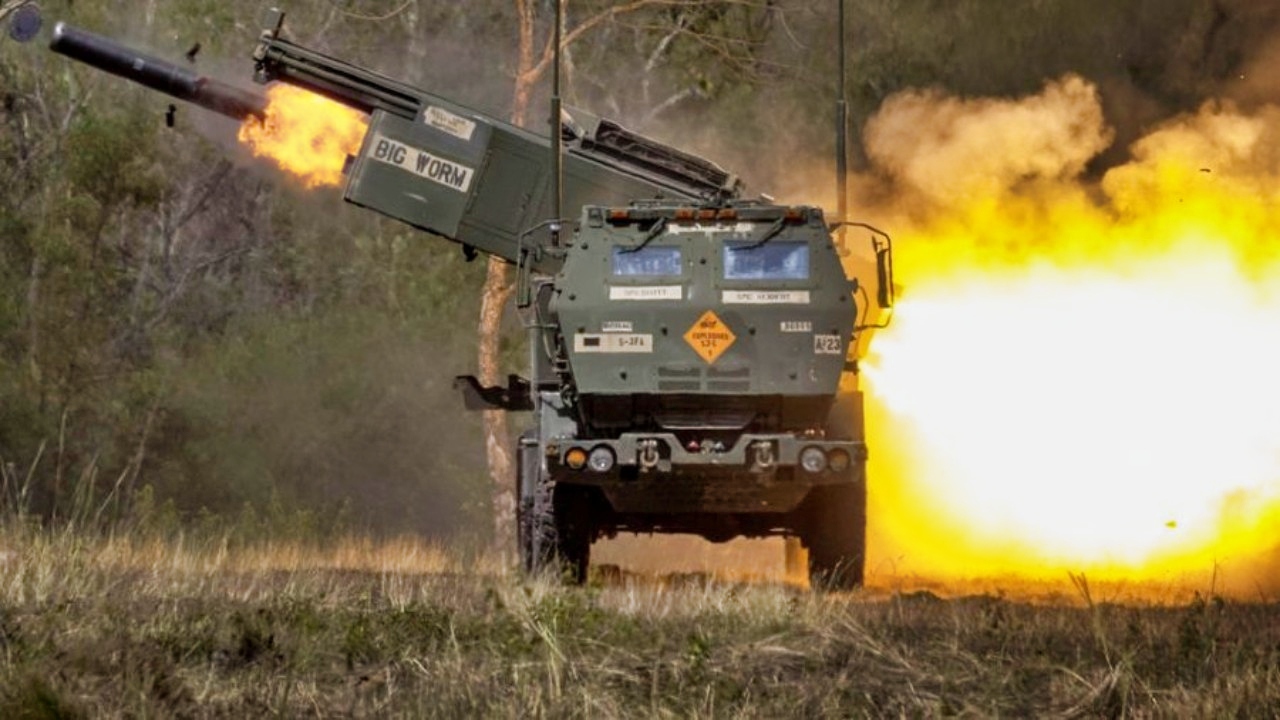
Key Points and Summary – The M142 HIMARS, having proven its devastating effectiveness in Ukraine, has become the most sought-after rocket artillery system for NATO nations bordering Russia.
-Alarmed by Russian aggression, the Baltic states of Estonia, Latvia, and Lithuania are leading a procurement rush, acquiring HIMARS batteries to create a credible deep-strike deterrent.
-The system’s success in destroying high-value Russian targets like command posts and ammunition dumps has turned it into a “game-changing” weapon.
-This has made it an essential acquisition for Eastern European countries bolstering their defenses against a potential future conflict with Moscow.
HIMARS For Everyone?
WARSAW, POLAND – Those NATO allies that have a common border with Russia look nervously at the wanton devastation that Moscow has visited on Ukraine and are fearful that they could be next.
Then there is the uncertain level of the US commitment to NATO and the future of the US military assistance to Ukraine after a recent but abrupt pause in shipments of US missiles.
Then there are Russian President Vladimir Putin’s unbending maximalist demands for Ukraine to surrender and disarm unconditionally.
This has more of these nations concerned since no one knows what the former KGB Lt. Col. might do next.
What they have all been observing in the course of the three-and-a-half-year conflict is that the one system that has delivered some of the more spectacular results on the battlefield has been the US Army’s M142 High Mobility Artillery Rocket System (HIMARS).
As they weigh the dangers of Putin coming after them next, they are lining up to purchase the US-made system as a hedge against Russian troops marching across their borders.
The HIMARS is a multiple rocket launcher that Ukraine has been employing as one of its primary strike weapons in its defense against Russia’s invasion.
The system was initially rated as a game changer when it was first provided to Ukraine, but Moscow’s military has since adjusted some of its tactics, making it less effective than before.
Nonetheless, the nations that are most concerned about their proximity to Russia all now see it as essential to their defense planning.
Could the Baltics be Next for HIMARS?
The three Baltic nations of Lithuania, Latvia, and Estonia, due to their size and history of being invaded and occupied by Russia prior to WWII, feel more vulnerable than any of the other potential targets for a Russian invasion.
Thus, they are deeply concerned that they will be Russia’s next target should Putin be successful in Ukraine.
They have now decided to procure the HIMARS as a lynchpin weapon in modernizing their defenses.
Estonia received six HIMARS in April, Latvia has an agreement with Washington to receive six of the systems, which are expected by 2027, and Lithuania is purchasing eight of them, with the first deliveries expected before the end of this year.
These three countries all regard the HIMARS’ ability to conduct deep strikes on the enemy’s rear as essential to thwarting and disrupting any invasion force.
These are conclusions that they have drawn after observing how Ukraine has employed the platform in taking our strategic targets.
Hanno Pevkur, Estonia’s defense minister, explained to Western media that his country believes that by acquiring the combat-tested HIMARS, they will be sending a “deterrence message” to Russia.
“We have the long strike capability, deep strike capability in Estonia already today,” he explained, showing that his country is preparing for the worst potential actions from Moscow.
NATO countries are now training and exercising with the system in the Baltic states. One of these was the Iron Wolf military exercises with NATO forces and partners that were conducted in Lithuania in May 2025.
Estonia’s Pevkur declared that the entirety of NATO must support the nations in this region.
“The eastern flank is the front door of NATO, so we need to keep it closed,” he stated.
Fighting With Limitations
Ukraine has managed to fight Putin’s army to a standstill by concentrating on four basic capabilities: increasing numbers of and more modern air defenses, maintaining large stockpiles of munitions in order to be able to take the fight to the enemy and sustain it when necessary, increasing innovation and effectiveness in electronic warfare systems and the ability to conduct the deep strikes that the HIMARS system is partially responsible for carrying out.
Before Kyiv received its first HIMARS batteries from the US, many of the big-value targets were out of reach of any of Ukraine’s artillery and existing battlefield weapons.
The HIMARS Guided Multiple Launch Rocket System (GMLRS) gave them the ability to finally hit Russian ammo depots, command and control centers, and other sites that were key nodes or logistic centers for the Russian military.
The GMLRS could now reach these critically important Russian targets.
The surface-to-surface rockets it fires have a range of 70 kilometers, and Ukraine has used them to hit Russian troops, ammunition depots, and aircraft bases.
Ukraine later received Army Tactical Missile Systems (ATACMS), which can hit targets at much longer ranges.
However, Washington initially forbade any strikes of this system being fired on Russian territory.
This has given the Russian military a full range of possibilities to base troops and aircraft, as well as stockpile ammunition and other logistics on Russian soil, knowing they are safe from attack.
Pevkur was asked in May about the wisdom of relying on the US to supply ammunition for weaponry like HIMARS, given the current disputes with NATO about nations’ spending levels.
He stated that Estonia was considering acquiring more of the system, but also analogues to the HIMARS that other suppliers produce.
He also suggested that there could be potential problems with the security of supply of ammunition for HIMARS.
“If we choose HIMARS, we need to be certain that the system can be fully operational and that the necessary ammunition will be available,” he said.
About the Author: Reuben F. Johnson
Reuben F. Johnson has thirty-six years of experience analyzing and reporting on foreign weapons systems, defense technologies, and international arms export policy. Johnson is the Director of Research at the Casimir Pulaski Foundation. He is also a survivor of the Russian invasion of Ukraine in February 2022. He worked for years in the American defense industry as a foreign technology analyst and later as a consultant for the U.S. Department of Defense, the Departments of the Navy and Air Force, and the governments of the United Kingdom and Australia. In 2022-2023, he won two awards in a row for his defense reporting. He holds a bachelor’s degree from DePauw University and a master’s degree from Miami University in Ohio, specializing in Soviet and Russian studies. He lives in Warsaw.
More Military
The U.S. Navy’s Submarine Crisis Is Real


waco
July 14, 2025 at 2:31 am
HIMARS is now a run-of-the-mill battlefield item. There’re better options out there today.
The korean chunmoo is a more modern competitor. Another is the mighty russian tornado.
HIMARS rocket projectiles nowadays can easily be shot out of the sky as proved in the ukraine conflict. Also, the launchers have frequently been targeted by iskander missiles with devastating results.
The best COUNTER TO HIMARS today in 2025 is TACTICAL battlefield nukes.
A hypersonic missile carrying a smallishly small nuke warhead is more than enough to defeat a foe armed with HIMARS.
Also, long-range fighter-bombers launching mini-nukes at HIMARS sites will force the enemy into suing for peace.
Remember, the coming war (planned by DoD & state dept), or ww3, will be fought with or using all kinds of nukes.
Nukes ranging from B61s to LRSOs and IRBMs, ICBMs and others. Like sub-launched cruise missiles armed with miniaturized thermonuclear warheads.
doyle-1
July 14, 2025 at 3:25 am
Putin’s ineptitude has contributed hugely to the current HIMARS reputation.
HIMARS is similar to the scud missiles used by Iraq during the gulf war where patriot defenses stationed at the Saudi border experienced difficulty downing them.
But Putin has learned nothing useful from the actions in the middle east.
HIMARS began arriving in Ukraine during biden’s time, but Putin completely failed to neutralize them immediately upon their arrival.
What’s that revealing to the world about Putin’s strategy.
It shows Putin doesn’t care about going for the jugular.
When fighting a dangerous enemy, you need to go straight for the jugular.
During the Korean war, the Americans very extremely vengefully pulverized the north Korean landscape. Full swathes of territory were destroyed and obliterated and burned to a crisp.
Putin has learned absolutely nothing. Putin needs to go.
Commentar
July 14, 2025 at 8:44 am
Trump hours ago, has very most provocatively, put forward his plan to send extra new massive US weaponry to ukraine, so that the nazis there can engulf a greater area in donbass for all-out war.
Thanks, donald. And thanks, also for the killing of gaza children who were just trying to get water.
Thanks, a lot. A massive lot.
Peace ? Peace is a word not found in the lexicon of global fascists who pretend they’re guardians of humanity.
They’re the hell guardians of war and logistical trains of war.