


Key Points and Summary – The U.S. Air Force faces a potential “air superiority gap” due to the small size and maintenance issues of its F-22 Raptor fleet.
-While the F-22 remains a qualitatively superior fighter, only 143 (numbers vary by source) of the 186 aircraft are combat-coded, a number dwarfed by China’s rapidly growing fleet of J-20s.

U.S. Air Force maintainers assigned to the 3rd Air Expeditionary Wing prepare F-22 Raptors for take-off on the flightline during exercise Resolute Force Pacific 2025 in Tinian, Northern Mariana Islands, July 19, 2025. The REFORPAC exercise is part of a first-in-a-generation Department-Level Exercise series, employing more than 400 Joint and coalition aircraft and more than 12,000 members at more than 50 locations across 3,000 miles. (U.S. Air Force photo by Airman 1st Class Tala Hunt)
-With the F-22’s successor, the F-47, potentially facing delays, the U.S. is betting that superior technology and pilot skill can overcome this numerical disadvantage.
-However, this strategy hinges on keeping the notoriously finicky Raptors at maximum readiness.
Only 143 Combat-Coded F-22 Raptor Fighters
It is going to take a sheer number of airplanes if the US Air Force wants to dominate the skies in a potential conflict with China or Russia. The Air Force may have a qualitative advantage with the F-22 Raptor, but in terms of quantity, there is a problem. There are only about 186 Raptors, but that number is misleading.
Only 143 (we admit, numbers vary based on the source) are “combat coded” and ready to take on active duty missions at any time. Plus, others need maintenance and repair, which further reduces the number prepared for battle. Then there are more than two dozen that could be retired.
The biggest problem would be in a showdown with China. The stealth J-20 Mighty Dragon is growing in numbers as China pumps them out at will. There might be as many as 200 to 400 J-20s. This is a force that could challenge the air superiority of the F-22. The Russian Su-57 fifth-generation fighter does not have these kinds of numbers, but it would take at least 150 active F-22s to outclass the Su-57.

Su-75 Checkmate and Su-57. Image Credit: Creative Commons.
Is the F-22 Durable and Dependable?
The F-22 is a notoriously finicky and maintenance-heavy airplane. Many of its internal systems are becoming dated. The Air Force also has an upgrade program that is slowly improving the F-22 with better stealth coatings and radar, but that still means some of the Raptors are continually out of action.
Delays with the New F-47 NGAD
This issue will need to be resolved before the transition to the F-47 NGAD sixth-generation fighter. The F-47 may not be ready until the early to mid-2030s. F-47 prime contractor Boeing is having difficulty. Its fighter jet workers went on strike in August, and while the company plans to hire non-union replacement workers, the F-47 could see developmental delays depending on how long the strike lasts.
The F-22 itself is around 30 years old, and upgrades are needed. The airplane is still one of the best in the world, though, and a good, combat-experienced pilot could still best the most advanced fighters from China and Russia. The F-22 is the first fifth-generation jet to be in service.

U.S. Air Force Capt. Nick “Laz” Le Tourneau, F-22 Raptor Aerial Demonstration Team commander, conducts a solo practice flight at Joint Base Langley-Eustis, Virginia DATE. This training session ensured that the demonstration pilot remains proficient in performing complex maneuvers that emphasize stealth and tactical superiority. (U.S. Air Force photo by Senior Airman Adisen Smith)
What’s Great About the F-22?
Its sensor fusion is great for situational awareness, and it can fly swiftly in supercruise mode without afterburners. Due to thrust vectoring, the F-22 is a pilot’s pride and joy, and it gives aviators a rush when flying it in various high-G maneuvers. The F-22 is also the stealthiest fighter in the world – much more radar evasive than the J-20 or even the F-35.
You Mean There Could Have Been 750 F-22s at One Point?
The F-22 has always been a victim of the numbers game. There were once plans to build 750 F-22s, but geopolitics and a changing threat environment cut those heady goals. The Global War on Terror necessitated fighter jets to be able to strike ground targets for close air support against insurgents and terrorists. The F-22 is not meant for surface strike. Russia wasn’t seen as much of a threat because the Cold War had ended, and China had yet to focus on a substantial military build-up that emphasized new production of fighter jets.
Due to the smaller numbers of F-22s, the upgrade costs are more expensive per unit, as much as $72.6 million each for the airplanes going through the process. This places significant pressure on the program to maintain the existing numbers and enhance the airworthiness of the fleet.
‘Air Superiority Gap’
This “air superiority” gap is a problem. Russia and China are quite aware of how many F-22s are ready for combat at any time. The US Air Force is betting that the Raptor is such a great dog-fighter that its lack of numbers compared to the J-20 and the Su-57 is not problematic.
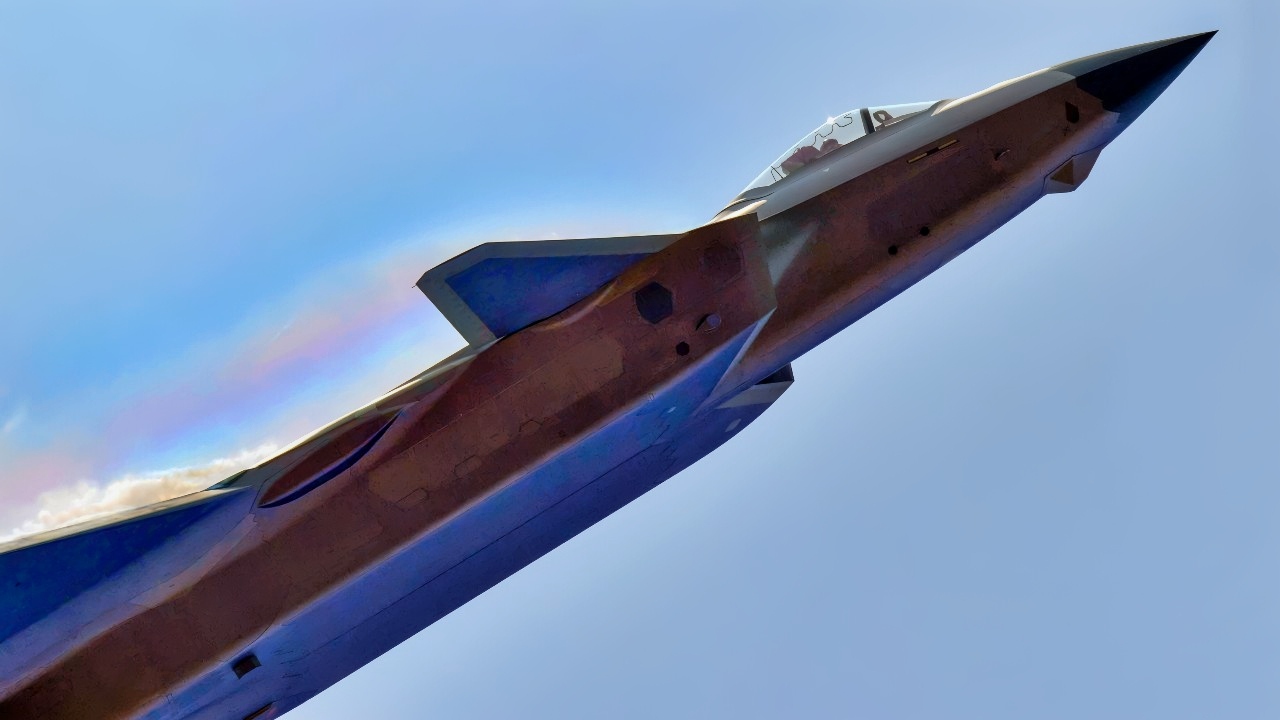
China J-20 Long Shot from 2021. Image Credit: Chinese Military.
The older F-22s are a separate issue, as the Block 20 models are taken out of service and used as trainers. This is where the Air Force could be caught in a pickle. Upgrade the F-22 and remove a warbird from active duty, or leave it combat-coded and risk it being outclassed by the newer J-20s and Su-57s. This is a difficult choice.
The current size of the fleet is not going to grow. There will be no more F-22s built in the future. This means that American battle planners must focus on the F-35 to bolster numbers. However, I’m inclined to believe that the total force of F-22s will probably be sufficient in the long run. There are enough to make the transition to the F-47. The labor strike will not last forever, and the F-47 research and development will continue later this year when worker demands are met.
But some are worried that the F-22 will have more difficulty in a head-to-head matchup with Russian and Chinese airplanes. Just take a look at the last combat engagement between Pakistan and India. Pakistan was flying fourth-generation J-10Cs, and Pakistani pilots shot down at least one Indian Dassault Rafale.
If one of China’s older non-stealth model airplanes can demonstrate such aerial battle skills, does it imply that newer Chinese airplanes are designed with a combat edge? Furthermore, does that also mean the Raptor would not have the expected level of success versus the J-20?
Those are questions that we must ask. So, the quality of the F-22 is more critical than the quantity after all. The remedy is to keep as many F-22s on combat status as possible. That means Air Force ground crews and technicians must work on the Raptor at optimal levels. There can’t be a large number of airplanes that are not ready to fight. The air superiority gap could be real, and adversaries are watching as they build more stealth fighter jets to challenge the F-22.
About the Author: Brent M. Eastwood
Brent M. Eastwood, PhD is the author of Don’t Turn Your Back On the World: a Conservative Foreign Policy and Humans, Machines, and Data: Future Trends in Warfare plus two other books. Brent was the founder and CEO of a tech firm that predicted world events using artificial intelligence. He served as a legislative fellow for US Senator Tim Scott and advised the senator on defense and foreign policy issues. He has taught at American University, George Washington University, and George Mason University. Brent is a former US Army Infantry officer. He can be followed on X @BMEastwood.
More Military
J-20 vs. F-47: Which Stealth Fighter Wins?
F-14 Tomcat: We Got As Close To This Fighter as the Law Allowed Us (Full Tour/Pictures and Video)
F-22 vs. J-20: Who Wins a Stealth Fighter Dogfight?


