

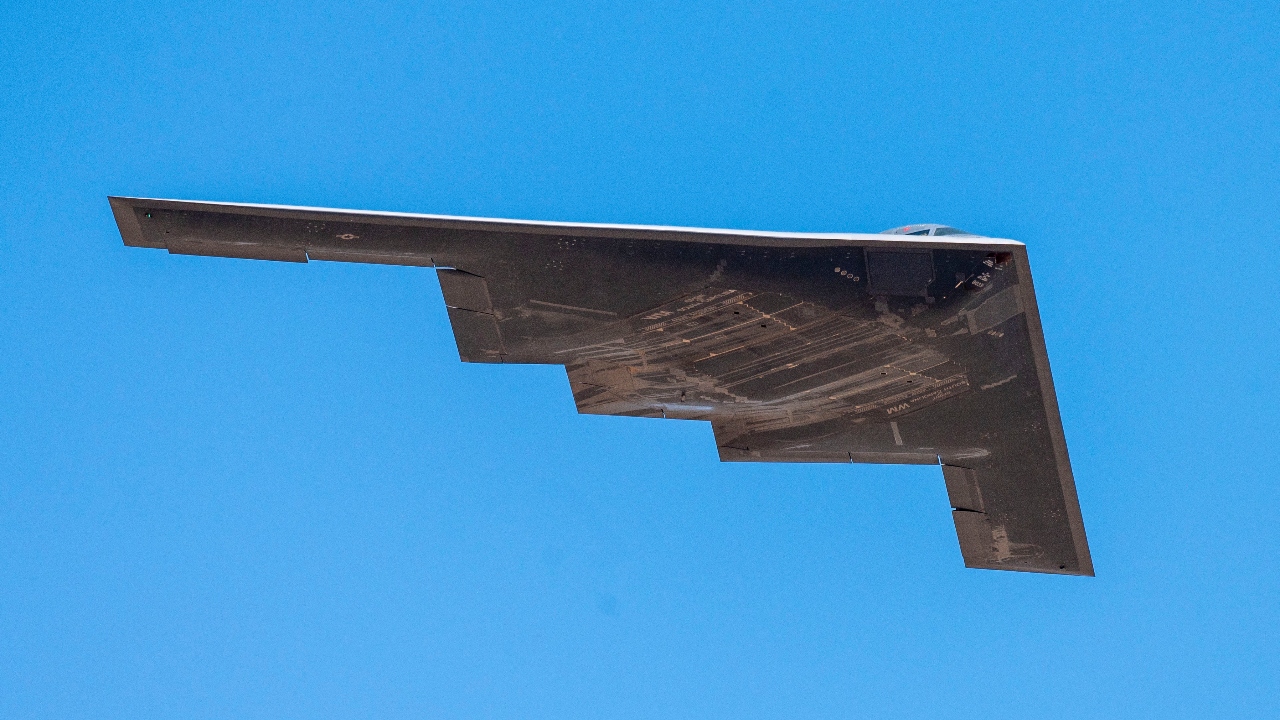
Key Points and Summary on B-21 Raider – The most significant military threat China and Russia both face today is the new B-21 Raider stealth bomber. And yet, neither can answer a key question: how many B-21 Raider bombers will the U.S. Air Force build? At present, the Air Force can’t answer that either.
-The U.S. Air Force is exploring a significant increase in the production of its next-generation B-21 Raider stealth bomber, a move that could reshape American air power.

B-21 Raider. Image Credit: Creative Commons.
-While the current plan calls for a minimum of 100 aircraft, top officials acknowledge that a larger fleet, with some analysts recommending up to 400 bombers, is needed to deter both China and Russia. Although Air Force Chief of Staff Gen.
-David Allvin has expressed caution about accelerating production too quickly, he also sees the potential for a “very, very promising” and “significant” capability boost for the nation’s strategic bomber force.
The B-21 Raider Bomber Question
The U.S. Air Force’s newest bomber, the upcoming B-21 stealth bomber, could see higher production numbers if the sixth-generation bomber’s unique manufacturing could be accelerated.
“The Air Force is committed to the successful fielding of the B-21 and is investing in the infrastructure necessary to support an increased yearly production capacity,” the U.S. Air Force told Air and Space Forces Magazine.
“This proactive measure ensures the long-term health and efficiency of the production line, enabling us to deliver this critical capability to the warfighter,” the statement added. “Details regarding specific production rates remain classified.”
What We Know
General David Allvin, the U.S. Air Force Chief of Staff, is not yet certain that America’s flying branch will buy more B-21s than planned initially.
Still, he told the Senate Appropriations Committee that the newest bomber “is manufactured differently” than other aircraft are, leading to potential production complications.
“We want to ensure that, before we accelerate [B-21 Raider production], we don’t want to be overly zealous without fully understanding what it might mean to accelerate beyond a certain production rate.”
General Allvin also said that the U.S. Air Force is “intensely looking at” boosting B-21 production rates, “not only from an affordability point of view, but also a feasibility point of view, to ensure that we don’t go too fast.”
Still, General Allvin did concede that the idea of accelerating production is not only “very, very promising,” but it would also give “a significant capability for our Air Force.”
B-2 Replacement
The B-21 Raider, named after the Doolittle Raider of Second World War fame, will ultimately replace B-2 Spirit, a stealth bomber with its roots in the latter stages of the Cold War.
Though that bomber has recently been put to use by the United States, successfully targeting Iran’s nuclear infrastructure, the B-21 promises improved sensor capabilities and significantly more sophisticated stealth features than its outwardly similar predecessor.
Both use a flying-wing design, which reduces drag and the plane’s radar cross-section, but are in essence different platforms.
A Numbers Game
As the Hudson Institute recently laid it out in bare terms, “the US Air Force has confirmed that 100 B‑21s is the minimum order, not the maximum. The original number, 100, was selected before the US realized that it would need to deter China and Russia simultaneously, and the PRC’s number of strategic systems has rapidly grown since then.”
The think-tank added that “the Center for Strategic and Budgetary Assessments recommends that the US plan to construct a force capable of defeating two major powers simultaneously and suggests that the US procure 288 B‑21s for this purpose…” but that “a prominent former national security official projected the number to range from 300–400.”
B-21 Raider: What the Air Force Needs
It remains unclear how many B-21s the U.S. Air Force will ultimately get, though it seems entirely possible, if not likely, that more B-21s will eventually fly with the U.S.A.F. livery. The crux of the issue may be funding.
However, there appears to be interest in acquiring more advanced bombers for the U.S. Air Force.
About the Author: Caleb Larson
Caleb Larson is an American multiformat journalist based in Berlin, Germany. His work covers the intersection of conflict and society, focusing on American foreign policy and European security. He has reported from Germany, Russia, and the United States. Most recently, he covered the war in Ukraine, reporting extensively on the war’s shifting battle lines from Donbas and writing on the war’s civilian and humanitarian toll. Previously, he worked as a Defense Reporter for POLITICO Europe. You can follow his latest work on X.
More Military
The U.S. Navy’s Submarine Crisis Is Real


