

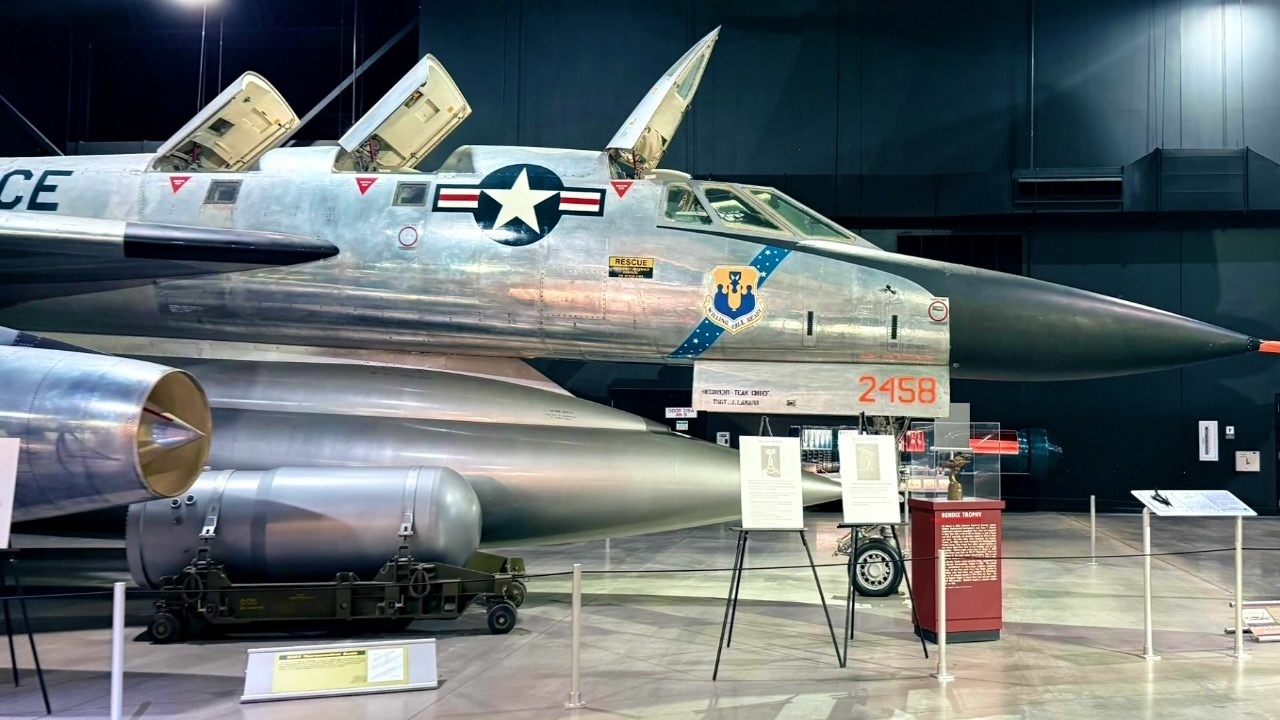
Key Points – The Convair B-58 Hustler was the world’s first supersonic bomber, a Cold War marvel designed to penetrate Soviet airspace at Mach 2.
-It carried its nuclear weapon and extra fuel in a unique external pod. Despite its record-breaking speed, the B-58 was a flawed concept.
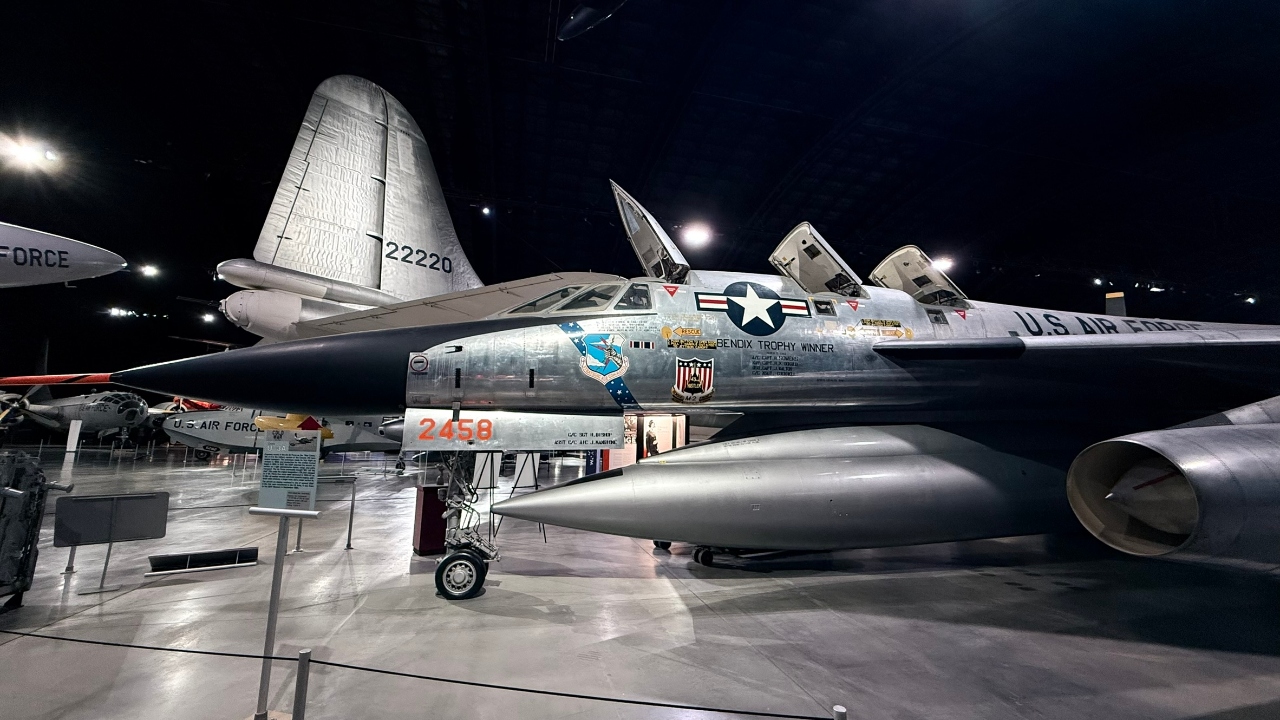
B-58 Hustler in the Air Force Museum. Image Credit: National Security Journal.
-Its high-altitude mission was quickly rendered obsolete by advanced Soviet surface-to-air missiles.
-Plagued by high operating costs and a staggering crash rate that saw over a quarter of the fleet lost, the Hustler was retired after just ten years, a brilliant failure that paved the way for future supersonic aircraft.
–National Security Journal toured the B-58 Hustler several days ago at the U.S. Air Force Museum in Dayton, Ohio. That is where all pictures are sourced from and are original.
The B-58 Hustler Bomber Explained
The Convair B-58 Hustler was a unique and groundbreaking aircraft that ushered in a new age in aerospace engineering.
After the end of the Second World War, the U.S. sought a bomber that could easily penetrate the Soviet Union’s air space and deliver a nuclear strike. The result was the B-58 Hustler, the first supersonic ever produced. Despite having a relatively short service life, the B-58 had a tremendous impact on the industry and heralded the age of supersonic aircraft.
Testing the Waters of Hypersonic Flight
The origins of the B-58 trace back to the immediate post war era, when the U.S. Air Force began exploring the concept of a supersonic bomber that could penetrate Soviet airspace with speed and altitude as its primary defenses. This initiative, known as the Generalized Bomber Study (GEBO II), was launched by the Air Research and Development Command in 1949.
The goal was to develop a bomber that could fly faster and higher than any interceptor or missile system of the time. Convair, a company already experienced with delta-wing aircraft through its work on the F-102 and F-106 interceptors, was awarded the contract to develop this new bomber.
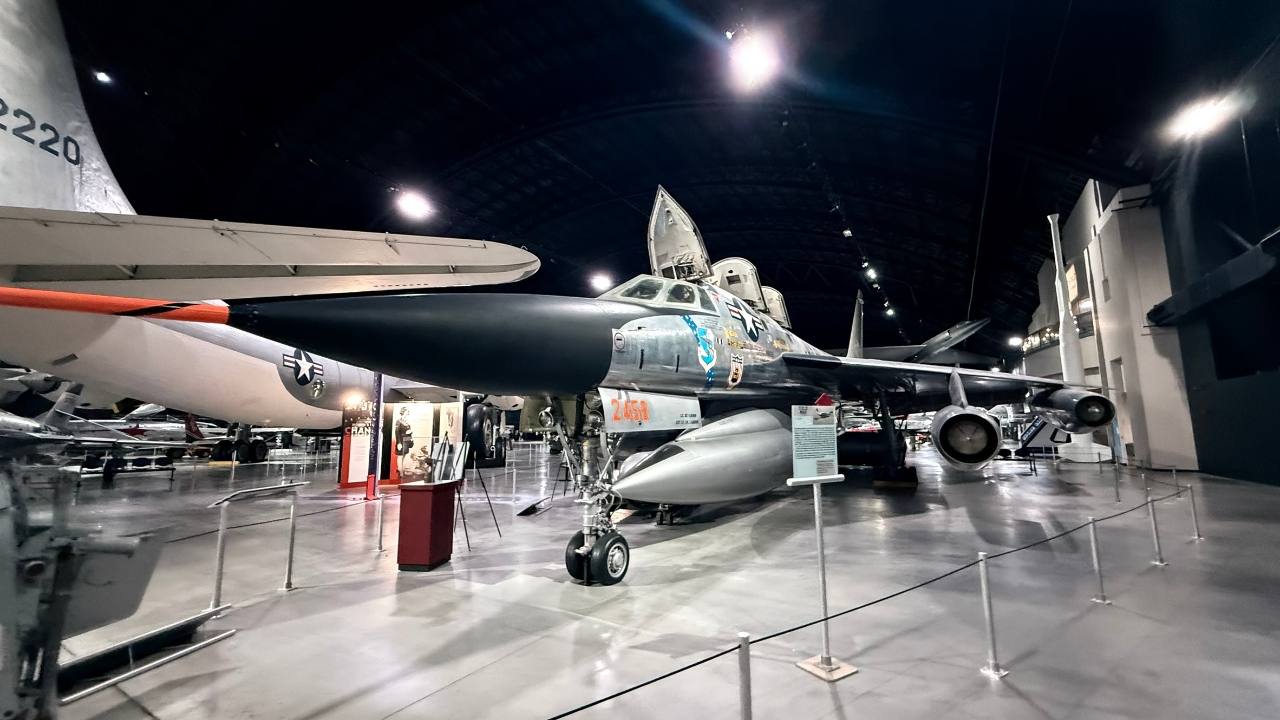
Side Angle of B-58 U.S. Air Force Museum. Image Credit: Harry J. Kazianis/National Security Journal.
Convair’s design for the B-58 was sleek and futuristic, featuring a delta wing configuration and four General Electric J79 turbojet engines mounted in underwing pods. The aircraft’s aerodynamic profile and powerful engines enabled it to reach speeds of Mach 2, or approximately 1,320 miles per hour, and altitudes exceeding 60,000 feet. The first prototype of the B-58 flew on November 11, 1956, and after several years of testing and refinement, it entered operational service with the Strategic Air Command on March 15, 1960.
Design and Specifications
The B-58 was a three-man aircraft, with a pilot, a navigator/bombardier, and a defensive systems operator seated in tandem under individual canopies. Unlike traditional bombers, the B-58 did not have an internal bomb bay. Instead, it carried a large external pod beneath the fuselage that housed both a nuclear weapon and additional fuel. Later versions of the aircraft were modified to carry up to five nuclear weapons, with four smaller bombs mounted on external hardpoints in addition to the central pod.
The aircraft’s mission profile was based on high-speed, high-altitude penetration of enemy defenses. It relied on its speed and altitude to evade interception, a strategy that was initially effective. However, the rapid advancement of Soviet surface-to-air missile technology, particularly the deployment of the SA-2 Guideline missile, forced a reevaluation of this approach. The B-58 was subsequently adapted for low-level penetration missions, which significantly reduced its range and strategic flexibility.
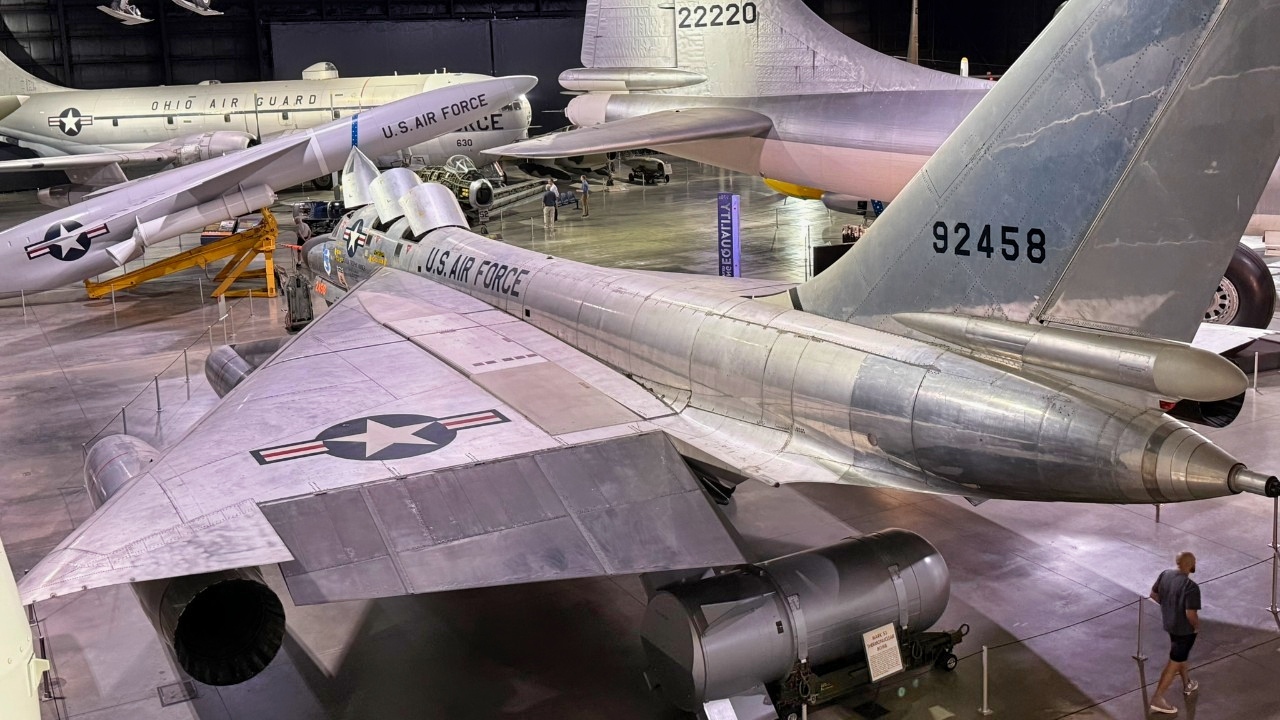
Top of B-58 Hustler Bomber. Image Credit: Harry J. Kazianis/National Security Journal.
In 4 Words: Good Idea, Poorly Executed
Despite its impressive performance, the B-58 faced numerous challenges throughout its service life. It was an expensive aircraft to operate and maintain, with high fuel consumption and complex systems that required extensive ground support.
The workload for the crew was also considerable, as the aircraft demanded constant attention and precision during flight. Additionally, the B-58 had a relatively high accident rate, with over a quarter of the fleet lost in crashes due to mechanical failures or pilot error.
Only 116 B-58s were built, including 30 test aircraft and 86 operational bombers. They were assigned to two Strategic Air Command wings: the 43rd Bombardment Wing at Carswell Air Force Base in Texas and the 305th Bombardment Wing at Bunker Hill Air Force Base in Indiana.

More B-58 Hustler Bomber. Image Credit: Harry J. Kazianis/National Security Journal.
The aircraft remained in service for just a decade, with the last B-58s retired in January 1970. Their role was eventually assumed by the FB-111A, a more versatile and cost-effective aircraft designed for low-level penetration missions.
Retirement and Legacy
Ultimately, the B-58 was killed by its own technical failings and advancing air defense technology which prompted the U.S. to shift towards lower altitude strike bombers. Despite its speed, the Hustler could not outrun the rapidly advancing surface-to-air missiles that the USSR was beginning to field in greater numbers.
However, the B-58 paved the way for future supersonic bombers like the F-111 Aardvark and the B-1B Lancer which is still in service to this day.
Despite its short operational life, the B-58 achieved several notable accomplishments. It set numerous world records for speed, altitude, and payload delivery.
One of the most famous flights occurred in 1962, when a B-58 named “Cowtown Hustler” won both the Bendix and Mackay Trophies by flying from Los Angeles to New York and back in under five hours, averaging over Mach 2 for the round trip. These achievements demonstrated the aircraft’s extraordinary capabilities and helped to cement its place in aviation history.
Today, several B-58s are preserved in museums across the United States, where they remain as a fascinating piece of Cold War history.
Notable examples can be found at the National Museum of the United States Air Force in Dayton, Ohio; the Strategic Air Command & Aerospace Museum in Nebraska; and the Pima Air & Space Museum in Arizona.
These preserved aircraft serve as tangible reminders of a bygone era, when speed and altitude were seen as the ultimate defenses in a nuclear-armed world.
About the Author:
Isaac Seitz, a Defense Columnist, graduated from Patrick Henry College’s Strategic Intelligence and National Security program. He has also studied Russian at Middlebury Language Schools and has worked as an intelligence Analyst in the private sector.
NOTE: This piece was first posted several days ago but has been reimagined with new photos and content.
More Military
We Almost Touched the F-117 Stealth Fighter


Pingback: The B-58 Hustler Supersonic Bomber Was a Failure (That Set 19 World Records) - National Security Journal