


The Convair B-58 Hustler was the world’s first operational Mach 2 bomber and one of the most dangerous aircraft Strategic Air Command ever flew. Entering service in 1960, retiring ten years later in 1970, the B-58 suffered a 22.4 percent hull-loss rate — 26 of 116 aircraft destroyed. Its delta wing demanded a 203-knot takeoff. Its four GE J79 engines could ‘unstart’ mid-flight and tear the airframe apart at Mach 2. Fuel had to be redistributed in flight to keep the bomber aerodynamically stable. The Stanley Aviation escape capsules that replaced ejection seats often failed when the crew needed them most.
The B-58 Hustler was a Mach 2.0 Failure for the History Books
The B-58 Hustler was the world’s first operational Mach 2 bomber.
Entering service in 1960 but retired just ten years later in 1970, the B-58 suffered a staggering accident rate—26 of 116 aircraft lost, a 22.4 percent hull-loss rate.
While the B-58 represented the cutting edge of Cold War supersonic engineering, the platform pushed technology beyond its practical limits.
The Hustler was a technological marvel—but it was also extraordinarily dangerous from a mechanical and aerodynamic perspective.
Fielding the B-58
During the Cold War, Strategic Air Command (SAC) wanted a supersonic nuclear bomber that could penetrate Soviet air defenses.
At the time, the theory was that speed equaled survival—a theory that manifested in the fielding of various supersonic platforms, including the SR-71 and Century Series fighters, that could outrun interceptors and missiles.
For the new supersonic bomber, the performance target was sustained Mach 2 flight to enable a nuclear-strike role.
The result was a radical aircraft, divorced from previous bomber designs, with a delta wing, slender fuselage, and podded engines. In the B-58, every design choice conformed to the need to outrun enemy air defenses.

Close Up of the B-58 Hustler Bomber. Image Credit: Harry J. Kazianis/National Security Journal.

More B-58 Hustler Bomber. Image Credit: Harry J. Kazianis/National Security Journal.
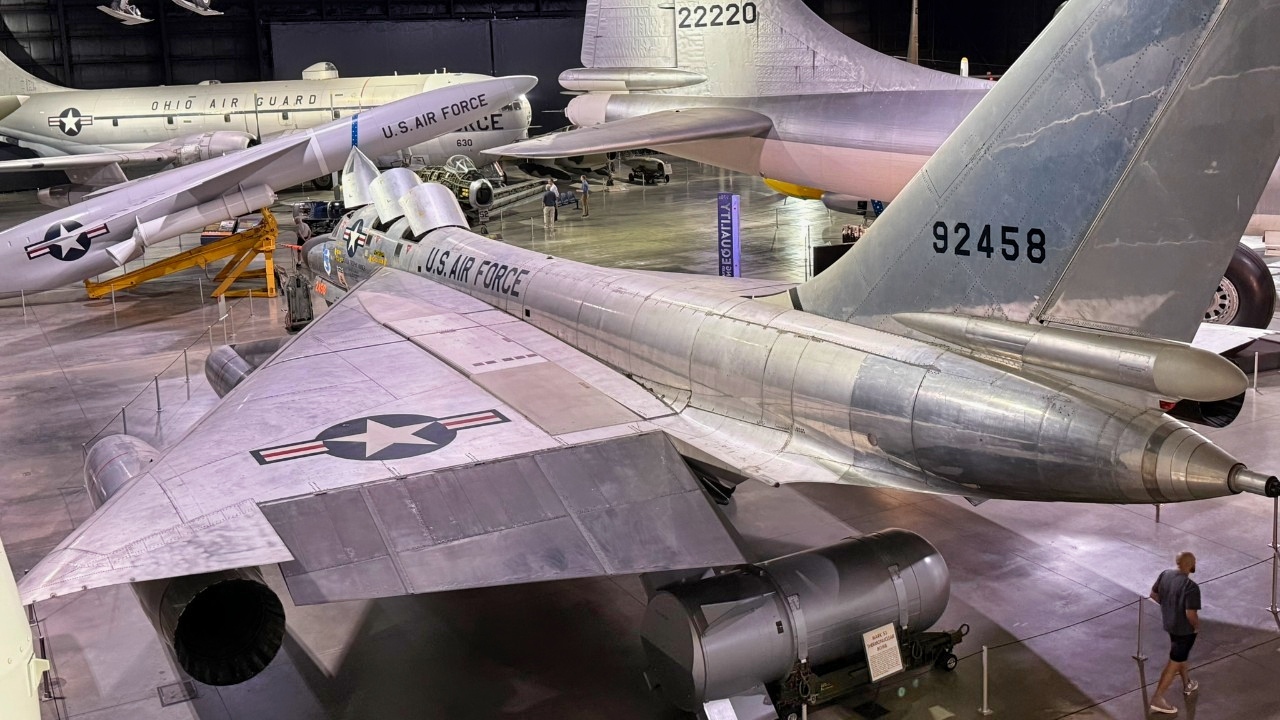
Top of B-58 Hustler Bomber. Image Credit: Harry J. Kazianis/National Security Journal.

Side Angle of B-58 U.S. Air Force Museum. Image Credit: Harry J. Kazianis/National Security Journal.
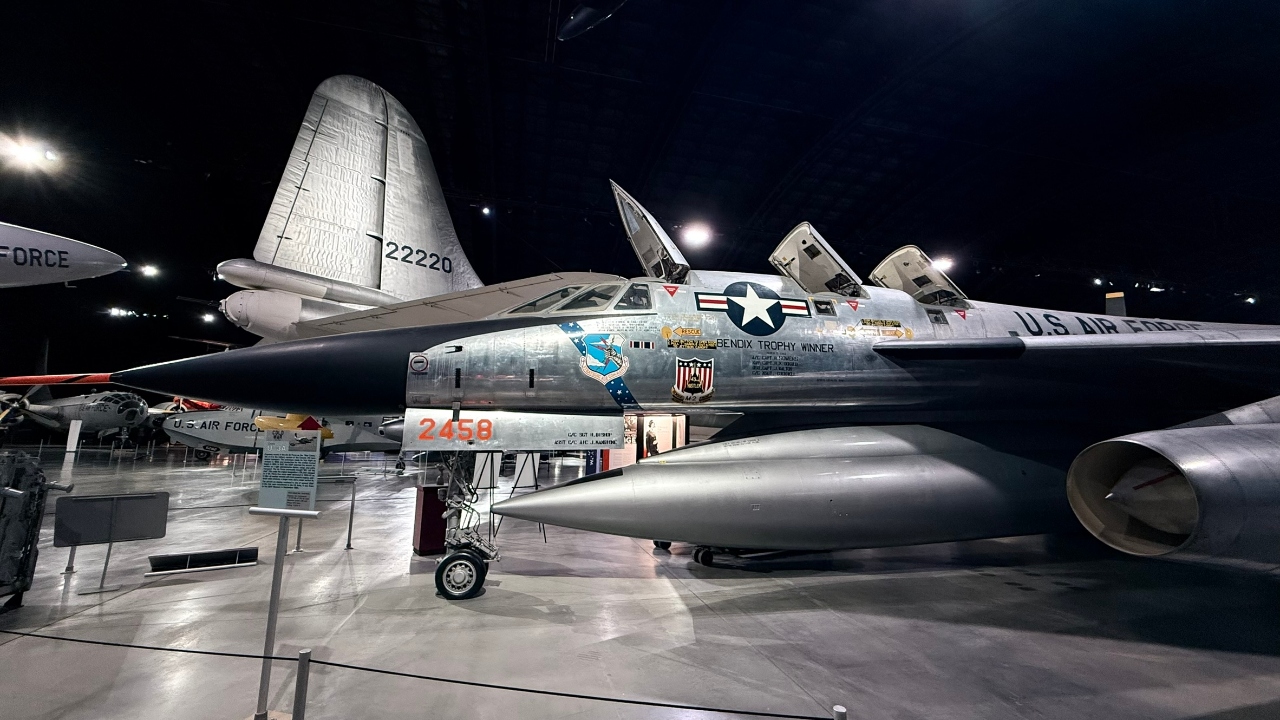
B-58 Hustler in the Air Force Museum. Image Credit: National Security Journal.
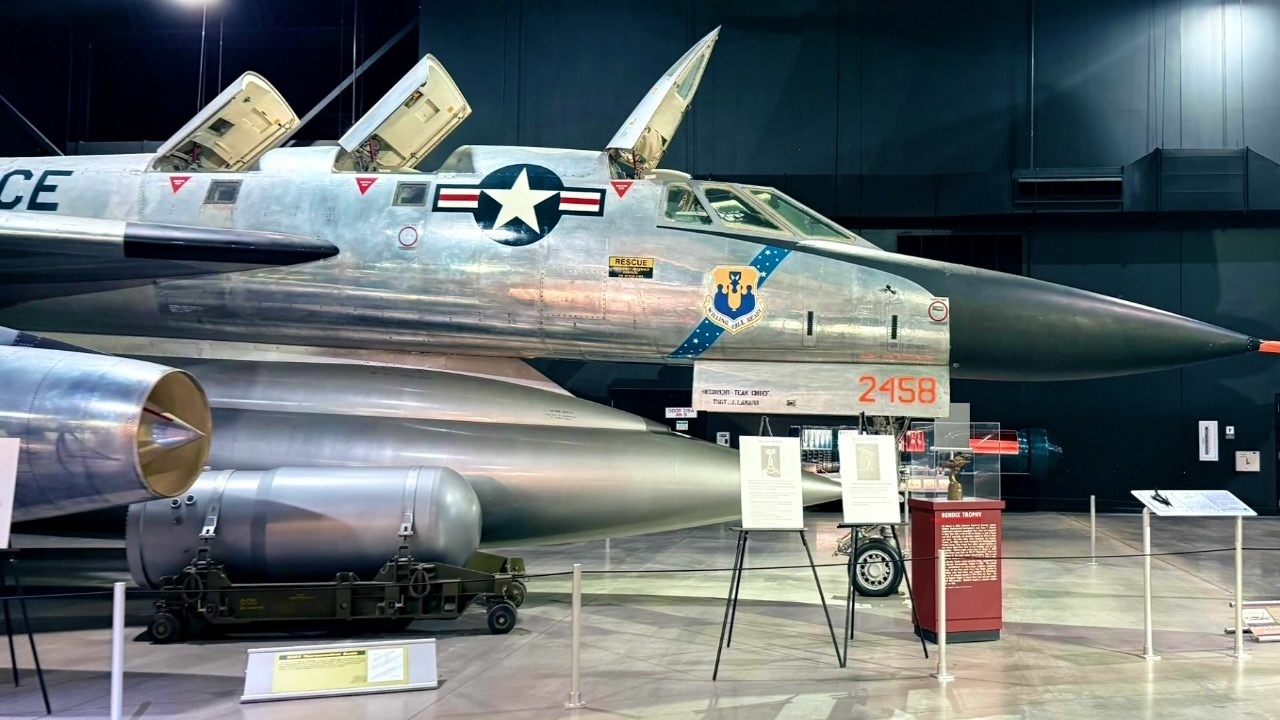
B-58 Hustler Bomber National Security Journal Photo All Rights Reserved.
The Delta Wing Problem
The Hustler incorporated a delta wing, which was efficient for supersonic flight, reducing drag at Mach 2.
But low-speed handling with the delta wing was terrible. This created dangers during takeoff and landing.
On takeoff, the aircraft rotated at just 14 degrees, yet with a blazing takeoff speed of 203 knots. This left only a small margin for error. Similarly, on landing, the B-58 needed to maintain high speeds—and did not use conventional flaps.
The Fuel Balancing Problem
In the B-58, fuel acted not just as a propellant but as a dynamic ballast system, because the center of gravity shifted dramatically between subsonic and supersonic flight.
So the B-58 had to constantly redistribute fuel, with the pilots and an analog computer moving it fore and aft as needed.
But sometimes, the B-58 suffered from a stuck transfer valve, which trapped fuel in the iron section.
This was especially dangerous during deceleration from Mach 2 and could result in violent nose-up pitch, uncontrollable instability, and, potentially, structural breakup. The Hustler was unique in that it needed constant fuel balancing just to remain aerodynamically stable.
The Unstart Problem
With four GE J79 turbojet engines, the B-58 required carefully managed airflow; moving intake spikes slowed supersonic air to subsonic speeds. But spike misalignment sometimes caused the engine to “unstart,” meaning it suddenly disrupted or blew out.
This created asymmetric thrust. And at Mach 2, asymmetric thrust was catastrophic, causing the aircraft to violently yaw.
The airframe often could not survive the side loads and would break up almost instantly. At Mach 2 speeds, even minor propulsion disruptions could become fatal within seconds, as the B-58 demonstrated.
The Landing Gear Problem
Because the Hustler featured a giant centerline weapons pod that occupied the fuselage belly, this forced the aircraft’s landing gear into thin delta wings.
The designers built tall, multi-folding gears with eight-wheel bogies. But tire blowouts were common at the 200-knot ground speeds the B-58 also pushed beyond; debris from blowouts often severed hydraulic lines, leading to frequent gear collapses.
In sum, the B-58 suffered from an extremely fragile landing gear for such a high-speed aircraft.
The Escape Capsule Problem
Compounding the various mechanical and aerodynamic issues facing the B-58 were problems with the escape capsules, the crew’s only lifeline in the event of a catastrophic problem.
Because standard ejection seats were useless at Mach 2 (the wind blast would kill the crew instantly), the B-58 featured Stanley Aviation escape capsules. These clamshell-shaped capsules closed around the crew and pressurized before ejection.
They included small viewing windows and controls.
However, the capsules were mechanically complex and required the crew to immediately position their bodies in an accommodating way, which they were not always able to do. Failures occurred—a cascade that precluded the crew’s ability to escape from their ruined aircraft.
Early Retirement
The B-58 was retired early; it was expensive, maintenance-intensive, and had a limited payload and range relative to newer bombers.
And of course, the aircraft was uniquely dangerous.
The Hustler will always be remembered as the outer edge of 1950s-era aerospace ambition: beautiful and futuristic but often dangerous.
About the Author: Harrison Kass
Harrison Kass is a writer and attorney focused on national security, technology, and political culture. His work has appeared in City Journal, The Hill, Quillette, The Spectator, and The Cipher Brief. He holds a JD from the University of Oregon and a master’s in Global & Joint Program Studies from NYU. More at harrisonkass.com.


