


Throughout the Cold War, the Soviet Union was a world leader in the production and development of tanks. Tanks like the T-64 and T-72 were considered among the world’s most advanced main battle tanks (MBTs) upon their introduction, and their continued service is a testament to their timeless design.
For years, the quality of Soviet tanks has been a topic of endless debate among experts and enthusiasts alike.

Russian T-90 Tank. Image Credit: Creative Commons.
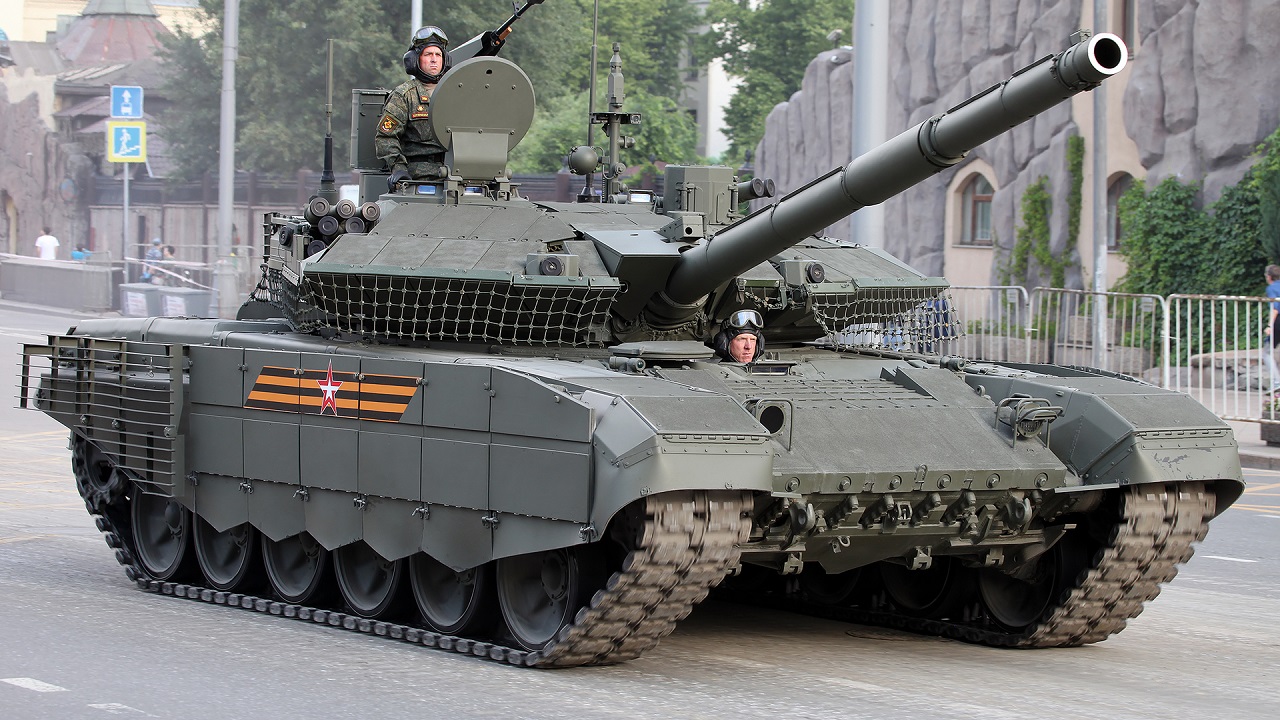
T-90M. Image Credit: Creative Commons.
No discussion of Soviet/Russian tanks is complete without mentioning the elephant in the room: the carousel autoloader.
This mechanism is an effective tool, but it is also one of the biggest weak points of Russian tanks to this day. So, what was the rationale behind this design choice? Why did the Soviets include this feature if it was such a glaring weakness?
The Carousel Autoloader
The Soviet autoloader is a simple and quite reliable mechanism. Ammo is stored in the carousel, which can rotate to select the ammunition type the gunner/commander needs.
The ammo and the charge are loaded into the gun breach using a mechanical hydraulic system, and the gun is then ready for the gunner to fire (this is somewhat of a simplification, but it gets the point across).
The autoloader has been a mainstay in Soviet/Russian tanks since the 1960s and has performed reliably since. This is evident in the fact that for the past four years of the Ukrainian war, neither side—that the author is aware of—has complained about the Soviet autoloader despite both sides using primarily Soviet tanks.
The problem with the autoloader is that it places all the ammo directly below the crew compartment, meaning that pretty much any projectile that penetrates the lower center of the tank will inevitably trigger a massive ammo detonation, killing the crew instantly.
During Operation Desert Storm and the following war in Iraq, the T-72 became synonymous with ammo detonations as turret after turret was popped off the Soviet-made tanks.

Russian T-90M Tank. Image Credit: Creative Commons.
Even today, every online discussion about Soviet MBTs inevitably brings up the autoloader and the ammo detonations associated with the system.
What Were the Soviets Thinking?
So, why did the Soviets choose this system despite the inherent risks? Were the Soviets not aware of this seemingly massive oversight, or did they simply not care?
The answer, in the author’s humble opinion, is that the advantages offered by the system outweighed the safety concerns at the time.
The autoloader was first introduced in the T-64 in the late 1950s. Designed under the guidance of A.A. Morozov, the T-64 was a revolution in Soviet tank design and the USSR’s first dedicated MBT.
The autoloader reduced the tank crew to three by eliminating the dedicated loader and allowed the tank’s 125 mm cannon to be reloaded in a matter of seconds.
Early models of the tank initially suffered from mechanical reliability issues, but with the introduction of the T-64A, these issues were quickly ironed out.
The T-72 further improved upon the T-64’s autoloader, making it more mechanically simple, although at the cost of an extra second or two to reload the gun.
The biggest change, however, was the addition of a thin layer of steel between the crew and the autoloader’s ammunition, perhaps a slight acknowledgment of the safety hazard posed by the system.
Without blowout panels, however, the pressure from any detonated ammo has nowhere to go except into the crew compartment, making the change somewhat meaningless in the end.
Interestingly, the Soviets conducted a study of the T-72’s ammo detonation in Iraq and found that the majority of ammo detonations were due to extra ammo in the crew compartment.
These findings would later influence the design of the T-90M, which removes the majority of its additional ammo from the fighting compartment and into a bustle storage container.
Victory Before Crew Safety: The Soviet Approach to Tank Design
When it comes to discussions on the carousel autoloader, we have to remember that this is the Soviet Union we are talking about.
The Soviets were notoriously unconcerned with the well-being of their tankers and instead focused on building as many tanks as humanly possible.
During the Second World War, the Soviet leadership estimated that its tanks would survive on the battlefield for only a few hours and consequently focused on producing as many tanks as possible at the expense of crew safety and comfort.
This allowed the USSR to produce tens of thousands of tanks during the war and ultimately win. Several decades later, yes, there were many changes in tank design and doctrine, but many of the same assumptions remained.
The Soviets could have built blowout panels into their tanks and reworked their autoloaders into more Western-style bustle autoloaders, but that would have been more expensive.
It would also compromise the soviet height and weight requirements, making them more costly to build and maintain, thereby limiting the total number of tanks produced, which was simply unacceptable.
The autoloader allowed Soviet tanks to transition from a traditional four-man crew to a three-man crew.
It also allowed the tanks to reload their guns, which were exceptionally large for their time, faster than human loaders, and the mechanisms were simple enough to be mass-produced at a low cost.
Today, the Russians continue to use the carousel-type autoloader for largely the same reasons. The tanks are cheap and easy to mass-produce.
The explosive weakness is accepted as an unfortunate but ultimately necessary sacrifice to build a numerically superior fighting force.
About the Author: Isaac Seitz
Isaac Seitz, a Defense Columnist, graduated from Patrick Henry College’s Strategic Intelligence and National Security program. He has also studied Russian at Middlebury Language Schools and has worked as an intelligence Analyst in the private sector.


Get Real
June 17, 2026 at 11:25 am
The article is all bullsh!t. How can a country with less than 10% of American’s GDP build any weapons better than the US? As we are finding out in Ukraine, Russian body armor is often just stuffed with wool, and their tanks “Reactive Armor” is filled with wood chips.