


Cheap FPV drones have destroyed or disabled 154 of Russia’s most modern T-90M Proryv tanks in Ukraine. Each FPV drone costs only a few hundred dollars. The T-90M is Russia’s most modern serial-production tank, excluding the T-14 Armata prototype. Open-source intelligence website Oryx has documented the T-90M losses as of January. The FPV drones target the T-90M’s known autoloader vulnerability.
The T-90M Tank vs. Drones: Who Wins?

T-90 Tank. Image Credit: Creative Commons.

Russian T-90 Tank. Image Credit: Creative Commons.
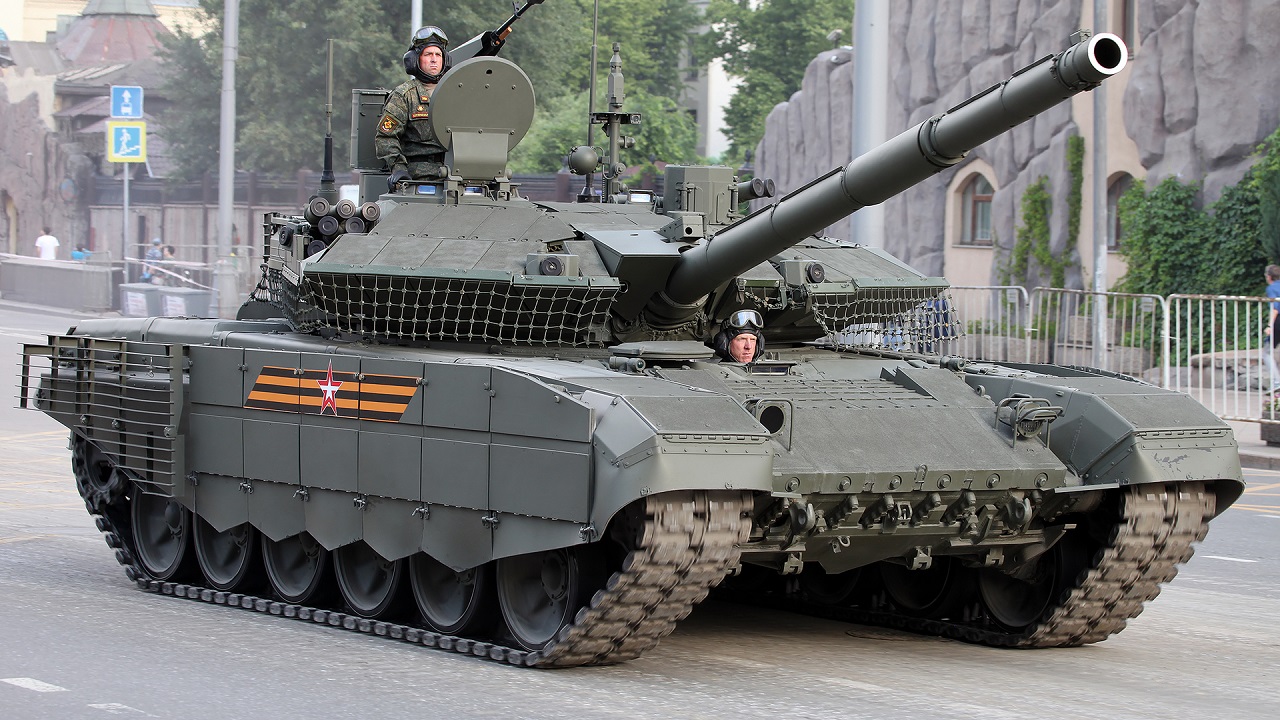
T-90M. Image Credit: Creative Commons.
The T-90M is the most modern Russian tank, excluding the T-14 Armata. With advanced fire-control systems (FCS), modern thermal imagers, and enhanced protection, the tank is truly one of the best available to the Russian Army.
As good as the tank may be on paper, in reality, the T-90M was not prepared for modern drone-centric warfare in Ukraine. Since the start of the Russian invasion of Ukraine, several T-90Ms have been disabled or destroyed by cheap FPV drones, most of which cost only a few hundred bucks. So, how did this happen? How come Russia’s mightiest tank is suffering so hard in Ukraine?
Russia’s Mightiest Tank
As said above, on paper, the T-90M is not a bad tank, despite its negative reputation in the West. Developed from the T-90A, the T-90M Proryv (“Breakthrough” in Russian) is equipped with a heavily modified, welded turret with an elongated bustle for extra ammo and blowout panels.
This reduces the risk of extra ammo in the fighting compartment being detonated during combat, which Soviet studies theorized to be one of the main causes of T-72 cook-offs in Iraq.
While this does increase crew safety somewhat, the carousel auto-loader, with all the ammunition situated below the crew, still remains, which is a major reason the T-90M seems to have a lower survivability rate compared to, say, Western tanks.
The T-90M also features Relikt explosive reactive armor (ERA), a significant advancement over the Kontakt-5 ERA on the T-90A. Other enhancements to the Proryv include a new engine to compensate for the tank’s heavier weight, the Kalina FCS, the most modern anti-tank rounds produced by Russia, and more.
The T-90M also includes better networking and digital capabilities, giving its crew better situational awareness on the battlefield. While its digital infrastructure is not as advanced as that of an M1A2 Abrams, the tank still possesses far better situational awareness than its predecessors.
Why the T-90M is Struggling in Ukraine
Despite its many improvements, the T-90M has struggled in Ukraine. As of January, OSINT sources like Oryx have documented around 154 T-90M tanks damaged or destroyed since 2022.
The reason for this is much deeper than poor quality design, as the T-90 (autoloader vulnerability aside) is a decent tank, not excellent, mind you, just decent. Part of this can be attributed to poor tactics.
Russian tanks are often sent in alone with minimal support from infantry or other armored vehicles. These tactics make the tank a huge target for anti-tank crews, who can easily destroy it with an ATGM. Saturation is another possible explanation.
Despite the T-90M being a relatively new tank, the Russians have deployed it in far greater numbers than Western models like the Abrams or even the Leopard 2. The tank is also produced in far greater numbers than its Western counterpart and therefore has a much greater presence on the battlefield. In wars of attrition, any platform deployed in large numbers is certain to incur higher casualties.
This is a reality that cannot be avoided in war.
Flying RPGs: The Bane of Russia’s Tank Fleet
The reality, however, is that neither Russia nor Ukraine was prepared for the realities of drone warfare. During the Americans’ time in the Middle East, the biggest threats to Abrams tanks were not enemy tanks, but rather they were RPGs and IEDs.
Today, the IEDs are flying. Small FPV drones can be equipped with explosive devices, typically RPG rounds, and can be used as slow-flying, cost-effective ATGMs. They are simple to produce, inexpensive to acquire, and can be manufactured in ridiculously high numbers in a short time.
In other words, they are the perfect anti-tank weapon.
Experienced pilots can maneuver these small unmanned aerial systems (UAS) to strike the tank’s weakest points. If one UAS is not enough, no problem. Drones are often deployed in groups distributed across the battlefield and can be coordinated to strike a single target.
Small UASs have accounted for the bulk of Russia’s tank losses, especially for the T-90M. Drone pilots are accurately aware of the tank’s weakness, mainly its autoloader, and strike the tank from the sides or from the rear.
The Russians have attempted to counter these drones by using an add-on screen armor, additional ERA, electronic warfare systems, and more. These measures have failed to effectively protect the tank against UASs.
Electronic warfare suites were quickly circumvented by the introduction of fubar-optic drones and screen armor, although it does help, it’s more of a band-aid solution.
No Tank is Safe From Drones–Not Even Western Tanks
To be fair to the T-90, these issues are not unique to Russia. Ukrainian tanks are just as vulnerable to drones as their Russian counterparts. Even Western tanks, which are larger, more advanced, and far more expensive than the T-90M.
According to some estimates, Ukraine lost around 87 percent of its American donated Abrams tanks by summer 2025, meaning that the tank has a higher casualty percentage per capita than the T-90.
This does not mean that Western tanks like the Challenger 2, Leopard 2, or the Abrams are bad tanks; it means that no one, not the Russians, not the Ukrainians, or even the West, was truly prepared for the problems of modern warfare.
About the Author: Isaac Seitz
Isaac Seitz, a Defense Columnist, graduated from Patrick Henry College’s Strategic Intelligence and National Security program. He has also studied Russian at Middlebury Language Schools and has worked as an intelligence Analyst in the private sector.


