


Key Points and Summary – The USS Nimitz (CVN-68) is nearing retirement after more than half a century as one of America’s most important aircraft carriers.
-Commissioned in 1975, Nimitz helped evacuate civilians from Lebanon, backed Reagan’s Cold War naval buildup, launched strikes in Desert Storm, and flew relentless combat missions in Afghanistan and Iraq.

Souda Bay, Crete, Greece (Feb. 22, 2006) Nimitz-class aircraft carrier USS Theodore Roosevelt (CVN 71) heads to sea following a brief logistics stop on the Greek island of Crete. Roosevelt and Carrier Air Wing Eight (CVW-8) are currently underway on a regularly scheduled deployment supporting maritime security operations. Roosevelt is the fourth ship in the NIMITZ – class of nuclear powered aircraft carriers and is homported in Norfolk, VA. U.S. Navy photo by Mr. Paul Farley
-The first carrier to land an F-35C, it has logged over 350,000 arrested landings.
-Yet age, maintenance costs, and reactor limits are forcing the Navy to stand it down just as the delayed USS John F. Kennedy comes online, raising hard questions about fleet size and risk.
Is It the End for the USS Nimitz Aircraft Carrier?
The USS Nimitz (CVN-68) is one of the most successful aircraft carriers in the history of the U.S. Navy. Few carriers have projected as much power as the Nimitz, which has carried the flag with aplomb for more than 50 years. This nuclear-powered floating air base has an excellent combat record, and the many sailors who serve on it remember the Nimitz with pride.
CVN-68 was commissioned in 1975—it’s hard to believe such a relic could still bring violence of action to the enemy. Unfortunately, the Nimitz will be retired next year, ending a jubilant era of valiant service. There are calls to extend the service life of the Nimitz to maintain readiness. But the future USS John F. Kennedy, a new Gerald R. Ford-class carrier, will take over for the Nimitz when delivered in 2027.
Tough to Say Goodbye to the USS Nimitz
Unfortunately, the U.S. Navy may have to spend a year or more with only 10 aircraft carriers on active duty instead of 11. The old flat-top may see some more action before all is said and done, but as of now it is slated for retirement.
Decorated Ship Is the Stuff for Hollywood
The Nimitz has earned multiple battle stars for exemplary service in combat. The oldest carrier in service, she faced down the Soviets during the Cold War, dominated during Operation Desert Storm, and was critical during the War on Terror. It even appeared in the 1980 movie “Final Countdown,” starring Kirk Douglas and Martin Sheen.
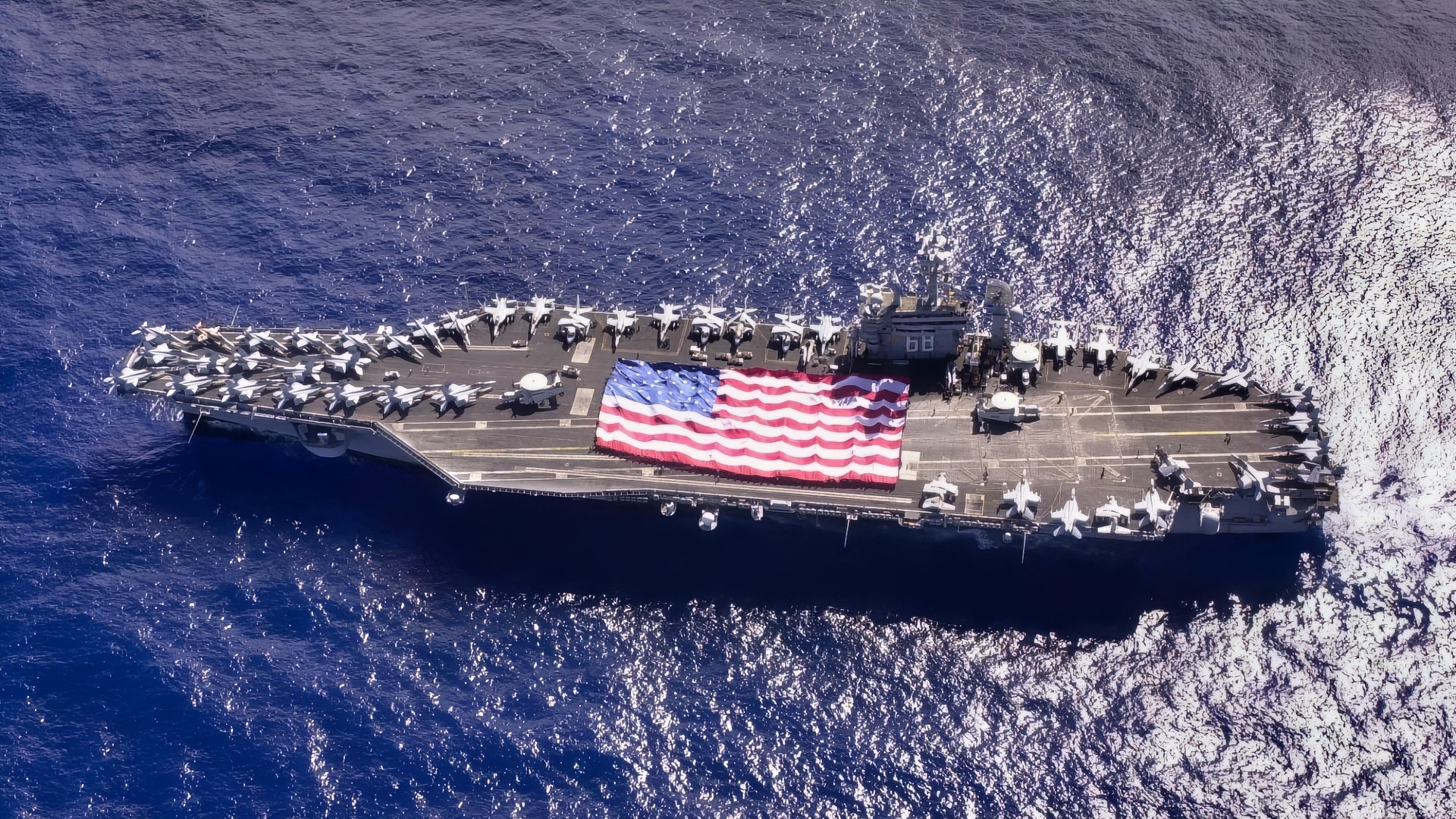
Pacific Ocean (Nov. 3, 2003) — USS Nimitz (CVN 68) crewmembers participate in a flag unfurling rehearsal with the help of family and friends on the ship’s flight deck during a Tiger Cruise. The Nimitz Carrier Strike Group and embarked Carrier Air Wing Eleven (CVW-11) are en route to San Diego, Calif., following an eight-month deployment to the Arabian Gulf in support of Operation Iraqi Freedom. U.S. Navy photo by Photographer’s Mate 3rd Class Elizabeth Thompson. (RELEASED)
Answered the Call in the mid-late 1970s
The carrier was homeported at Naval Station Norfolk in Virginia—it focused on the European area of operations, and its first active-duty cruise was to the Mediterranean. In 1976, the Nimitz helped evacuate more than 1,100 people from Lebanon during that country’s civil war.
It also conducted war games in the region with more than 45 countries that year. In 1977, the Nimitz conducted exercises with NATO for “Dawn Patrol,” leading more than 70 ships and submarines.
Nimitz Is the Pride of the 1980s
In just two years’ time, the Nimitz was that busy. This early dominance presaged its valuable service life. By 1980, the Nimitz had settled into regular duty. It participated in the doomed Operation Eagle Claw (Evening Light) to rescue American hostages held by Iran; the Nimitz provided RH-53D Sea Stallions for the mission.
By 1981, the carrier had completed four deployments in the Mediterranean. The rest of the 1980s were a busy time for the Nimitz as it led President Ronald Reagan’s naval build-up. It conducted numerous NATO exercises that showed the Soviets the U.S. Navy would not be intimidated.
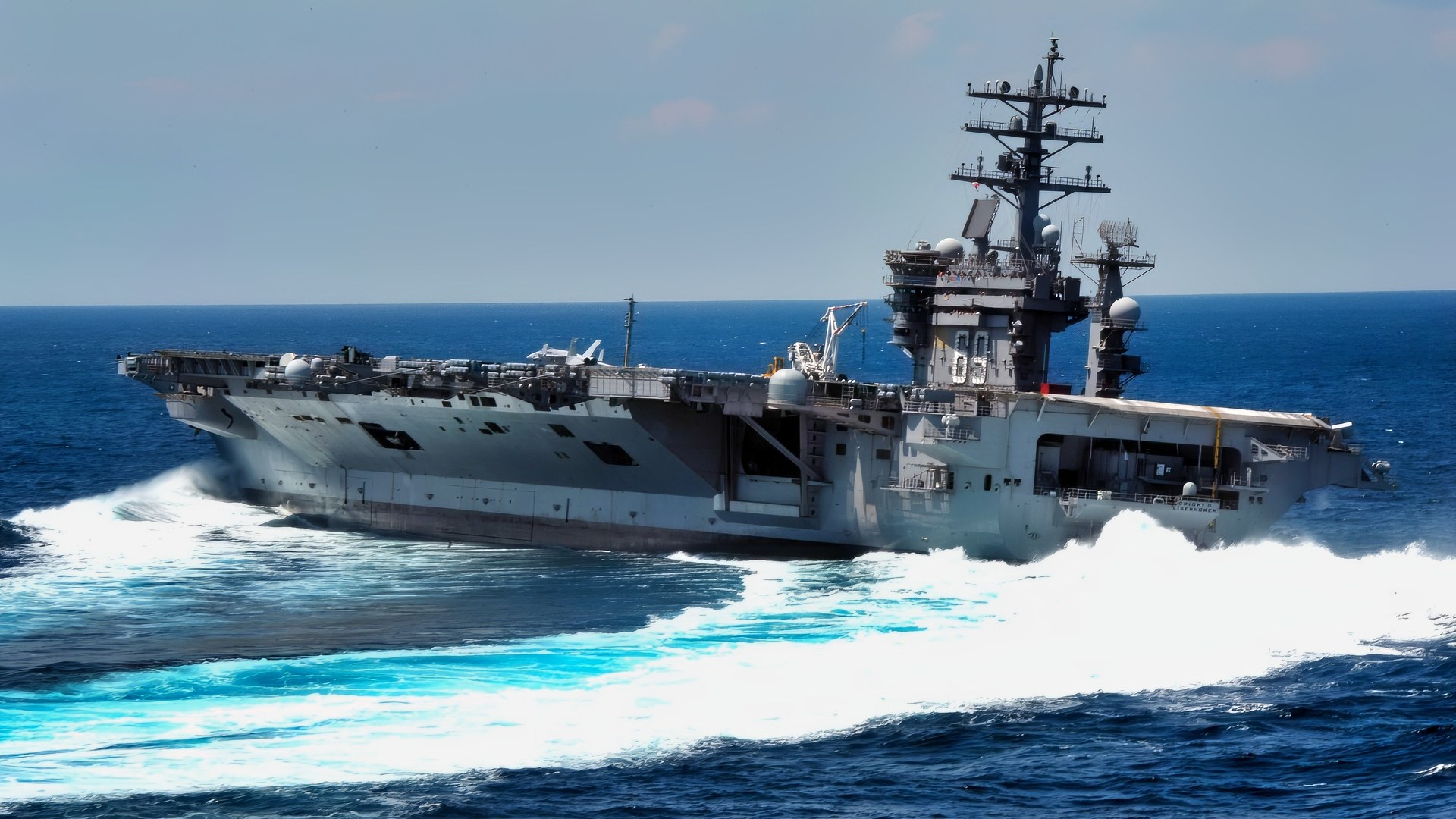
The Nimitz-class aircraft carrier USS Dwight D. Eisenhower conducts rudder turns during sea trials. Dwight D. Eisenhower completed a nine-month planned incremental availability at Norfolk Naval Ship Yard on June 10, 2011.
Gulf War Stalwart
It was during Operation Desert Storm that the USS Nimitz really shined. Its air wing flew round the clock during the abbreviated war to strike Saddam Hussein’s hoards and punish key military targets. Close air support from airplanes onboard the Nimitz were decisive in Iraq’s defeat by the U.S.-led coalition.
During the War on Terror, the Nimitz was extremely active. Numerous strikes rained down from Nimitz-based aircraft to destroy high-value targets. The first deployments of both the F/A-18F Super Hornet and E-2C Hawkeye happened during the years following 9/11.

Aircraft Carrier Nimitz-Class Back. Image Credit: Creative Commons.
In March 2003, the Nimitz launched air strikes in support of Operation Iraqi Freedom, according to the National Naval Aviation Museum. Attacks against the Taliban in Afghanistan were dominant. The Nimitz was the first carrier to land an F-35C Lightning II, in 2014, and by 2022, the ship had executed its 350,000th arrested aircraft landing.
Quick Specs on the Nimitz
The USS Nimitz displaces 100,000 tons with a full combat load. It is nearly 1,100 feet long. The beam is 252 feet, and the ship can reach a speed of more than 30 knots.
Two Westinghouse A4W nuclear reactors power the carrier. There are four steam turbines, four shafts, and four propellers. This is a floating city, with 3,500 sailors on the ship and 2,480 personnel on the air wing. The Nimitz deploys up to 90 aircraft.
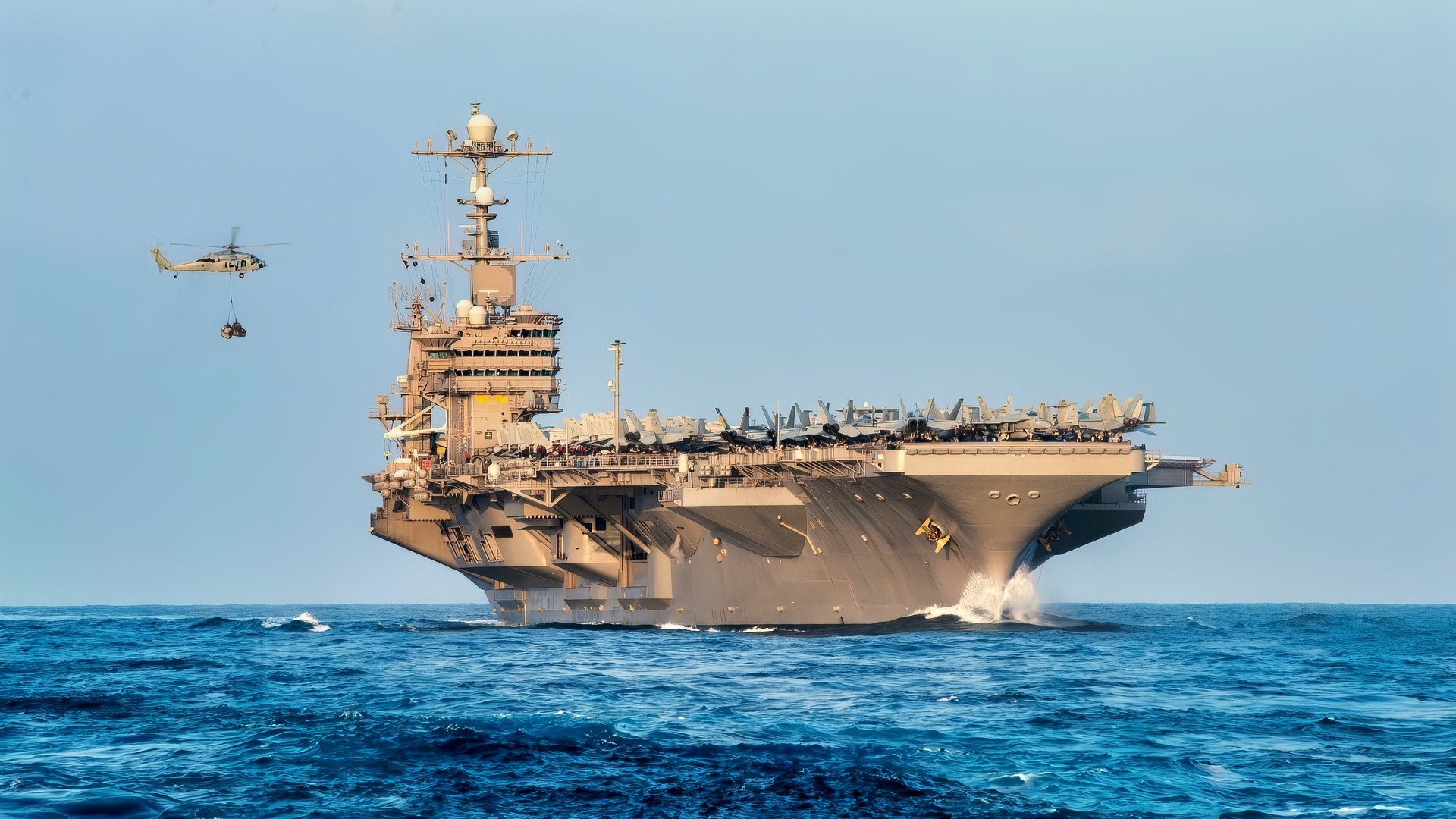
(Aug. 1, 2016) – The Nimitz-class aircraft carrier USS John C. Stennis (CVN 74) receives stores while conducting a vertical replenishment at sea, during Rim of the Pacific 2016. Twenty-six nations, more than 40 ships and submarines, more than 200 aircraft and 25,000 personnel are participating in RIMPAC from June 30 to Aug. 4, in and around the Hawaiian Islands and Southern California. The world’s largest international maritime exercise, RIMPAC provides a unique training opportunity that helps participants foster and sustain the cooperative relationships that are critical to ensuring the safety of sea lanes and security on the world’s oceans. RIMPAC 2016 is the 25th exercise in the series that began in 1971. (U.S. Navy photo by Mass Communication Specialist 2nd Class Ryan J. Batchelder)
The Nimitz is armed with eight Sea Sparrow surface-to-air missiles, eight Evolved Sea Sparrows, and 21 Rolling Airframe Missiles.
“A typical Nimitz carrier air wing can include 24-36 F/A-18E or F Super Hornets as strike fighters; two squadrons of 10–12 F/A-18C Hornets, with one of these often provided by the U.S. Marine Corps (VMFA), also as strike fighters; 4-6 EA-18G Growlers for electronic warfare; 4-6 E-2C or D Hawkeyes for airborne early warning (AEW), C-2 Greyhounds used for logistics (to be replaced by MV-22 Ospreys); and a Helicopter Antisubmarine Squadron of 6-8 SH-60F and HH-60H Seahawks,” according to Seaforces. “Aircraft that have previously operated from Nimitz-class carriers include F-4 Phantoms, RA-5C Vigilantes, RF-8G Crusaders, F-14 Tomcats, S-3 Vikings, A-7 Corsair II and A-6E Intruder aircraft.”
The decision to retire the Nimitz was difficult for the Navy. The USS Nimitz had become challenging and expensive to maintain. The carrier’s advanced age and high operational tempo made it hard to keep its reactors humming effectively.
This USSS Nimitz will go down as one of the best carriers in the modern era. Its combat service was superb. The Nimitz was a decisive ship that helped win the Cold War and Operation Desert Storm. Its service against the Iraqis in the Second Gulf War and in support of U.S. and allied efforts in Afghanistan was exemplary.
The Navy will miss the USS Nimitz, and her crew will remember it fondly.
About the Author: Brent M. Eastwood
Author of now over 3,000 articles on defense issues, Brent M. Eastwood, PhD is the author of Don’t Turn Your Back On the World: a Conservative Foreign Policy and Humans, Machines, and Data: Future Trends in Warfare plus two other books. Brent was the founder and CEO of a tech firm that predicted world events using artificial intelligence. He served as a legislative fellow for US Senator Tim Scott and advised the senator on defense and foreign policy issues. He has taught at American University, George Washington University, and George Mason University. Brent is a former US Army Infantry officer. He can be followed on X @BMEastwood.


