


Key Points and Summary – ‘One Mission’ – The “Super Tomcat 21” (ST21) was an ambitious 1990s Grumman proposal to save the F-14 by transforming it into a multi-role fighter.
-The plan would have added new engines (capable of Mach 1.3 supercruise), AESA radar, and precision-strike capabilities to fill the gap left by the canceled A-12.
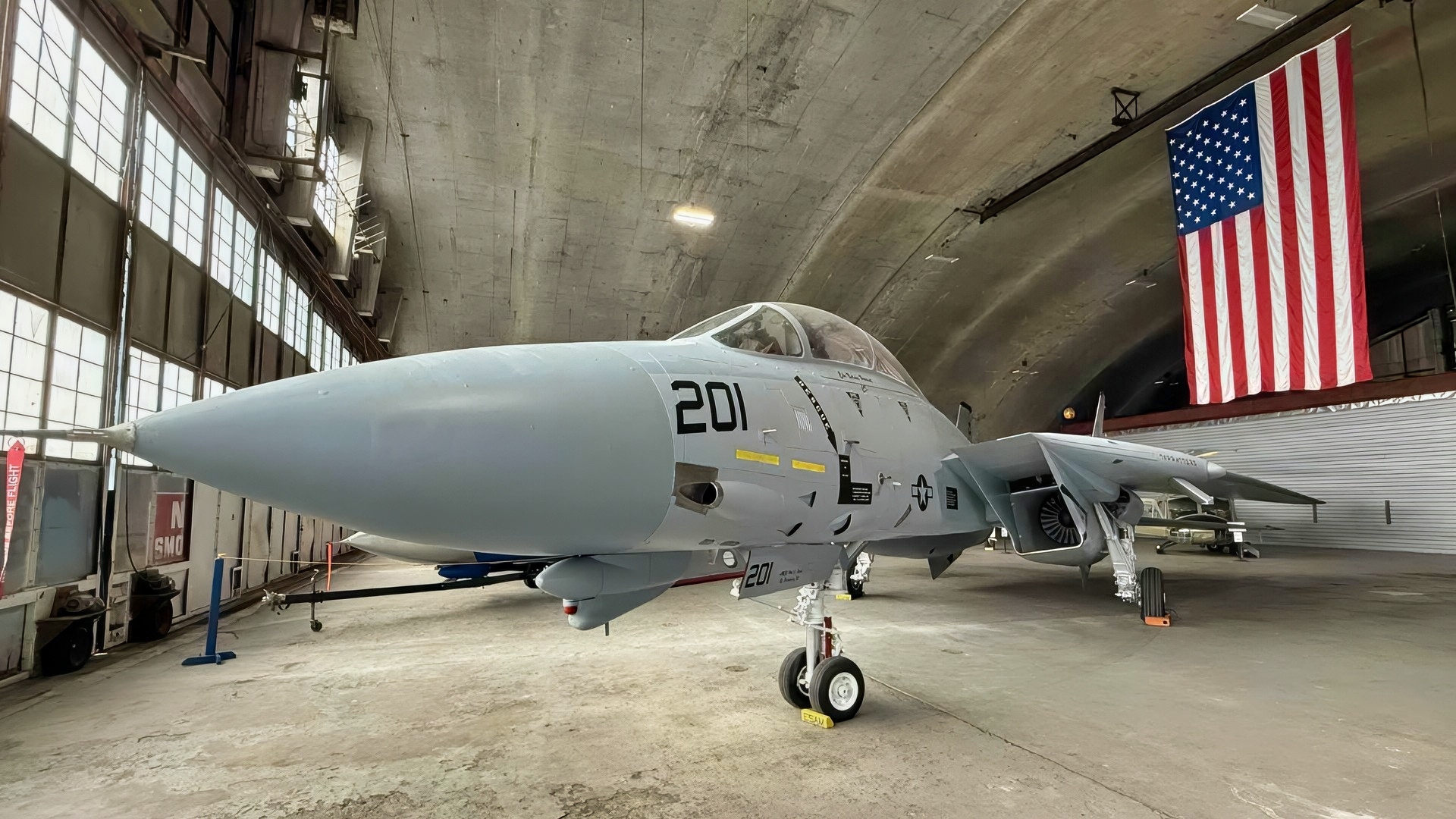
F-14 Tomcat in Museum with US Flag. Image Credit: National Security Journal.

F-14D Tomcat Fighter Image from National Security Journal

F-14D Tomcat Onboard USS Intrepid in NYC. Image Taken by National Security Journal on 9/19/2025.
-Despite its potential, the ST21 was canceled. Key reasons included high costs in a post-Cold War budget, the F-14’s “notorious” maintenance complexity, and a U.S. policy desire to end the F-14 program entirely to block spare parts from reaching Iran.
-The Navy ultimately chose the less capable but “more reliable” F/A-18E/F Super Hornet.
The F-14 Super Tomcat 21 Would Have Been Special
The F-14 Tomcat was an iconic Cold War-era aircraft designed as the U.S. Navy’s premier carrier-borne interceptor.
However, by the time the 1990s rolled around, the venerable Tomcat was starting to show its age. Its maintenance costs were high, its avionics were growing more outdated, and the Navy needed a new fighter after the cancellation of the A-12 Avenger II stealth aircraft.
To address these issues, Grumman proposed the Super Tomcat 21, informally referred to as the F-21.
This proposed aircraft was a deep modernization of the F-14, which would have radically transformed it into a formidable multi-role fighter.
Modernizing the F-14 Tomcat
The design philosophy behind the Super Tomcat 21 was to build upon the F-14D, the most advanced Tomcat variant at the time, and address its shortcomings while enhancing its strengths.
The aircraft would have featured powerful F110-GE-429 engines capable of delivering approximately 30,000 pounds of thrust each with afterburner. One of its most touted capabilities was its ability to supercruise likely around Mach 1.3.
This feature would have given the Navy unmatched speed and endurance for long-range intercept missions, something even modern fighters struggle to achieve.
Aerodynamic improvements were also central to the concept. Enlarged wing gloves were proposed to store additional fuel, adding roughly 2,200 pounds per side and significantly extending range.
The design would have eliminated problematic glove vanes, which had been a major maintenance headache on earlier Tomcats, and incorporated digital flight control systems for improved agility and reduced pilot workload.
These changes aimed to make the aircraft more reliable and easier to handle while preserving its distinctive variable-sweep wing design.
The F-14 the Navy Never Got
The Super Tomcat 21 was expected to feature an Active Electronically Scanned Array (AESA) radar, likely derived from technology developed for the canceled A-12 program, along with an upgraded AN/APG-71 radar and forward-looking infrared systems for enhanced targeting.
Advanced electronic warfare suites and satellite datalink capabilities would have enabled network-centric operations, a concept that was just emerging in the early 1990s. These improvements would have transformed the Tomcat from a pure interceptor into a true multirole fighter.

F-14 Tomcat Photo Taken on August 24 2025. Image Credit: Jack Buckby/National Security Journal.
One of the program’s goals was to transform the Tomcat from an interceptor into a full-fledged multirole aircraft.
The ST21 would have integrated precision-guided munitions such as JDAMs and laser-guided bombs while retaining its long-range air-to-air capability with AIM-54 Phoenix missiles, supplemented by AIM-120 AMRAAMs.
Later concepts, such as the ASF-14 (Advanced Strike Fighter), even envisioned thrust-vectoring engines, which would have made the aircraft a formidable dogfighter.
Combined with its large internal fuel capacity and ability to carry heavy ordnance loads without sacrificing performance, the Super Tomcat 21 promised significantly greater range and payload than the F/A-18E/F Super Hornet, which ultimately became the Navy’s choice.
Why the Super Tomcat Never Took off
Initially, the Navy was interested in the ST21 because it offered a solution to several pressing problems.
The cancellation of the A-12 Avenger II left a significant gap in carrier air wings, as the Navy needed a platform capable of deep strike missions.
The aging F-14 and A-6 fleets were maintenance-intensive and increasingly obsolete, and the Navy still required long-range interceptors to counter emerging threats such as cruise missiles and advanced regional air forces.
Grumman pitched the ST21 as a low-risk, high-reward solution because it leveraged an existing airframe rather than starting from scratch.
The company argued that Tomcat’s fundamental design —its large radar, long range, and heavy payload capacity—was still relevant to modern times and that modernizing it would be cheaper and faster than developing a new aircraft.
While the Super Tomcat was a neat idea and would have been a good addition to the Navy, it never left the drawing board.
Like any ambitious project, cost was one of the most significant factors. Upgrading existing F-14s and building new ST21s would have required billions of dollars, and post-Cold War budget cuts made Congress and the Pentagon wary of expensive programs. Maintenance complexity was another issue.
The F-14 was notoriously maintenance-heavy, mainly due to its variable-sweep wing mechanism and older systems.
Even with upgrades, the ST21 would have retained some of these complexities, making it less attractive than the simpler, more reliable F/A-18E/F design.
Iran and the Emergence of Stealth Aircraft
Iran was also a significant factor that ultimately led to the Tomcat’s untimely retirement. After the Islamic Revolution, the newly formed Islamic Republic of Iran became one of the foremost operators of the F-14 at the time.
Fearing the now hostile Iranian air force, the U.S. cut off support for the F-14 and did everything in its power to prevent spare parts from making their way to Iran. This had the unfortunate side effect of killing the U.S.’s own F-14s and ensuring no future modernizations for the aircraft, the ST21.
With the Soviet Union gone, the Navy shifted its focus from long-range fleet defense to regional conflicts and strike missions.
Stealth aircraft became the Air Force’s new primary focus, and the ST21 lacked stealth features, making it appear less future-proof.
Finally, reliability mattered more than raw performance in an era of shrinking budgets and carrier deck constraints.
Former Navy test pilots have noted that the ST21 would have outperformed the Super Hornet in almost every metric —speed, range, and payload capacity —except reliability. The Hornet family was easier to maintain and operate, which ultimately tipped the scales in its favor.
About the Author: Isaac Seitz
Isaac Seitz, a Defense Columnist, graduated from Patrick Henry College’s Strategic Intelligence and National Security program. He has also studied Russian at Middlebury Language Schools and has worked as an intelligence Analyst in the private sector.
More Military
The M113: America’s “Forgotten” APC That Just Won’t Quit
How British Aircraft Carriers Keep Sinking in War Games
Boeing F-47 NGAD Fighter: One Missing Fact Could Decide Its Fate
Canada Knows How to Sink U.S. Navy Nuclear Aircraft Carriers


