


Key Points and Summary – The Navy retired the F-14 Tomcat for five intertwined reasons: crippling upkeep (tens of maintenance hours per flight hour and high cost per hour), the fading of its Cold War fleet-defense mission, the rise of the cheaper, more versatile F/A-18E/F Super Hornet, a worsening parts pipeline after production ended (tightened further to keep components from Iran), and the burdens of an aging, complex swing-wing design.
The Tomcat’s AWG-9 radar and AIM-54 Phoenix made it a legend, but budget, mission fit, and logistics won the argument.

F-14 Tomcat from Outside DC NSJ Image.
In the Super Hornet, the Navy traded peak interceptor prowess for reliability, multirole punch, and sustainment.
Why Did The Navy Retire The F-14 Tomcat: Five Reasons
Naval aviators loved the F-14 Tomcat for its unmatched long-range fleet defense capabilities; its high-speed, high-altitude interceptor performance bolstered by powerful AIM-54 Phoenix missiles; and its versatile, variable-sweep wings, which provided agility for fights and speed for flight.
The Tomcat’s powerful radar, capable of tracking multiple targets simultaneously, and the two-man crew, allowing for enhanced situational awareness, made it a dominant air superiority fighter.
The variable-sweep wing design, combined with advanced fire-control systems and the AIM-54 Phoenix missile, made the F-14 capable of engaging multiple targets at long distances while still performing close-in combat and engaging in dogfights.
The Tomcat was born during the Cold War and made to meet Cold War exigencies. The U.S. Navy expected the Soviets to unleash a torrent of bombers over the world’s oceans, firing a fusillade of missiles at the Navy’s carrier task forces.
The missile defenses onboard U.S. ships were very effective, but advanced fighters were needed to defend against enemy bombers and engage the fighters that would accompany them.
Eventually, the Navy decided to replace the iconic F-14. What were the major factors that prompted the retirement of the warbird of Top Gun fame?
Meet The F-14 Tomcat
The 1970s were the golden age of U.S. aviation. During that decade, the United States developed three outstanding fighter aircraft that are still in use 50 years later.
The Air Force developed the F-15 Eagle and the F-16 Falcon, both of which the service still operates, with variants that look indistinguishable from the originals. The Navy developed the F-14 Tomcat. There may or may not still be a few flyable airframes left in Iran, but Israeli air strikes in June may have destroyed the final few F-14 models.

F-14 Tomcat on Flight Deck at USS Intrepid Museum. Image Credit: National Security Journal.
When discussions began on replacing the F-4 Phantom as the fighter in the Navy’s carrier air wings, the service first evaluated the F-111 Aardvark, the Air Force’s fighter-bomber. Choosing the F-111 would allow for continued commonality between the Air Force and the Navy, but it was not to be; the Aardvark was far too heavy for carrier operations.
The Navy kickstarted the VFX program to solicit answers to the issue. Grumman designed its Model 303, which proposed a variable-geometry, two-seat, twin-engine design built around the Hughes AWG-9 weapon system.
Grumman had gained considerable experience with swing-wing technology from its earlier XF10F Jaguar, which was built only as a prototype. However, the wing design of the A-6 Intruder greatly influenced the technology for the F-14.
The F-14 Was The Navy’s Best Fighter And Recruiting Tool
The Tomcat was fast enough to intercept Soviet bombers. It also had radar and missiles capable of detecting and shooting them down over long distances, and the maneuverability to engage in dogfights and defeat agile enemy fighters.
In other words, the F-14 was one of the world’s best fighter jets.
It saw considerable duty in Libya, the Gulf War, Iraq, and Afghanistan. The last F-14 retired from active service with Strike Fighter Squadron 213 in 2006.
The F-14 saw more combat than all U.S. fighters in the decades since Vietnam, but it only ever shot down five enemy fighters.
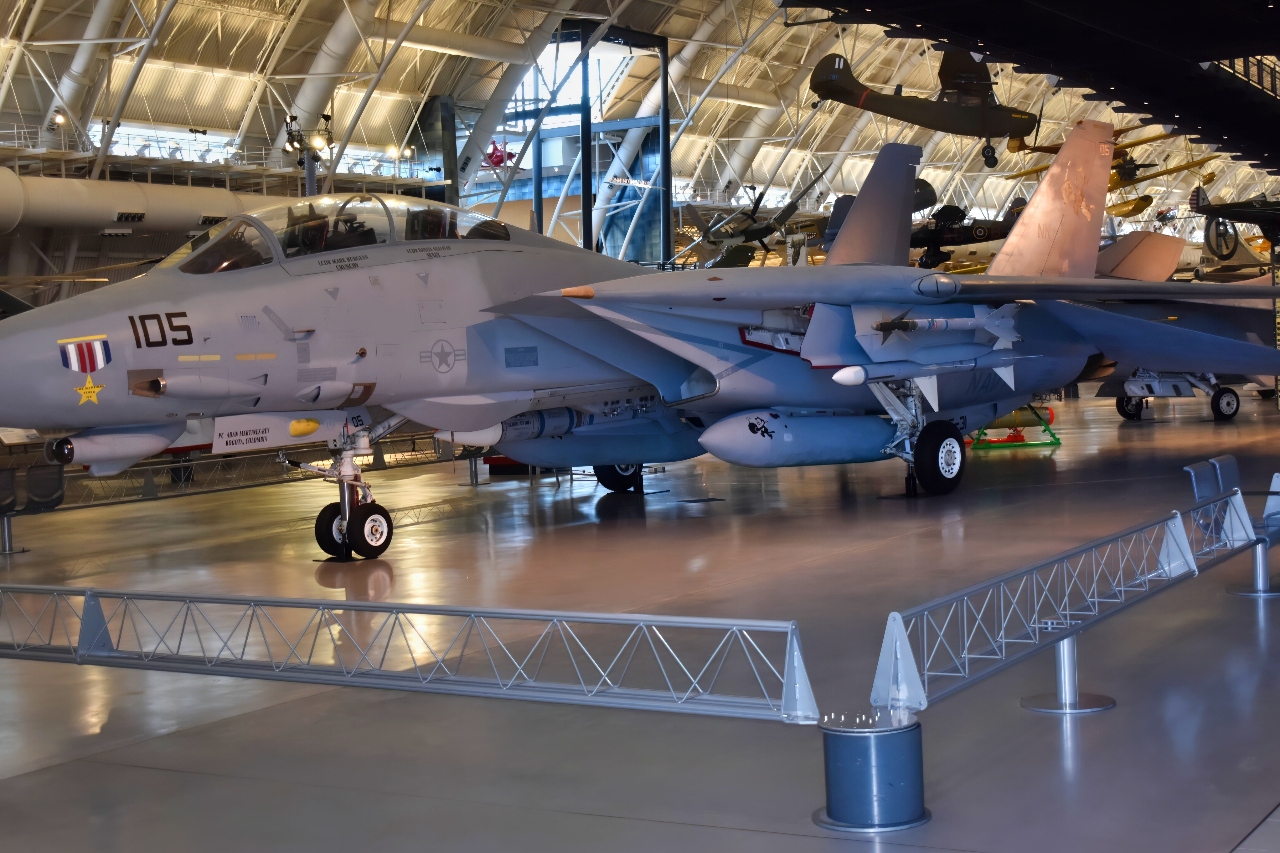
F-14D Tomcat. Image Taken By National Security Journal.
However, the Iranians, who owned 78 F-14s purchased when the Shah was still in power, claimed that during the Iran-Iraq War, their Tomcats shot down dozens of Soviet-made Iraqi aircraft.
The Hollywood film Top Gun centered around a hotshot pilot, but the actual star of the film was the Tomcat. Navy recruiting skyrocketed thanks to the film, and it remains an icon of American military movies.
What Factors Caused The Navy To Retire The Tomcat?
The F-14 Tomcat was retired due to its high maintenance costs; the obsolescence of its primary interceptor role after the Cold War; the emergence of the more versatile and cheaper F/A-18 Super Hornet; the difficulty and expense of obtaining replacement parts; and the fact that advanced features such as the variable-sweep wings were complex and prone to issues.
Costly Maintenance Programs
The Tomcat was expensive to operate and maintain, requiring significantly more maintenance hours per flight hour compared to newer aircraft, such as the F/A-18 Hornet.
It required 40 to 60 maintenance hours for every hour of flight time. This high cost was due to its complex design, including the variable-sweep “swing wing,” and its reliance on older, less reliable technology before the advent of modern electronic components.
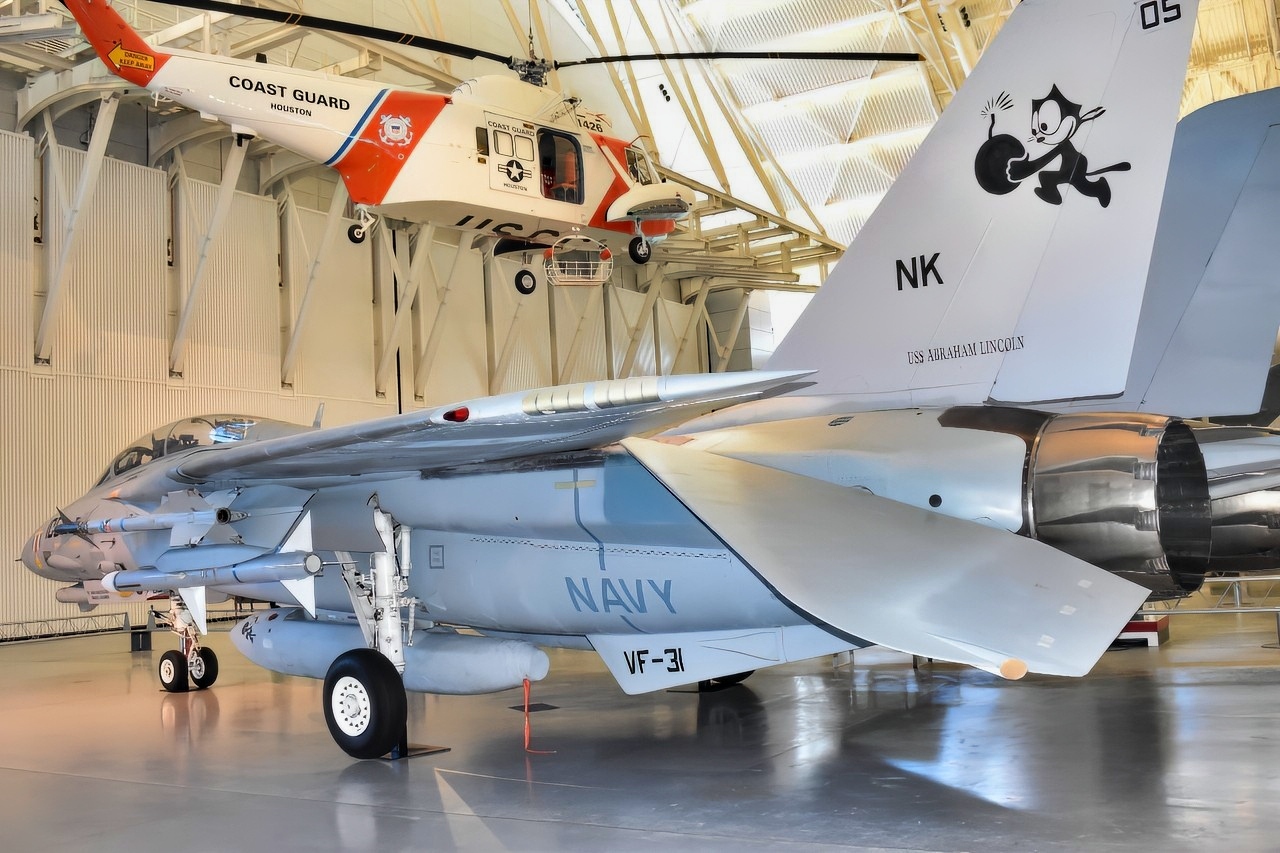
F-14 Tomcat Image by Dr. Brent M. Eastwood/National Security Journal.
Operating costs were estimated to be between $35,000–40,000 per flight hour. The F/A-18 Super Hornet was estimated to cost about $17,000 per flight hour.
Loss of Its Primary Mission
The F-14 was initially designed as a fleet-defense interceptor against Soviet bombers during the Cold War. It had a powerful radar system that could track enemy aircraft from more than 90 miles away and fire AIM-54 long-range missiles before the enemy even became aware of its presence.
The F-14 Tomcat was supersonic and one of the most advanced jets in the world. However, its mission became obsolete with the end of the Cold War.
Replacement by the F/A-18 Super Hornet
The F/A-18E/F Super Hornet offered greater versatility at a lower cost and with better logistical support, making it a more economical choice for the Navy’s future needs.

An F/A-18 Super Hornet from Naval Air Station Oceana, Virginia, performs an aerial demonstration over Rickenbacker International Airport, Ohio, June 16, 2024, as part of the Columbus Air Show. This year’s event featured more than 20 military and civilian planes, including a KC-135 Stratotanker from the 121st Air Refueling Wing, which served as the base of operations for military aircraft participating in the show. (U.S. Air National Guard photo by Senior Airman Ivy Thomas)
The Super Hornet wasn’t as fast, but it was more reliable, easier to maintain, and better suited to carrier operations. For the Navy, it made more sense to switch to the Super Hornet than to keep investing in an older design.The Super Hornet was also a superior multirole aircraft compared to the Tomcat, and it performed better as a dogfighter at lower speeds.
Lack Of Spare Parts
After the F-14’s production ended in 1991, obtaining and manufacturing replacement parts became difficult and costly. The U.S. also dismantled retired aircraft to prevent parts from reaching Iran, which still operated the Tomcat.
Complex and Aging Design, Especially The Swing Wing
The F-14’s advanced but complex variable-sweep wings, and other advanced systems, were a maintenance burden, and the aircraft were increasingly unable to compete with modern stealth technology.
The swing wing system’s primary issues were its weight, complexity, and the high maintenance it required, along with the need to counteract a significant change in the aircraft’s center of lift at supersonic speeds.

F-14 Tomcat Photo Taken on August 24 2025. Image Credit: Jack Buckby/National Security Journal.
While the swing wing was a successful design that provided both low-speed lift and high-speed performance, the system’s complexity made it expensive and demanding throughout the F-14’s service life.
About the Author: Steve Balestrieri
Steve Balestrieri is a National Security Columnist. He served as a US Army Special Forces NCO and Warrant Officer. In addition to writing on defense, he covers the NFL for PatsFans.com and is a member of the Pro Football Writers of America (PFWA). His work was regularly featured in many military publications.
More Military
Canada’s F-35 Fighter Debate Summed Up in 3 Words
The U.S. Air Force’s B-52J Bomber Crisis
Mach 5.1 X-51 Waverider ‘Hypersonic Scramjet’ Has a Message for the Air Force
Beast Mode: How the F-35 Stealth Fighter Bolts on 22,000 Pounds of Bombs


James DeNisco
November 2, 2025 at 8:54 am
Why did you not mention that the TF30-412/414 engine was not the original
engine for the F14? The aircraft was suppose to get a Navy version of F100
engine being developed for the F15. The Navy decided not to wait and the TF30
was use in its place. That is one of the reasons the TF30 had to be clocked
5 degrees to fit in the airframe.
Frank
November 3, 2025 at 8:17 am
You also left out the sixth reason and his name was Dick Cheney. Coincidentally, his wife worked for McDonald Douglas during those years and Dick had an extreme hatred of Grumman. Conflict of interest, I think so