


Key Points and Summary – The Grumman F-14 Tomcat may be a Hollywood icon, but its most impressive combat record belongs to Iran, not the United States.
-Iranian F-14 crews claimed well over 100 kills against Iraqi aircraft in the brutal Iran–Iraq War, with at least one pilot becoming an ace.

F-14 Tomcat. Image Credit: Creative Commons.
-By contrast, U.S. Navy Tomcats scored five air-to-air kills over Libya and Iraq and never lost a jet in aerial combat.
-Retired from U.S. service in 2006, the F-14 now survives in museums and on Iranian ramps, where roughly 40 airframes still fly as aging but potent symbols of Tehran’s airpower.
Top Gun’s F-14: The Legendary Jet Iran Still Flies Into Combat
The Grumman F-14 Tomcat is arguably the most popular fighter jet of all time amongst American moviegoers, thanks primarily to the Top Gun blockbuster film franchise, both the 1986 original in which then-young US Navy aviator Lieutenant (pay grade O-3) Pete “Maverick” Mitchell (played by Tom Cruise, of course) earned his combat spurs.
He took our breath away, and again in the 2022 sequel, in which Maverick is now a Captain (pay grade O-3), even though he should already be a two-star admiral. (The 1980 sci-fi film “The Final Countdown” also contributed to the F-14’s cinematic popularity.)
Filmic fiction and Hollywood hokum aside, the Tomcat’s real-world combat record is also quite impressive.
National Security Journal now takes a deeper dive into that record.

Meet the F-14 Tomcat Museum. Image Credit: Creative Commons.

F-14 Tomcat At Smithsonian. Image Credit: Creative Commons.
Aces of an American Adversary
Even though the F-14 is a US-made warbird, its most successful combat user has not been the good ol’ US of A, but, ironically enough, one of America’s biggest and longest-running adversaries and a member of the former “Axis of Evil to boot:” Iran.
(Granted, Iran’s F-14s are carryovers from happier times when that nation was actually still a US ally, i.e., during the reign of the Shah.)
At least one of those Iranian Tomcat jockeys attained ace status (none of his American counterparts can claim such lofty bragging rights).
That would be Sarhang (Colonel) Mostafa Roustaie, who scored five kills against Iraqi opponents during the Iran-Iraq War of 1980-1988 and described his beloved plane as “the last word in the fighter business.”
All in all, F-14 pilots of the late Ayatollah Khomeini claimed 130 shootdowns versus only four losses against their Iraqi Air Force (IqAF) adversaries.
However, as noted by aviation expert Tom Cooper in Smithsonian Magazine, “It is impossible to tabulate, for example, how many air-to-air victories were scored by Iranian F-14s because air force records were repeatedly tampered with during and after the war for political, religious, or even personal reasons.”
As for those lucky few IqAF fighter pilots (working for [the now kaput] strongman Saddam Hussein at the time) who managed to kill a Tomcat – rare birds, indeed – the admittedly scanty evidence indicates that two of them did so in a MiG-23 “Flogger,” while one kill apiece is credited to a Dassault Mirage F1 and a MiG-21 “Fishbed.”
American Tomcat Crews in Action
Of course, not to be outdone, USN Tomcat crews also earned their fair share of combat accolades, even if they didn’t achieve the sheer number of aerial victories their Iranian counterparts did.
The US-flown F-14s’ total combined kill tally is 5: two Libyan Sukhoi Su-22 Fitter jets destroyed during the 1981 Gulf of Sidra incident; two Libyan MiG-23 Floggers downed during the 1989 Gulf of Sidra incident; and one Iraqi Mi-8 Hip helicopter killed during the 1991 Persian Gulf War, AKA Operation Desert Storm.
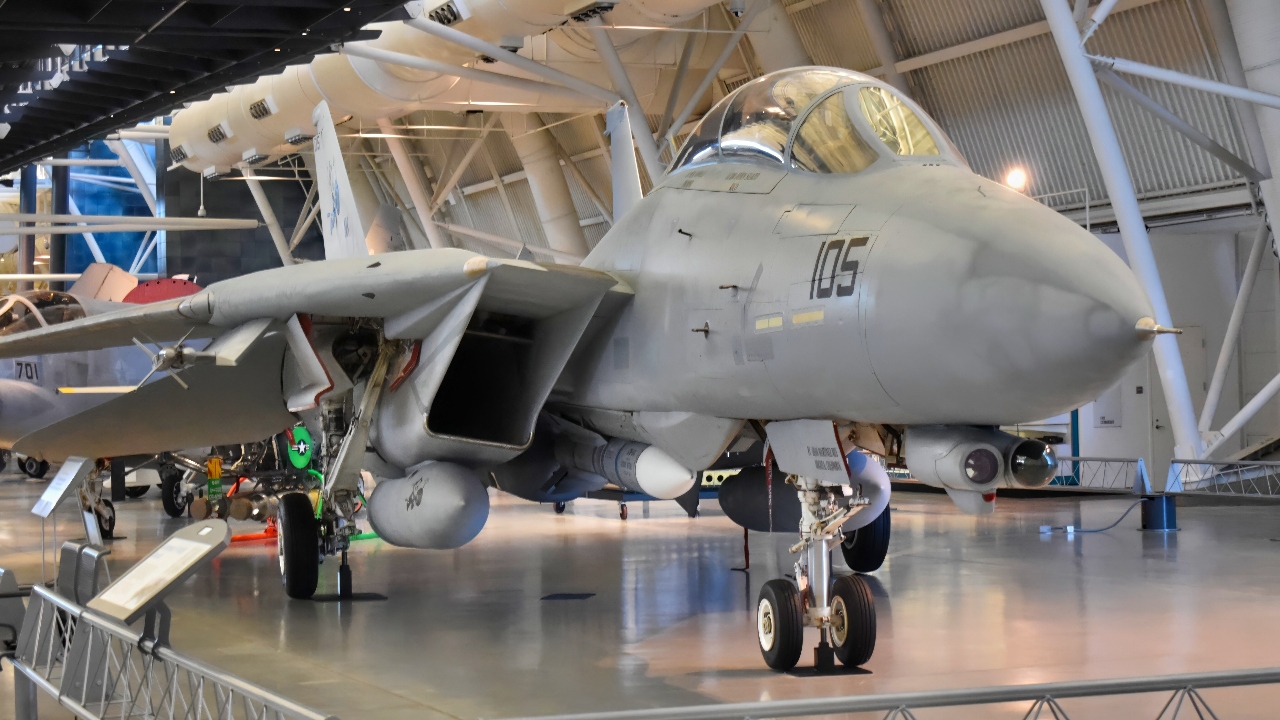
F-14 Tomcat Fighter National Security Journal Photo
In turn, no USN F-14s were ever lost in air-to-air battles, though one Tomcat was lost to enemy ground fire during Desert Storm.
Its pilot, Lt. Devon Jones, was saved by US Air Force pararescuemen (“PJs”) the day after the downing, while his radar intercept officer, Lt. Lawrence R. Slade, ended up as a prisoner of war (POW) for the remainder of the war. (Unlike the ill-fated Goose from the original Top Gun film, Mr. Slade lived to tell the tale.)
Where Are They Now?
The USN’s last serving Tomcat, an F-14D bearing Bureau Number (BuNo)164603, number 711 of the 712 total Tomcat airframes built, made her final flight on September 22, 2006. (12 years prior, Grumman had merged with Northrop to form what we now know as Northrop Grumman.)
That particular Tomcat specimen, affectionately nicknamed “Felix 101,” is now preserved for posterity at the Cradle of Aviation Museum in Garden City, New York.
For good measure, an additional 80+ F-14s survive as static displays at museums and military installations around the US
Meanwhile, the only active user of the F-14 is…surprise, surprise, surprise, the Islamic Republic of Iran Air Force (IRIAF; Nirvi-ye Hevayi-ye Artesh-e Jimhuri-ye Eslâmi-ye Iran).
According to the World Directory of Modern Military Aircraft (WDMMA), the IRIAF has 41 F-14A/AMs in its fighter fleet, which also includes an array of older American-made aircraft, such as the F-4D/E/RF Phantom II (63) and the F-5E Tiger II (35).
About the Author: Christian D. Orr, Defense Expert
Christian D. Orr is a Senior Defense Editor. He is a former Air Force Security Forces officer, Federal law enforcement officer, and private military contractor (with assignments worked in Iraq, the United Arab Emirates, Kosovo, Japan, Germany, and the Pentagon). Chris holds a B.A. in International Relations from the University of Southern California (USC) and an M.A. in Intelligence Studies (with a concentration in Terrorism Studies) from American Military University (AMU). He is also the author of the newly published book “Five Decades of a Fabulous Firearm: Celebrating the 50th Anniversary of the Beretta 92 Pistol Series.”


