


Key Points and Summary – The F-14 Tomcat was built for a specific Cold War nightmare: long-range Soviet bombers and cruise missiles hunting U.S. carriers.
-With huge internal fuel, smart external tanks, variable-geometry wings, and upgraded F110 engines, it could sprint at over Mach 2 and still range 500–600 nautical miles in combat—farther than today’s F/A-18E/F and F-35C.

F-14 Tomcat. Image Credit: Creative Commons.
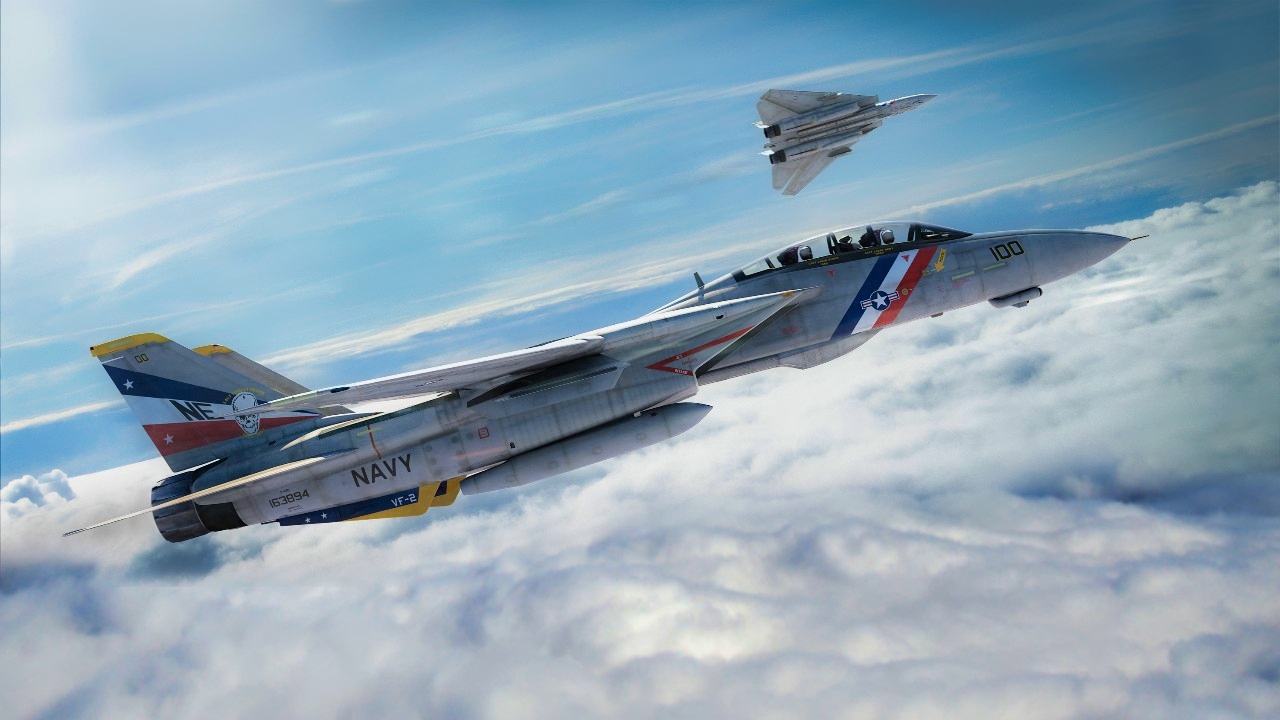
F-14 Tomcat US Navy. Image Credit: Creative Commons.
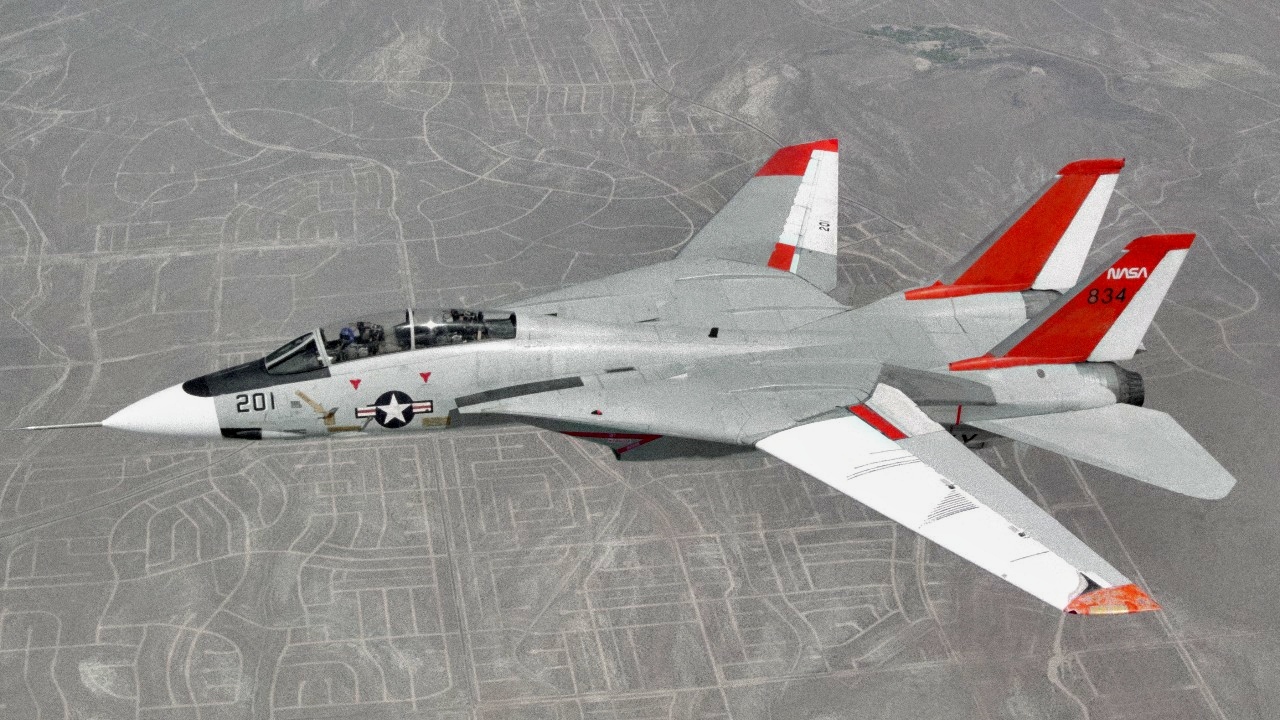
NASA 834, an F-14 Navy Tomcat, seen here in flight, was used at Dryden in 1986 and 1987 in a program known as the Variable-Sweep Transition Flight Experiment (VSTFE). This program explored laminar flow on variable sweep aircraft at high subsonic speeds. An F-14 aircraft was chosen as the carrier vehicle for the VSTFE program primarily because of its variable-sweep capability, Mach and Reynolds number capability, availability, and favorable wing pressure distribution. The variable sweep outer-panels of the F-14 aircraft were modified with natural laminar flow gloves to provide not only smooth surfaces but also airfoils that can produce a wide range of pressure distributions for which transition location can be determined at various flight conditions and sweep angles. Glove I, seen here installed on the upper surface of the left wing, was a ”cleanup” or smoothing of the basic F-14 wing, while Glove II was designed to provide specific pressure distributions at Mach 0.7. Laminar flow research continued at Dryden with a research program on the NASA 848 F-16XL, a laminar flow experiment involving a wing-mounted panel with millions of tiny laser cut holes drawing off turbulent boundary layer air with a suction pump. April 11, 1986 NASA Photo
-Retired in 2006 to simplify logistics and deny Iran spare parts, the Tomcat was replaced by more modern but shorter-legged jets.
-The Navy gained better sensors and maintainability, but it never truly replaced the F-14’s unique mix of speed, reach, and carrier-based punch.
The F-14 Tomcat Did One Thing the F-35 Never Will
The F-14 Tomcat is an old platform that has been retired for almost 20 years at this point.
During its service, the F-14 was the aircraft of choice for the United States’ naval aviation.
While other aircraft outperform it in specific metrics, the Tomcat possessed high speeds and a long range, making it the ideal naval aircraft.
These capabilities were invaluable for carrier operations, allowing naval aviation to project power even further.
Unfortunately, since its retirement, the U.S. Navy has not been able to find a suitable replacement that reaches as far as the F-14 did.
The Navy’s One-of-a-Kind Fighter
The need for a long-range interceptor arose during the Cold War, when the U.S. Navy faced the threat of Soviet bombers and cruise missiles targeting carrier battle groups.
The F-14 was developed to replace the failed F-111B program (a program that tried to modify the F-111 for carrier operations) and was explicitly tailored for naval operations.
It was a two-seat aircraft, with a pilot and a radar intercept officer (RIO) on board.
It was equipped with advanced avionics and weapons systems that allowed it to detect, track, and engage multiple targets at long distances.
Its primary mission was to intercept incoming threats before they could reach the fleet, and this required not only powerful radar and missiles but also the ability to fly far from the carrier and remain on station for extended periods.
The range of the F-14 varied depending on mission profile and configuration. In a typical combat scenario, its combat radius was approximately 500 to 600 nautical miles, which translates to roughly 926 to 1,111 kilometers.
This meant the aircraft could fly out to a target area, engage, and return without needing to refuel.
For ferry missions, where the aircraft was flown from one location to another without a combat load, its maximum range extended to about 1,600 nautical miles, or 2,963 kilometers.
With aerial refueling, the F-14’s range became effectively unlimited, constrained only by crew endurance and mechanical limits.
How the F-14 Got Its Impressive Range
But how was the F-14 able to reach such impressive ranges?
First and foremost was its large internal fuel capacity.
The aircraft could carry approximately 16,200 pounds of fuel internally, providing it with substantial endurance without the need for external tanks.
This internal capacity was complemented by the ability to carry external fuel tanks, specifically, two 267-gallon drop tanks mounted under the fuselage.

On board USS Harry S. Truman (CVN 75).
An F-14B Tomcat assigned to the”Swordsmen” of Fighter Squadron Three Two (VF-32) launches off of one of four steam powerd catapults on the flight deck. The Harry S. Truman carrier strike group is on a six-month deployment in support of the global war on terrorism and is currently conducting carrier qualifications of the east coast of the Untied States. US Navy photo by Photographer’s Mate Airman Ryan O’Connor. (Released by HST Public Affairs)
These tanks could be used to extend the aircraft’s range during long missions and were designed to be jettisoned if necessary during combat to reduce drag and weight.
Another key factor was the aircraft’s variable-geometry wing design.
The wings could sweep forward or backward depending on flight conditions. During takeoff, landing, or low-speed flight, the wings were extended to provide maximum lift and stability.
At high speeds or during cruise, the wings swept back to reduce drag and improve aerodynamic efficiency.
This adaptability allowed the F-14 to maintain optimal performance across a wide range of speeds and altitudes, which in turn contributed to fuel efficiency and extended range.
The Ideal Naval Interceptor
The engines also played a significant role. Early models of the F-14 were powered by Pratt & Whitney TF30 engines, which were known for reliability issues and poor fuel efficiency.
Later models, particularly the F-14B and F-14D, were equipped with General Electric F110-GE-400 engines.
These engines provided greater thrust and improved fuel economy, especially at cruise settings.
While the F-14 was not a true supercruise aircraft in the modern sense, the upgraded engines allowed it to sustain high subsonic speeds without relying heavily on afterburners, which consume fuel at a much higher rate.
Aside from the impressive range, the F-14’s engines allowed the aircraft to reach top speeds of around Mach 2.34.
This enables the Tomcat to respond to threats quickly and allows it to travel great distances in relatively short amounts of time.
To this day, the F-14 remains the fastest naval aircraft in U.S. service, with the F/A-18E/F and F-35 not even coming close.
The Fighter the Navy Could Never Replace
In 2006, the Tomcat took its final flight before being retired for good from the U.S. Navy. It was replaced by the F/A-18 Super Hornet and then by the F-35B/C.
These fighters offered more advanced systems than the F-14, and after the Iranian revolution, retiring the F-14 ensured that Iran could not maintain and modernize its own F-14 fleet.
However, despite its replacements being more advanced in many ways, the U.S. Navy was never able to find another aircraft quite like the Tomcat.
The F-18 and F-35 are good aircraft, great even, but they lack the speed and the range that the F-14 offered.
The F-18 has a top speed of around Mach 1.8, and the F-35 is even slower, at around Mach 1.6 (slower still at sea level).
Furthermore, the F-14’s range remains unmatched by its successor.
The F/A-18 comes close with a total range of around 1,260 nautical miles, but it still falls short.
Granted, the F-35C has a higher combat range with 670 nautical miles, but it still lacks the speed and overall range of the Tomcat.
Retiring the Tomcat was necessary to prevent spare parts from falling into Iranian hands, but by doing so, the U.S. gave itself a minor setback. The F-14 was a one-of-a-kind aircraft that offered high speeds, extended ranges, and deadly armaments.
Many have argued that the F-14 should have been retained and modernized.
Unfortunately, what’s done is done.
The F-14 is no more. The best thing to do now is to learn the right lessons from the F-14 and apply them to future aircraft projects.
About the Author: Isaac Seitz
Isaac Seitz, a Defense Columnist, graduated from Patrick Henry College’s Strategic Intelligence and National Security program. He has also studied Russian at Middlebury Language Schools and has worked as an intelligence Analyst in the private sector.
More Military
The YF-23 Black Widow II Stealth Fighter Almost Made the Ultimate Comeback
The New Leopard 2A8 Tank Has a Message for the Russian Army
The F-22J Raptor Stealth Fighter Will Never Fly For Japan (China Is Smiling)


Peter Sutton
October 9, 2025 at 5:19 am
The F-14 pictured was used in Topgun along with 101/2/4
John
October 9, 2025 at 7:16 am
The F14 could actually reach Mach 2.5, basically the same speed as the F15 but the navy limited it, it could also pull 9gs as well but was limited to 6.5 to lengthen service life.
Had it been upgraded as proposed, more powerful radar(aesa) super cruise, thrust vectoring engines along with more fuel and larger payload, the F35 like wouldnt have been needed.
The F14 would have likely been able to carry 6, SM-6 missiles.
If combined with the F35, it could have been a missile truck like the F15. The tomcat was retired before its time but it happened not for cost but for dick “head” Chaney and his dealings with the f18 program. Cost was the excuse since the f35 costs more per flight hour.
The F35 can’t carry the sm-6 and beast mode which somehow carrying external weapons gave it the nickname which is a joke, external weapons negates stealth.
The F14 would have still bested it in that aspect but hey, always trust our politicians and military brass to do whats best for the military, especially when they are pocketing money from their decisions….
Cough * A10 retirement * cough
They would never put lives at risk for their own personal greed….
Rob Milford
October 9, 2025 at 10:24 am
This is an AI generated article. (Generated, not written) The While the information is substantially correct, its lack of comments by current and former naval aviators who flew the Tomcat is disappointing. AND it forgot to
Mention a certain movie in 1986, and how that really changed ALL of naval aviation.
Lighting1
October 9, 2025 at 11:35 am
Sooo let me get this straight. The U.S. navy couldn’t track spare parts to keep them out of Iranian hands, therefor it justifies stopping a successful program. It seems that the current threat (prc) has overwhelming numbers for short distance and an f14 can simultaniously stop multiple targets at long range. With improvements in electronics over the last 20 years, an upgraded f14 sounds like what the navy needs.
Krystal cane
October 9, 2025 at 12:38 pm
I agree 100% after goose and Maverick bailed out of an f-14 and goose was killed the program has been haunted ever since. Now we’re at war with some undisclosed country with nuclear weapons and luckily we were able to get in there where their f-18s and take them out and fly out in one of their stolen f-14s 🤔
Ghost_Tomahawk
October 9, 2025 at 12:44 pm
The Navy and Air Force love retiring platforms so they can bloat their budgets to acquire new airframes that lack in performance. Stealth. Were dumping money into platforms that can be detected by 60s and 70s era Soviet SAM technology. Israel lost 3 160 million dollar F35s in a weekend. That’s almost a BILLION dollars on 3 planes.
It would be very easy to resume making the F14 in an improved version. Very.
Cal Lawrence
October 9, 2025 at 3:21 pm
The F-14 could and should have gotten continued upgrades to remain in service to today, but Cheney had a pathological hatred of Grumman and canceled the Super Tomcat.
Intruder
October 9, 2025 at 3:53 pm
Ya, we all know Cheney was a complete fool for not only ending the Tomcat but then supersizing his ignorance with Raptor tooling destruction. His hatred of Grumman screwed not only the Navy but then the AF with amazing idiocy. Unbelievable.
Alex Jauch
October 10, 2025 at 2:52 pm
“Current fighters lack the range of the F-14”
Nope. F-35 has a greater combat range.
It’s also super silly to say the F-14 could carry extra ferry tanks but forget to mention that the F-18 and F-35 can also.
Of course, all three can mid air refuel.
The only actual advantage for the F-14 was top speed. History shows that this isn’t actually done. Also, who cares about slick config? What was the top speed when carrying six AIM-54s?
Finally, the F-111B was co-developed with the A model. It wasn’t developed later. The entire idea of the F-111 was a multi service aircraft.