

Key Points and Summary – Although an icon, the F-14 Tomcat was plagued by “legitimate flaws” that made it a “logistical nightmare” for the Navy. It required an “astronomical” 50+ maintenance hours per flight hour, largely due to its complex variable-sweep wings.
-Its original Pratt & Whitney TF30 engines were a “terrible mismatch” (designed for a bomber) and prone to “catastrophic” compressor stalls that could cause flat spins.
-This, combined with “unsustainable” operating costs and an “obsolete” mission (intercepting Soviet bombers) after the Cold War, led the Navy to retire it for the cheaper, more reliable F/A-18E/F Super Hornet.
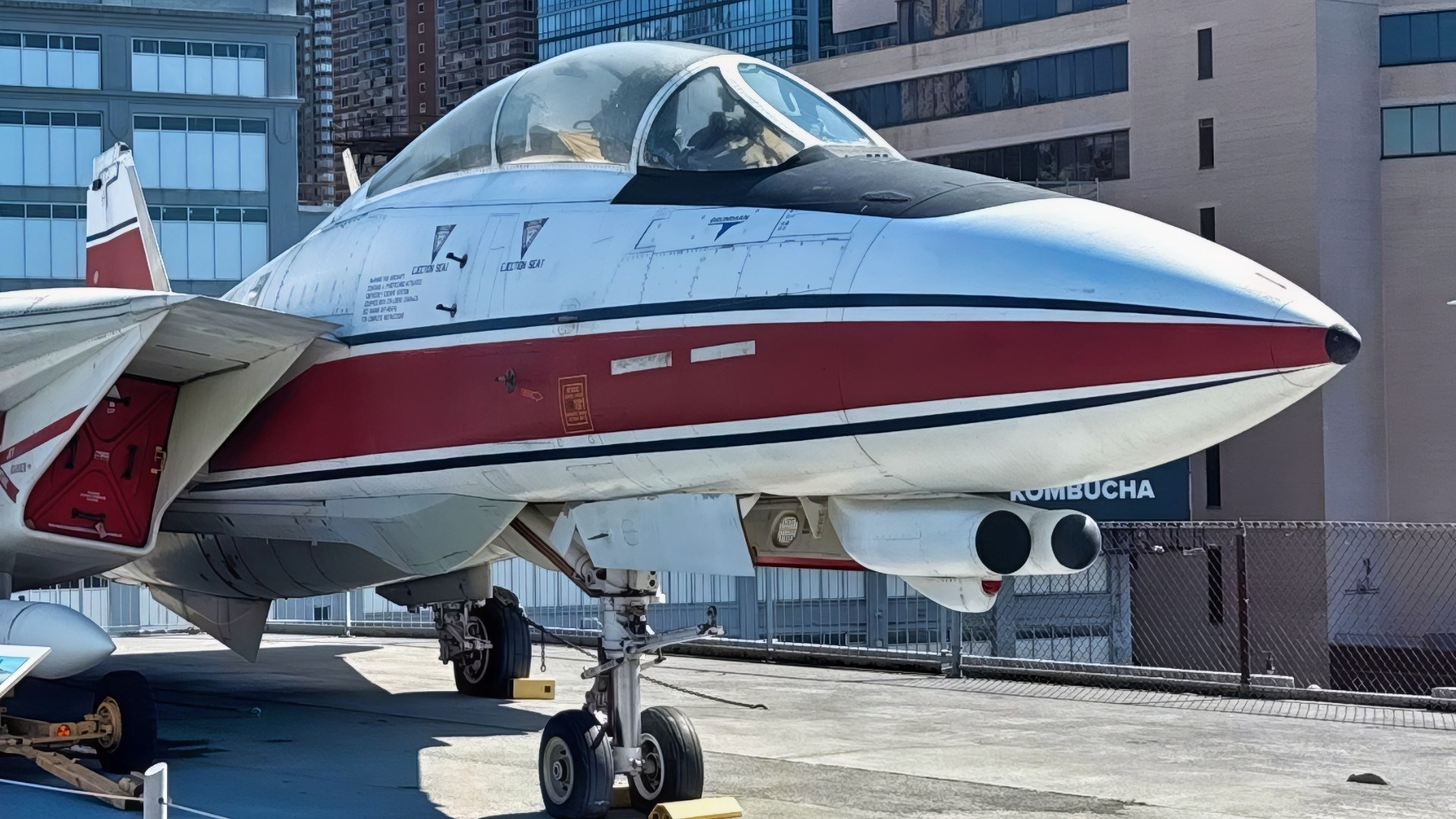
BONUS – We recently visited the F-14 Tomcat onboard USS Intrepid. We have included those photos below.
The F-14 Tomcat Was Far From Perfect
The F-14 Tomcat is an iconic, much-venerated Cold War aircraft known for its speed and easily recognizable profile.
It served with the U.S. Armed Forces throughout the Cold War and is fondly remembered by aviation enthusiasts worldwide.
Despite this, the aircraft still had several flaws that made maintaining these beautiful birds a real headache.
From maintenance complexities to performance issues, these are the top five aspects about the F-14 that the Navy intensely disliked.
Just as a disclaimer: this is not a hit piece on the F-14.
I myself love the Tomcat and agree with many that it was retired prematurely (we can all thank Iran for that).
However, the F-14 did have legitimate flaws that are perfectly valid to criticize.
Maintenance Issues
Anyone who worked on the F-14 will gladly tell you how much of a pain the aircraft was to maintain.
The aircraft was notoriously difficult and costly to keep operational.
Its variable-geometry wings, while innovative, introduced mechanical complexity that required constant attention.
Hydraulic actuators, pivot bearings, and seals had to be inspected and serviced regularly, and any failure in this system could ground the aircraft.
Operating in a maritime environment exposed the Tomcat to saltwater corrosion, which accelerated wear on structural components and avionics, making corrosion control a full-time job for Navy crews.
The aircraft required extensive pre- and post-flight checks, and its maintenance man-hours per flight hour were among the highest of any fighter in U.S. service, often exceeding 50 man-hours per flight hour in later years.
By the 1990s, the cost of maintaining the Tomcat had become astronomical, and this was a major factor in the Navy’s decision to retire it in favor of the F/A-18E/F Super Hornet, which was far cheaper to maintain.
In short, the Tomcat’s complexity made it a logistical nightmare, draining resources and manpower.
Engine Reliability
Another major flaw was the reliability of its engines. Early variants of the F-14 were powered by Pratt & Whitney TF30 engines, originally designed for subsonic bombers rather than high-performance fighters.
This mismatch led to severe problems. The TF30 was prone to compressor stalls during high-angle-of-attack maneuvers or rapid throttle changes.
In a dogfight, this could be catastrophic, leading to a sudden loss of thrust or even an engine flameout.
A stall in one engine often resulted in asymmetric thrust, which could induce uncontrollable yaw and roll, sometimes leading to flat spins.
Pilots had to manage throttle inputs carefully to avoid engine stalls, adding stress during combat and reducing confidence in the aircraft’s performance.
Later upgrades introduced the General Electric F110-GE-400 engines in the F-14D, which solved most of these issues, but this improvement came late in the aircraft’s life and was not applied fleet-wide.
For much of its service life, the Tomcat’s engines were a liability, limiting its maneuverability and increasing accident risk.
Operating Costs
The F-14 was costly to operate, even compared to other fighters of its era. Its twin engines and large airframe consumed vast amounts of fuel, especially at supersonic speeds or during afterburner use.
The complexity of its systems, radar, swing wings, and avionics meant a constant need for specialized parts, and as the aircraft aged, these parts became scarce and costly.
By the early 2000s, the Navy estimated that retiring the F-14 would save hundreds of millions annually, a financial reality that outweighed its remaining tactical advantages.
In an era where efficiency and cost-effectiveness were increasingly prioritized, the Tomcat’s operating costs were unsustainable.
Aging Avionics
The F-14’s avionics were state-of-the-art for their time, but they gradually grew more obsolete as time went on, especially as newer aircraft like the F-22 were released. Its AWG-9 radar was initially a game-changer, offering long-range detection and the ability to track multiple targets simultaneously.
However, as electronic countermeasures advanced, the AWG-9 became increasingly vulnerable and lacked the processing speed of modern systems.
The F-14 Tomcat was designed as an interceptor, not a strike fighter.
Although later upgrades allowed it to carry precision-guided munitions in the so-called “Bombcat” role, this was a retrofit solution rather than a design feature.
The cockpit ergonomics also reflected an older philosophy: the two-seat configuration, with a pilot and a radar intercept officer, was necessary for managing complex systems, but by the 1990s, automation in newer fighters made this arrangement less efficient.
Keeping the Tomcat relevant required costly upgrades, and even then, it struggled to match the capabilities of newer aircraft.
Obsolescence After the Cold War
Finally, the F-14 Tomcat’s design philosophy was tied to a specific Cold War threat environment that never fully materialized.
This is less a criticism of the aircraft itself than a comment on how times can change in unexpected ways.
The F-14 Tomcats’ primary mission was to intercept Soviet bombers before they could launch anti-ship missiles against U.S. carrier groups.
With the collapse of the Soviet Union, this role became less critical. The F-14 was large and lacked stealth features, making it more detectable in an era increasingly focused on low-observable aircraft.
Despite its variable-geometry wings, the Tomcat was not as agile as smaller fighters like the F-16 or MiG-29.
Its weight and engine limitations reduced its effectiveness in close-range engagements, and as air combat doctrine shifted toward multirole flexibility and stealth, the Tomcat’s specialized design left it less adaptable to modern needs.
F-14 Tomcat Visit by National Security Journal

F-14D Tomcat NSJ Image. Image Credit: Taken by Jack Buckby on 9/18/2025.

F-14D Tomcat Photo Onboard USS Intrepid. National Security Journal Photo.

F-14 Tomcat on Flight Deck at USS Intrepid Museum. Image Credit: National Security Journal.

F-14D Tomcat in NYC on USS Intrepid. Image Credit: National Security Journal Taken on 9/19/2025.
About the Author: Isaac Seitz
Isaac Seitz, a Defense Columnist, graduated from Patrick Henry College’s Strategic Intelligence and National Security program. He has also studied Russian at Middlebury Language Schools and has worked as an intelligence Analyst in the private sector.
More Military
Europe and Canada Are Finally Saying No to the F-35 Stealth Fighter
The Exact Day Navy Battleships Became Obsolete Is Clear
The X-44 Manta Has a Message for Every Air Force on Earth


