

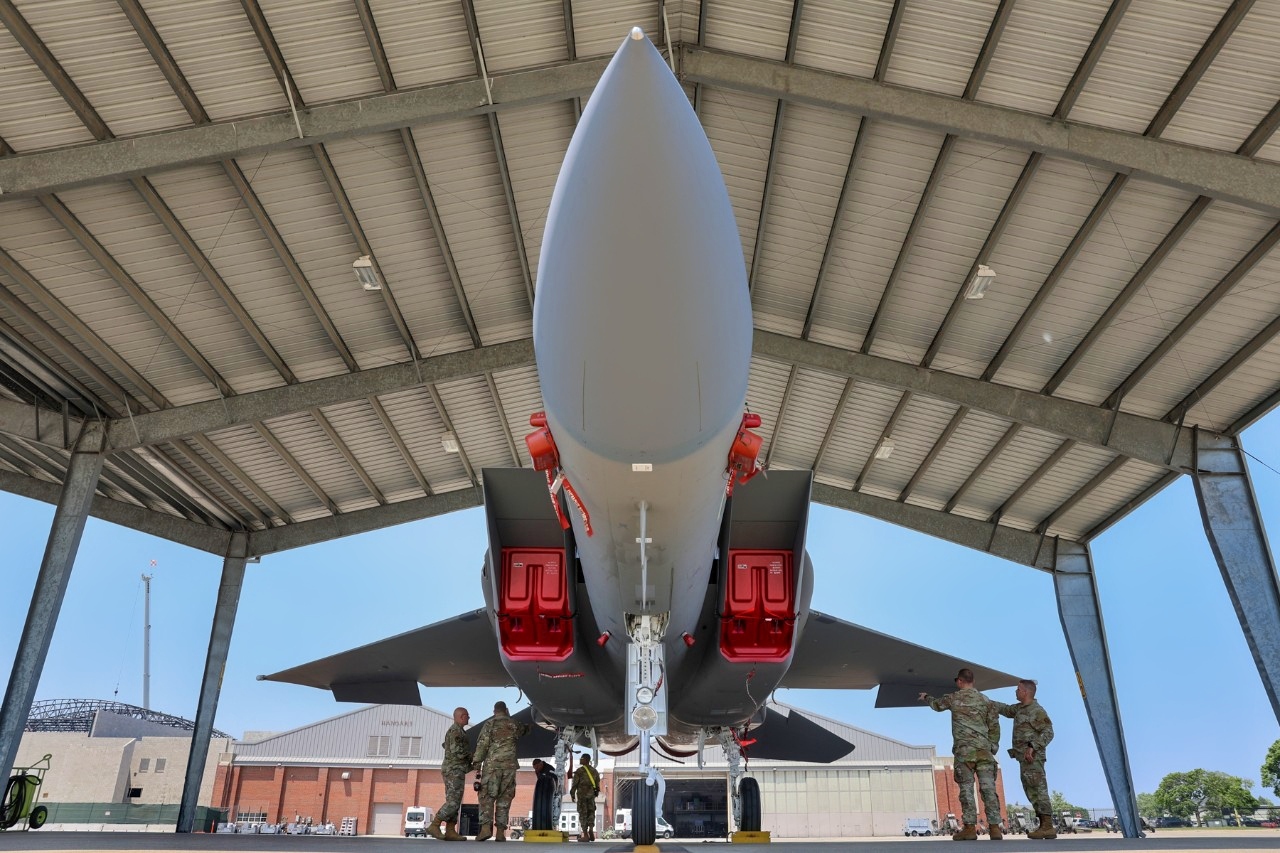
Key Points and Summary – The U.S. Air Force is significantly increasing its planned fleet of fourth-generation F-15EX Eagle II fighter jets from 98 to 129 aircraft, a move solidified in the newly released Fiscal Year 2026 defense budget proposal.
-The budget allocates approximately $3 billion to procure more of the advanced fighters. While not a stealth aircraft, the F-15EX is valued for its massive payload capacity (29,500 lbs), advanced AESA radar, modern electronic warfare suite, and lower operational costs.
-The decision to buy more F-15EXs, which will replace aging A-10s and older F-15s, comes as the Pentagon is simultaneously cutting its F-35 orders.
The F-15EX Fighter Needs to Impress in a Stealth World
According to recent reports, the DoD has recently shared its 2026 budget proposal to the public, allowing everyone to see the Trump administration’s defense priorities.
One of the biggest winners is the F-15EX, which will be receiving a significant increase in funding. The program, which has seen drastic fluctuations in planned fleet size, will grow from 98 aircraft to 129.
The F-15EX Fleet is Growing
The proposed 2026 budget allots around $3 billion in funding for the latest variant of the iconic F-15.
These jets are intended to replace older variants as well as phase out the retiring A-10 Warthog. According to sources, these fighters are slated to serve at Portland, Fresno, New Orleans, and two squadrons at Kadena Air Base in Okinawa in Japan, with the rest going to Air National Guard units or used for training purposes.
The F-15EX has been through its fair share of controversy with critics pointing out the fighter’s high cost and aged frame. Additionally, some argued that investing in a new fourth-generation fighter is a step backward in an era increasingly dominated by stealth and unmanned systems. However, based on the budget proposal, the current administration sees enough value in the fighter to invest further into it.
Modernizing the F-15 Eagle
The origins of the F-15EX can be traced back to the early 2010s, when the U.S. Department of Defense began evaluating options to modernize its tactical fighter fleet. The F-15C/D models, though still effective, were nearing the end of their operational lifespans. Rather than relying solely on the F-35 to fill the gap, the Air Force sought a complementary solution that could be fielded quickly and cost-effectively.
Boeing proposed the F-15EX, a heavily upgraded version of the F-15QA developed for Qatar, which incorporated state-of-the-art avionics, weapons systems, and structural enhancements.
The F-15EX retains the classic twin-engine, twin-tail configuration of its predecessors but features a significantly strengthened airframe rated for 20,000 flight hours. It is powered by two Pratt & Whitney F110-GE-129 engines, which provide exceptional thrust and enable the aircraft to reach speeds of up to Mach 2.5 or more.
This makes the F-15EX one of the fastest fighters in the U.S. inventory, capable of rapid response and long-range missions.
Design and Specs
One of the most notable advancements in the F-15EX is its avionics suite. The aircraft is equipped with a digital fly-by-wire system, replacing the older mechanical flight controls and allowing for more precise handling and reduced pilot workload. The cockpit features a large area display, modern mission computers, and an open mission systems architecture.
This open architecture is particularly important, as it allows for the rapid integration of new technologies and weapons, ensuring that the F-15EX can evolve to meet future threats.
The radar and sensor systems on the F-15EX are also state-of-the-art. It is equipped with the AN/APG-82(V)1 active electronically scanned array (AESA) radar, which provides superior detection, tracking, and targeting capabilities. In addition, the aircraft includes the Eagle Passive/Active Warning and Survivability System (EPAWSS), a comprehensive electronic warfare suite that enhances survivability in contested environments by detecting and countering enemy radar and missile threats.
In terms of firepower, the F-15EX is unmatched among U.S. fighters. It can carry up to 29,500 pounds of munitions, the largest payload capacity of any fighter in the U.S. arsenal. This includes a wide array of air-to-air and air-to-ground weapons, such as AIM-120 AMRAAM and AIM-9X Sidewinder missiles, Joint Direct Attack Munitions (JDAMs), Small Diameter Bombs (SDBs), and AGM-158 Joint Air-to-Surface Standoff Missiles (JASSMs).
The aircraft also supports anti-radiation missiles like the AGM-88 HARM, making it effective against enemy air defenses. With 12 external hardpoints and conformal fuel tanks, the F-15EX can conduct long-range missions without sacrificing firepower or endurance.
A Good Fighter Even Without Stealth
Operational integration of the F-15EX has been progressing steadily. The 173rd Fighter Wing at Kingsley Field in Oregon was designated as the first formal training unit for the F-15EX, with initial aircraft deliveries beginning in 2024. Boeing has been fulfilling contracts for multiple production lots, with plans to produce two aircraft per month by 2026. The aircraft’s compatibility with existing F-15 infrastructure, including maintenance facilities, pilot training programs, and logistics systems, has enabled a smooth transition and reduced overall costs.
Strategically, the F-15EX fills a unique role within the U.S. Air Force. While it lacks the stealth capabilities of fifth-generation fighters like the F-35 and F-22, it offers complementary strengths that make it invaluable in certain mission profiles.
Its high speed, long range, and massive payload capacity make it ideal for homeland defense, no-fly zone enforcement, and stand-off missile delivery. In scenarios where stealth is not a primary concern, the F-15EX can deliver overwhelming firepower and maintain air superiority with ease.
The aircraft’s export potential is also significant. Several U.S. allies have expressed interest in the F-15EX, including Indonesia, which is evaluating it alongside other advanced fighter platforms. The combination of proven design, modern upgrades, and interoperability with U.S. forces makes the F-15EX an attractive option for countries seeking a powerful multirole fighter without the high costs and logistical demands of stealth aircraft.
About the Author:
Isaac Seitz, a Defense Columnist, graduated from Patrick Henry College’s Strategic Intelligence and National Security program. He has also studied Russian at Middlebury Language Schools and has worked as an intelligence Analyst in the private sector.
Iran War
30,000 Pound Bunker-Buster Bombs Might Not Be Able to Destroy Fordow


Pingback: The YF-118G 'Bird of Prey' Stealth Fighter Summed up in 4 Words - National Security Journal