

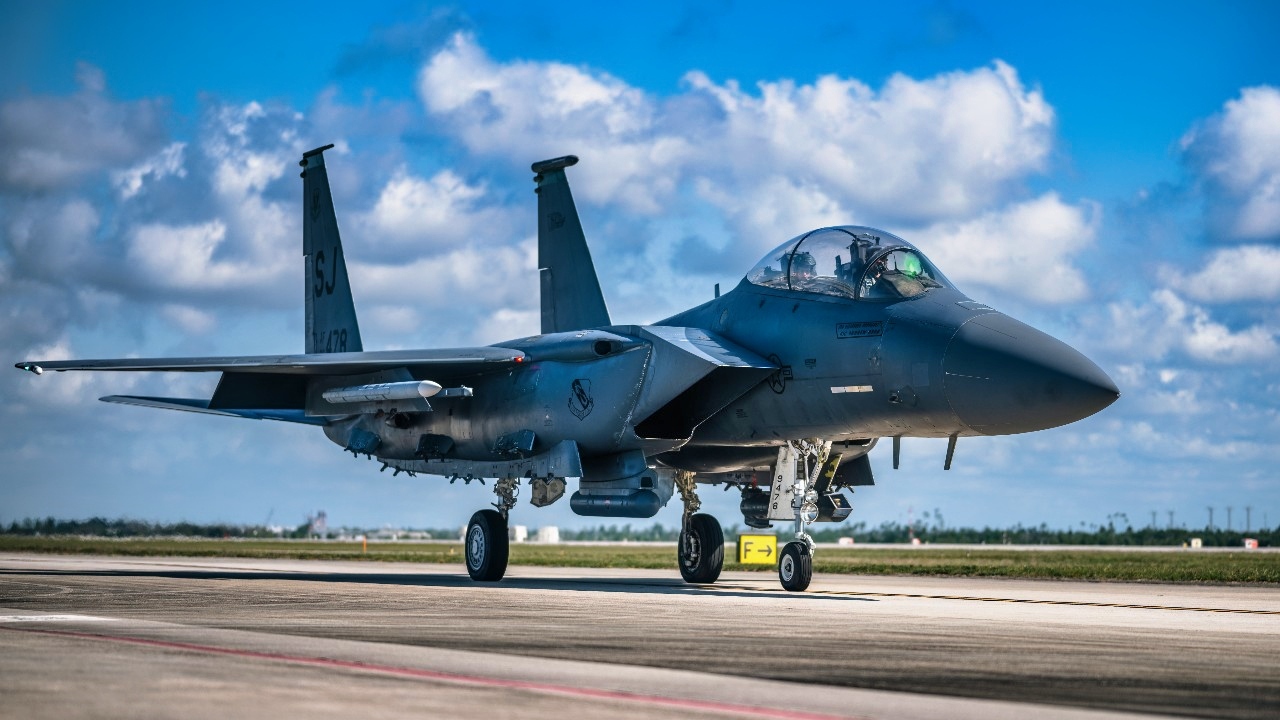
Key Points – Recent photos (May 22, 2025) show a US Air Force F-15E Strike Eagle test-flying with up to 42 AGR-20 APKWS II 70mm guided rockets, significantly boosting its munition capacity for engaging drones and cruise missiles.
-This integration, first prompted during the defense of Israel against Iranian attacks in April 2024 due to limited air-to-air missile loads, offers a cost-effective solution (~$30,000 per rocket vs. expensive AAMs) for countering numerous, low-cost aerial threats.
-The F-15E’s two-seat configuration allows a single aircraft to designate and engage targets with APKWS II, an advantage over F-16s requiring two aircraft for similar missions.
The F-15E Gets More Weapons
Photos seen as of May 22, 2025, show a United States Air Force (USAF) F-15E Strike Eagle undergoing some first-time and unusual flight testing with a new weapon system. Specifically, the aircraft was loaded with clusters of munitions totaling 42 AGR-20 APKWS II 70 mm guided rockets.
These photos, initially published by The Merge, show a dramatic increase in the munition capacity for the aircraft. A normal, non-special mission load-out for the aircraft is six or up to eight air-to-air missiles (AAMs). The integration of the APKWS II will now allow the F-15E to carry up to 42 guided rockets in addition to the AAMs.
This armament is several orders of magnitude greater than the established weapons load—increasing the number of engagement opportunities by a factor of seven. The rockets are a primary defense against unmanned aerial systems and cruise missiles. Those two systems, perhaps not coincidentally, are the categories of weapons fired in large numbers by Russia against Ukrainian civilian population centers.
Possible Change in Policy
Numerous suggestions abound that the US and its NATO allies might close the skies over Ukraine to prevent the large numbers of Iran-design Shahed-series drones (Geran-series in the Russian license-produced version). However, to date, there has been no confirmation any plan for the US to enter into the Ukraine conflict is in the offing.
However, the APKWS II rockets have already been used aboard the F-16s in the US military’s conflict with the Yemen-based Houthi rebels. The Concept of Operations (Con Ops) utilized thus far in this theater calls for F-16s to operate in pairs. One jet “paints” the target with a laser target designator from the Sniper Advanced Targeting Pod, while the other makes an attack run with the rockets.
Employing the AKPWS II dramatically reduces the cost per kill in these kinds of engagements. An AIM-9X infrared (IR)-guided AAM costs about $450,000. The longer-ranged and active radar-homing AIM-120 AMRAAM can run more than $1 million per copy.
A single APKWS II rocket is estimated to cost around $30,000, which is much closer to the unit cost of most of the Iranian-made and other homemade drones employed in the Red Sea theater where the Houthis operate.
The one drawback is that the AKPWS has a very limited engagement envelope. While very effective against slow-moving, non-maneuvering targets such as drones or cruise missiles, it is not able to turn sharply or correct trajectory to the degree that the Sidewinder, AMRAAM, or other specialized air-to-air weapons are designed for.
Operational Advantages
Putting the F-15 into the role of a drone and cruise missile killer is more effective than when the F-16 performs that mission, as had been the battle plan until recently. Not only can the F-15 carry more weapons, but with the second seat, the WSO (Weapons Systems Officer) can paint the target with the Sniper ATP while the pilot concentrates on the attack run.
This allows the F-15E to perform the mission alone with a single aircraft, whereas the F-16s flying this mission were forced to operate in pairs.
The original integration of the APKWS II with the F-15E began when the aircraft was involved in defending Israel against Iran’s drone attacks in April 2024. The modification to the aircraft was prompted by its limited capacity to carry high-priced air-to-air missiles.
The APKWS II was an option that presented a much higher probability of being able to degrade enemy drone and cruise missile attacks.
An F-15E armed to the teeth with dozens of air-to-air rockets could also destroy far more of these types of targets and would permit the aircrews to fly considerably longer and more effective counter-drone sorties.
The F-15E has been a major participant in nearly every major US air campaign since its introduction more than 30 years ago.
In the 1991 Gulf War, it conducted precision strikes on SCUD launchers, command centers, and airfields and even achieved one air-to-air kill using a GBU-10 bomb against a Mil Mi-24 helicopter.
Only two F-15 aircraft were lost in combat, one to surface-to-air missiles and another under unclear circumstances in hostile territory.
In operations over Iraq, F-15E models targeted radar and SAM sites during no-fly zone patrols. During Operation Allied Force in the Balkans, it fired AGM-130 standoff weapons against other ground targets. In Afghanistan, during Operation Enduring Freedom, the aircraft delivered bunker-busting munitions such as GBU-28s and maintained a long-duration presence, with missions lasting over 15 hours. In Operation Iraqi Freedom, it targeted communication nodes, radars, and elite Iraqi military units, often performing dual roles in strike and reconnaissance.
Limits on air-to-air munitions have been an issue as well in earlier conflicts.
During the April 2024 Iranian drone and missile attack on Israel, one F-15E fired off its entire six-missile load-out and had to rely on its Vulcan onboard cannon, unsuccessfully.
Engagements like these have prompted the need for loading high-performance jet fighters with higher-capacity munitions like the APKWS II.
About the Author:
Reuben F. Johnson is a survivor of the February 2022 Russian invasion of Ukraine and is an Expert on Foreign Military Affairs with the Fundacja im. Kazimierza Pułaskiego in Warsaw. He has been a consultant to the Pentagon, several NATO governments and the Australian government in the fields of defense technology and weapon systems design. Over the past 30 years he has resided in and reported from Russia, Ukraine, Poland, Brazil, the People’s Republic of China and Australia.
Fighter Jet Fails


