

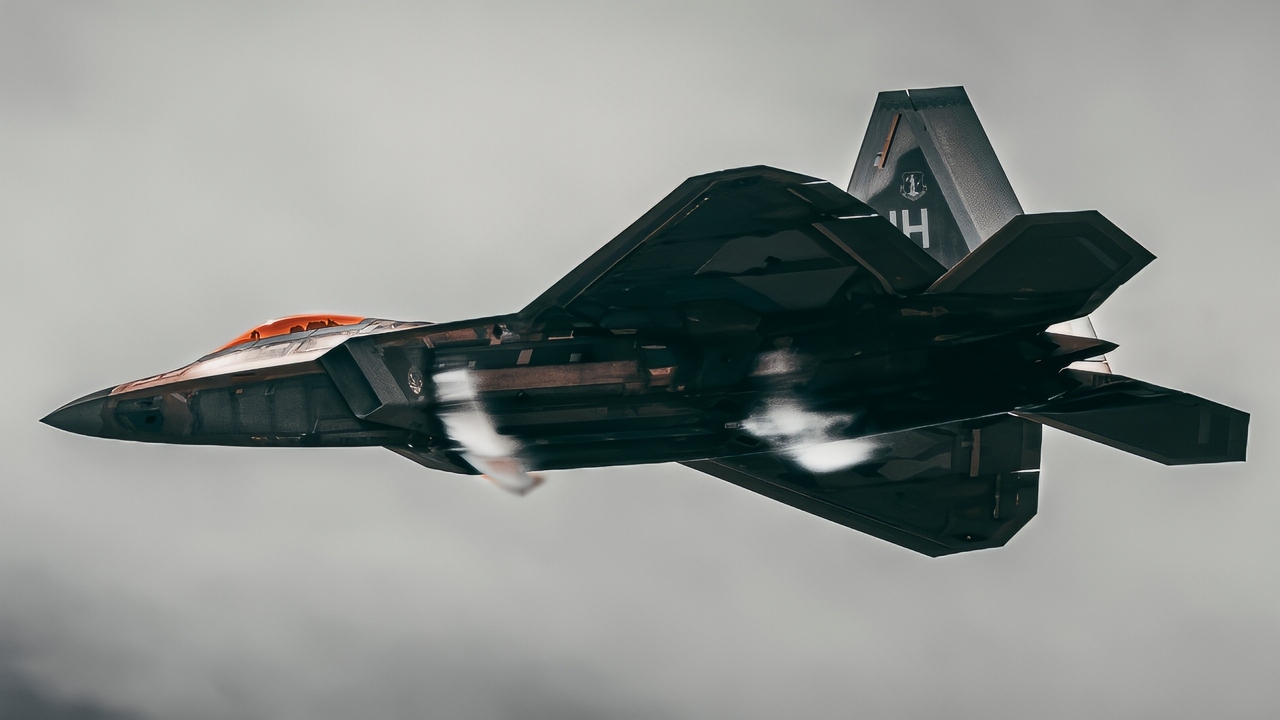
Key Points and Summary: The critical matchup between America’s F-22 Raptor and China’s J-20 Mighty Dragon is a battle of “quality versus quantity.”
-While the F-22 remains the undisputed king of air-to-air combat due to its superior stealth and agility, its small, aging fleet faces a growing challenge from a different strategic approach.
-China is producing the J-20 in massive numbers and integrating it into a new doctrine of manned-unmanned teaming.
-The J-20 doesn’t need to be a better fighter than the F-22; it just needs to outlast it.
J-20 vs. F-22: A Deep Dive Into Stealth Fighter Combat
The airpower balance of the twenty-first century might very well come down to one question: Can America’s F-22 Raptor hold an advantage against China’s rapidly proliferating J-20 Mighty Dragon? It’s not just about thrust-to-weight ratios or radar cross-sections. It’s about two different philosophies of power.
Airpowers Match Up
The F-22 is the best air-to-air fighter on the planet, a stealthy killing machine designed to wipe out enemy air assets before they know what hit them. The J-20 was once written off as an inferior derivative. Now, with a production run under its belt, it is starting to look far more dangerous: a platform that is just good enough to contest the airspace, but being built in such large numbers that it has the potential to upset the calculus.
At the end of the day, it’s not about which jet is better in a vacuum but about whether the exquisite can compete with the relentless.
At present, the answer seems clear. The Raptor has features that are light-years ahead of the J-20. An engine that can supercruise at sustained speeds above Mach 1.5 without afterburner thrust; thrust-vectoring nozzles that provide an agility in three-dimensional space no other airframe can match; radar cross-sections a thousand times smaller than a standard fighter jet, making the F-22 almost impossible to locate on an enemy’s radar.
Eight internal air-to-air missiles, a fused sensor package, and a sensor suite that consists of an active electronically scanned array radar, an infrared search and track sensor, and a next-generation electronic warfare suite.
The F-22 is an air superiority platform that the Raptor can fire at from beyond visual range and down before the other pilot even knows they’re there. If we were to imagine a one-on-one fight against an equal and opposite force, the contest would be over almost before it began: The F-22 is the most formidable dogfighter ever produced.
Changing the Fight and Flight
But that is not how China is choosing to fight.
In many ways, the J-20 makes technical tradeoffs compared to the F-22. The canard-delta design used by the Mighty Dragon gives the aircraft a larger radar cross-section compared to the F-22, making the J-20 inferior in the detection-avoidance realm.
It is also less adept at long-range target engagement. The J-20’s avionics are less mature than its American competitor, and early production aircraft were handicapped by underpowered Russian engines. The newly-indigenously produced WS-15 engine has narrowed the performance gap, but the J-20 still lags behind the F-22’s combination of stealth, supercruise, and agility. The Chinese aircraft can do one thing the F-22 cannot, however, and that is fly farther (range of over 5,000 km) and carry more fuel and ordnance. It’s also part of an emerging Chinese command-and-control and battle network.
The Raptor is an elite platform. The J-20 is a cheap, common one. Washington built fewer than 200 of them before shuttering production over a decade ago. Today, fewer than 150 are left combat-coded.
Beijing, by contrast, has fielded between 200-250 J-20s so far, and it is estimated that somewhere between 500 and 1000 of the aircraft will be in service by the early 2030s. If we judge each fighter based on its individual characteristics alone, every J-20 is almost certainly inferior to an F-22 in a pure power contest. But there is logic to numbers: at a certain point, quantity equals quality. In the opening stages of a major war over Taiwan or the South China Sea, that critical qualitative edge would be quickly challenged by raw quantity.
It is in doctrine where the logic of Chinese design decisions becomes clearest. Beijing is already testing a twin-seat J-20 variant designed to operate as battle managers for swarms of drones and “loyal wingmen” to project and augment the Dragon’s capabilities in the air. This is less a fighter than it is a node in an emerging system of manned-unmanned teaming. The F-22 was designed in the 1990s, before any of that was imaginable.
The Raptor, for all its cleverness, is a product of a different age. It was built for a world that has not yet seen the proliferation of drone swarms, long-range precision strike complexes, integrated air defenses, and electronic warfare layers that are now hallmarks of modern warfare.
The F-22 Still Flies Above
None of that changes the fact that the F-22 is, in the narrow, specific domain of air-to-air combat, peerless. In a straight dogfight, Raptors would have visual on J-20s from ranges their Chinese counterparts never even imagined and blow them out of the sky. But that is not how wars are won. They are not fought on sterile, quantitative terms. In a contested airspace, factors like numbers, geography, and even operational doctrine matter just as much as performance curves. On that broader, messier, more realistic battlefield, the Chinese way of war is starting to look disturbing.
The deeper point here is that these aircraft are products of their times, and that these times are themselves the products of different strategic cultures. The F-22 represents America’s faith in overmatch through technology, in building platforms so exceptional that no quantity of inferior forces can overcome their excellence. The J-20 reflects China’s historic reliance on scale, persistence, and iterative adaptation to grind down its opponents.
The Raptor is sublime. The Dragon is more disposable but designed to swarm, adapt, and overwhelm.
Taking Score
Which plane, then, is king of the skies? On a raw technical level, the answer is simple: the F-22 is far superior. On a strategic level, however, the J-20 is encroaching on the old American advantage by other means: mass production, the evolution of air doctrine, and incorporation into an emerging system of systems.
The Raptor may rule the dogfight, but the Dragon is changing the battlespace. That is the far more disquieting proposition for Washington than any single performance metric.
This is not a message for the Chinese. It is a wake-up call for the United States, which faces an uncomfortable historical paradox. Air dominance can’t be won on a shrinking, aging fleet of Raptors, however wonderful they may be. The F-22 production line has long since been frozen, the F-35 is already falling short of expectations, and any potential replacements are years, if not a decade, away from entering operational service.
By contrast, China is fielding new J-20s at scale, experimenting with follow-on derivatives, and integrating them into a far more imposing operational architecture. Washington will have to move with the urgency it has not yet shown to field the next generation of air dominance fighters in the required numbers to keep control of the skies. It risks losing not because its technology will fail it, but because its strategy did.
So what, then, are we left with? In one sense, the verdict is simple: the F-22 dominates today, but the J-20’s trajectory bodes ill for a not-too-distant future where that is no longer the case. Dominance, and especially air dominance, is always ephemeral, and the fight between the Raptor and the Dragon is only the opening round of a more protracted struggle. The real question being contested is not which jet is better but which country can outcompete the other in the unforgiving game of modern war. On that, the answer is far from clear.
America is already well on its way to fielding its sixth-generation air dominance fighter with the Next Generation Air Dominance program. The new aircraft has promises of better stealth, sensor fusion, range, and drone teaming, but even those aircraft are years away from real-world service, let alone being fielded at scale.
The true question is whether Washington can defend its skies with a small, expert fleet of F-22s and an as-of-yet underpowered stable of F-35s long enough for the new machines to arrive and matter. If it can’t, the simple truth is that the Dragon does not need to outfly the Raptor.
It only needs to outlast it, and on the current trajectory, it will.
About the Author: Dr. Andrew Latham
Andrew Latham is a non-resident fellow at Defense Priorities and a professor of international relations and political theory at Macalester College in Saint Paul, MN. You can follow him on X: @aakatham. He writes a daily column for National Security Journal.
Military Affairs
China’s Stealth Air Force Has 1 Mission


