


Key Points and Summary – The futuristic YF-23 (or what would have been the F-23) Black Widow II lost the Advanced Tactical Fighter competition to the YF-22 (later F-22 Raptor) for complex reasons.
-While potentially faster and stealthier, the YF-23 lost due to the USAF’s enduring preference for extreme maneuverability, which the YF-22 demonstrated aggressively with thrust vectoring.
The YF-23 was also perceived as a higher-risk design during a period of defense budget cuts and program cancellations.
-Lockheed’s more compelling flight demonstrations and potentially greater perceived confidence in their team’s ability to manage complex systems integration likely sealed the deal, relegating the visually stunning YF-23 to history.
The F-23 Black Widow II Fighter Just Won’t Go Away: 5 Reasons It Failed
In the late 1980s, the twilight years of the Cold War, the United States Air Force embarked on one of the most ambitious technological quests in its history: the search for the Advanced Tactical Fighter (ATF).
This wasn’t just about building a new jet; it was about forging the weapon that would guarantee American air supremacy for the next half-century, a machine so advanced it would render anything the Soviets—or anyone else—could field utterly obsolete.
Two contenders emerged from this crucible of innovation, two prototypes that represented the absolute pinnacle of aerospace engineering: Lockheed’s YF-22 and Northrop/McDonnell Douglas’s YF-23.
Both were marvels, incorporating stealth, supercruise (supersonic flight without afterburners), and integrated avionics that promised pilots god-like situational awareness. But they were also radically different, embodying contrasting philosophies of what the future of air combat would look like. The YF-22 was the agile brawler, a direct descendant of the F-15 Eagle, enhanced with stealth and cutting-edge technology.
The YF-23, nicknamed the “Black Widow II,” was something else entirely—a futuristic dart, prioritizing all-out speed and unprecedented levels of stealth, a true ghost designed to strike unseen from the heavens.
To many observers at the time, the YF-23 looked like the embodiment of the future. And to be honest, I have spent a lot of time with the only two built YF-23 fighters, one at the U.S. Air Force Museum and another outside Los Angeles. I have collected many photos, which I will include here for your viewing pleasure.

YF-23 Black Widow II from National Security Journal Photo Shoot.

X-32 and YF-23 Together at U.S. Air Force Museum. Image: National Security Journal.
Its sleek, alien lines screamed technological superiority. Yet, in April 1991, the Air Force made its choice, and it wasn’t the Black Widow. The contract went to the YF-22, the design that would become the legendary F-22 Raptor. The YF-23, arguably one of the most visually stunning and technologically daring aircraft ever built, was relegated to museums and the realm of “what ifs.”
Why? Why did the Air Force choose the seemingly more conservative path? Take it from me: the decision wasn’t simple, and it wasn’t just about which plane was “better.” It was a complex calculus involving deeply ingrained doctrine, perceptions of risk, program management, and perhaps even a bit of showmanship. The ghost of the YF-23 still haunts discussions about air power today, a reminder that sometimes, the future arrives before we’re ready for it.
Here are five key reasons why America’s most futuristic fighter never got its chance.
1. The Enduring Dogma of the Dogfight
At the heart of the YF-22 versus YF-23 debate was a fundamental disagreement about the future of air combat. Northrop designed the YF-23 based on the premise that stealth and speed were paramount. Their vision was a fighter that would detect the enemy long before it was detected itself, launch its missiles from beyond visual range (BVR), and use its superior speed and low observability to escape any counterattack.
In this vision, traditional, close-in dogfighting was becoming a relic. Why get into a swirling knife fight when you could eliminate your opponent from miles away without them ever knowing you were there? The YF-23’s design reflected this – it was faster than the YF-22, especially in supercruise, and its unique shaping likely gave it superior all-aspect stealth.
Lockheed’s YF-22, however, hedged its bets. While it incorporated significant stealth features and advanced BVR capabilities, it also placed a massive emphasis on extreme maneuverability. Its secret weapon was thrust vectoring – engine nozzles that could pivot up and down, allowing the aircraft to perform breathtaking post-stall maneuvers and maintain control at incredibly high angles of attack (AoA). This was a capability tailor-made for the chaotic, close-range turning battles that had defined air combat for decades.
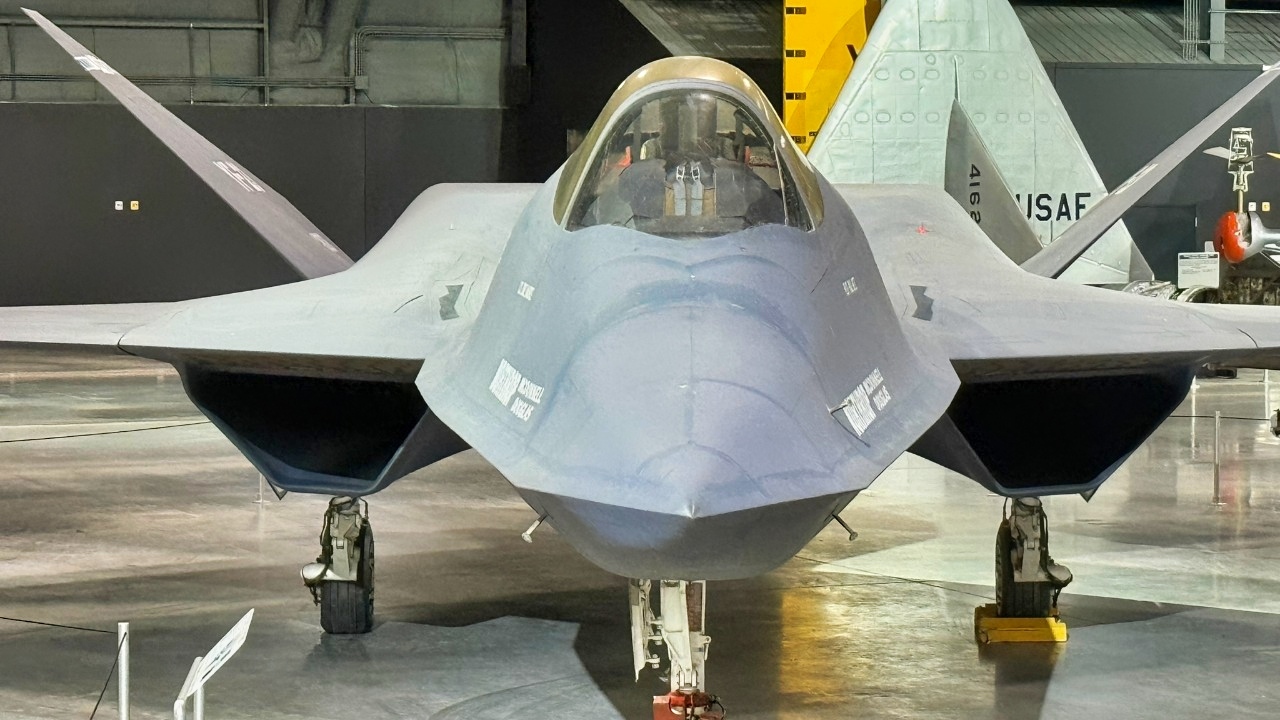
YF-23 at U.S. Air Force Museum Photo by NSJ. Taken on 7/19/2025 by Harry J. Kazianis.
The Air Force, ultimately, bought into Lockheed’s vision. Despite the promise of stealth revolutionizing air warfare, the ingrained culture of the fighter pilot, steeped in the legends of pilots like Robin Olds and the hard-won lessons of Vietnam where BVR missiles initially failed to deliver, still valued supreme agility. The ability to “turn and burn,” to outmaneuver an opponent in a visual-range engagement, remained a deeply held priority.
The YF-22’s spectacular demonstrations of high-AoA flight, seemingly defying the laws of physics, likely resonated powerfully with the generals making the final decision. They chose the known quantity of maneuverability, enhanced by new technology, over the more radical bet on pure speed and stealth offered by the YF-23. They weren’t quite ready to give up the ghost of the dogfight.
2. Playing it Safe: The Spectre of Perceived Risk
Building a fifth-generation fighter was an undertaking of staggering complexity. Integrating stealth, advanced engines, revolutionary sensors, and the software to fuse it all together was a leap into the unknown. Against this backdrop, the Air Force wasn’t just evaluating the aircraft; they were evaluating the risk associated with bringing each design to fruition. And in this calculation, the YF-23 may have simply looked like the riskier proposition.
Its design was more unconventional. The trapezoidal wings, the V-tail configuration (lacking separate horizontal stabilizers), the highly refined stealth shaping – it all pushed the boundaries further than the YF-22, which, while advanced, still bore a clearer lineage to existing fighters like the F-15.

F-15C Fighter at Smithsonian National Security Journal Photo
The YF-23 relied more heavily on complex computational fluid dynamics and cutting-edge stealth prediction codes that were still relatively new. There might have been concerns, justified or not, about whether Northrop’s predicted performance, particularly in terms of stability and control across its flight envelope, could be fully realized without extensive and potentially problematic tweaking.
Furthermore, the late 1980s and early 1990s were littered with troubled defense programs that had gone over budget and behind schedule. The Navy’s A-12 Avenger II stealth attack plane had just been canceled in a spectacular fiasco.
The B-2 Spirit stealth bomber program, while ultimately successful, was facing immense cost overruns and political scrutiny. In this climate, program managers and Pentagon leadership were likely becoming intensely risk-averse. The YF-22, with its slightly more conventional design and perhaps a perceived more straightforward path to integrating its systems, might have felt like the safer bet. Lockheed’s team might have projected greater confidence in meeting cost and schedule targets, even if both designs were pushing the technological envelope.
The YF-23 was perhaps a leap too far for an institution wary of another high-profile failure.
3. The Flight Demonstration: Selling the Sizzle
The ATF competition culminated in a fly-off between the two prototypes. Both aircraft successfully met or exceeded the Air Force’s demanding performance requirements. However, the way each team conducted their flight demonstrations differed significantly and may have played a crucial role in the final decision.
Lockheed and its YF-22 adopted a more aggressive, almost airshow-like approach. Their pilots pushed the envelope, showcasing the aircraft’s stunning high angle-of-attack capabilities, firing off test missiles (an AIM-9 Sidewinder and an AIM-120 AMRAAM), and generally demonstrating the platform’s raw kinematic potential in a very visual and visceral way. It was a performance designed to impress, to show the fighter pilots in charge that this was a machine they could truly fight with.

YF-23A Black Widow Outside. Taken by Harry J. Kazianis for National Security Journal on August 16, 2025.
Northrop and the YF-23 team took a more conservative, engineering-focused approach for a future F-23. Their primary goal during the demonstration phase (known as Dem/Val) was to validate their design predictions and gather clean, reliable test data. They focused on proving that the aircraft met the specified speed, altitude, and stealth requirements. While their demonstrations were technically successful, they lacked the dramatic flair of the YF-22’s displays. They didn’t fire any missiles during the Dem/Val phase, and they didn’t push the high-AoA boundaries in the same way.
In hindsight, this difference in philosophy may have been critical. The Air Force wasn’t just buying data points; they were buying confidence. The YF-22’s flashy performance, particularly the missile shots and aggressive maneuvering, offered tangible proof of its combat potential.
It looked like a finished weapon system. The YF-23, while meeting its technical marks, might have come across as slightly less mature, its potential still more theoretical. Lockheed did a better job of selling the sizzle, and in a multi-billion dollar competition, perception can be reality.
4. Team Dynamics and Contractor Confidence
Behind the gleaming prototypes stood two massive industrial teams, consortiums of aerospace giants vying for what was seen as the most important defense contract in a generation. On one side, Lockheed teamed up with Boeing and General Dynamics. On the other, Northrop partnered with McDonnell Douglas. The Air Force wasn’t just selecting an airframe; they were selecting a partner for a decades-long program, and their confidence in the respective teams’ ability to manage such a complex undertaking was paramount.
While difficult to quantify definitively from the outside, subtle factors related to program management and past performance could have tipped the scales. Lockheed was riding high on the success of its Skunk Works division, which had delivered the revolutionary F-117 Nighthawk stealth fighter.

F-117 at the US Air Force Museum July 2025. Image taken by National Security Journal.
They had a proven track record in managing highly classified, cutting-edge programs. Northrop, while also a leader in stealth with the B-2 bomber, was grappling with that program’s aforementioned cost issues and political challenges. McDonnell Douglas, Northrop’s partner, had its own history of program difficulties.
Did the Air Force simply have more faith in the Lockheed-led team’s ability to navigate the inevitable technical hurdles, control costs, and deliver the final product on time? Did Lockheed present a more convincing, better-structured management plan?
These “softer” factors, relating to institutional confidence and perceived management competence, often play an outsized role in major acquisition decisions. The YF-22 team may have simply projected a more reassuring image of stability and reliability to a risk-averse customer.
5. The Unseen Battle: Software and Systems Integration for ‘F-23’
Perhaps the least glamorous, but potentially most decisive, factor was the invisible war being fought in the realm of software and systems integration. A fifth-generation fighter is more than just an airframe and engines; it’s a flying supercomputer. Its effectiveness hinges on the seamless integration of its radar, its infrared sensors, its electronic warfare suite, its communications systems, and the complex software algorithms that fuse all that data into a coherent picture for the pilot.
Developing this “sensor fusion” was arguably the biggest technological leap required by the ATF program. Reports and analyses compiled after the decision suggest that the Air Force may have had significantly greater confidence in the Lockheed team’s approach to this daunting challenge.
Their plan for developing, testing, and integrating the complex avionics suite might have been deemed more mature, more robust, or simply lower risk than Northrop’s.
In the high-stakes world of advanced avionics, where software development often proves to be the longest and most difficult part of fielding a new weapon system, even a slight perceived advantage in this area could have been enough to sway the decision.
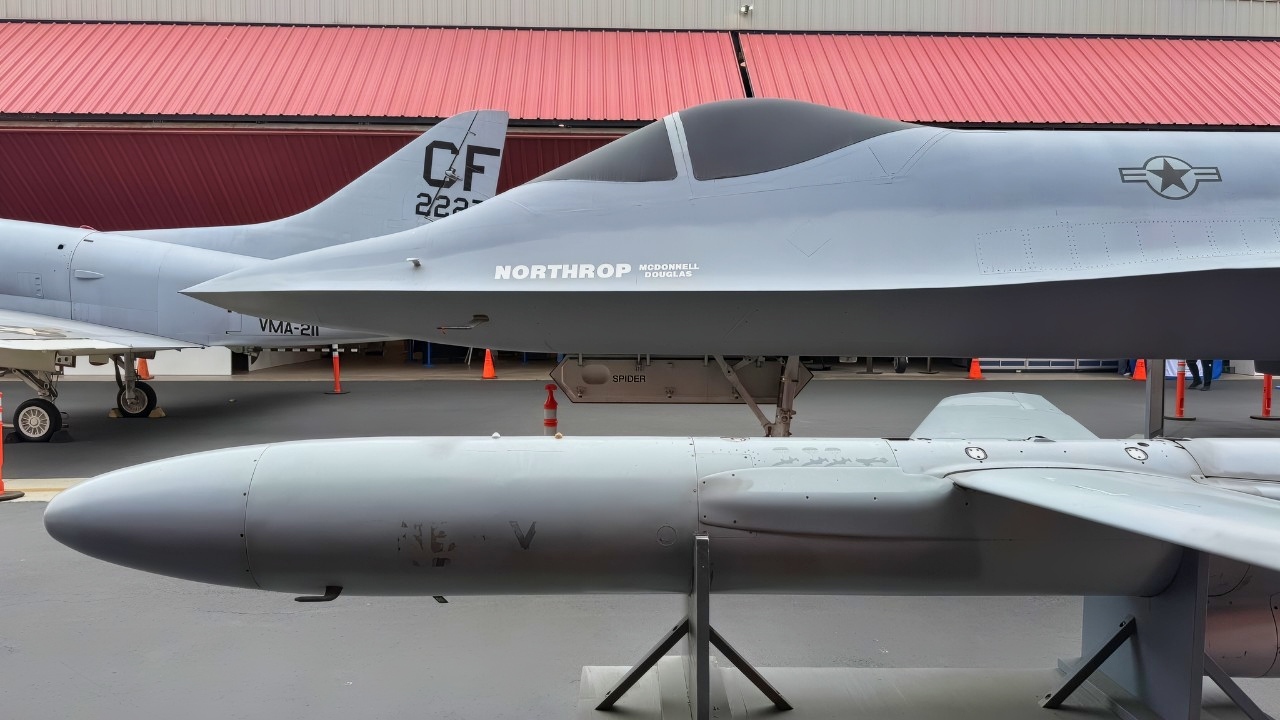
YF-23A Black Widow II Stealth Fighter in Torrance
The Air Force wasn’t just buying hardware; they were buying a complex ecosystem of software and sensors. They needed assurance that this digital brain would function reliably. Lockheed may have provided that assurance more convincingly. The YF-23 might have won the aerodynamic beauty contest, but the YF-22 might have won the hidden battle of the bits and bytes.
A Future Lost, A Legend Born
The YF-23 Black Widow II, or what would have been the F-23, remains one of the great “what ifs” of military aviation history.
It was a stunning machine, a bold vision of the future that, by many metrics, might have been the superior aircraft in terms of raw speed and stealth. Its loss in the ATF competition was not a clear-cut case of technical inferiority, but rather the result of a specific set of priorities held by the U.S. Air Force at a unique moment—a preference for agility, a deep aversion to program risk, and perhaps a more compelling sales pitch from the competition.
We will never know how history might have changed had the Black Widow II become the Raptor’s replacement. Would its greater speed and potentially superior stealth have been more valuable in the long run than the F-22’s extreme maneuverability?
It’s a debate that still rages among aviation enthusiasts and defense analysts. What is undeniable is that the YF-23 pushed the boundaries of what was thought possible, and its influence can still be seen in aircraft design today. It remains a ghost of the future, a tantalizing glimpse of a different path America might have taken on its journey to dominate the skies.
And, man, I would really have loved to see a fully baked F-23 Black Widow II. How sad. Well, I will always have museum visits to look forward to.
About the Author: Harry J. Kazianis
Harry J. Kazianis (@Grecianformula) is Editor-In-Chief and President of National Security Journal. He was the former Senior Director of National Security Affairs at the Center for the National Interest (CFTNI), a foreign policy think tank founded by Richard Nixon based in Washington, DC. Harry has over a decade of experience in think tanks and national security publishing. His ideas have been published in the NY Times, The Washington Post, The Wall Street Journal, CNN, and many other outlets worldwide. He has held positions at CSIS, the Heritage Foundation, the University of Nottingham, and several other institutions related to national security research and studies. He is the former Executive Editor of the National Interest and the Diplomat. He holds a Master’s degree focusing on international affairs from Harvard University. Email Harry: [email protected].
More Military
How an F-16 Fighter Barely Dodged 6 Surface-to-Air Missiles
The Mach 2.15 F-111 Aardvark Has a Message for the U.S. Air Force
The U.S. Army’s Bradley Fighting Vehicle Has a Message for Any Military On Earth
The U.S. Navy’s Great Missile Shortage
The F-14 Tomcat U.S. Navy Fighter Has A Message for Any Military On Earth


